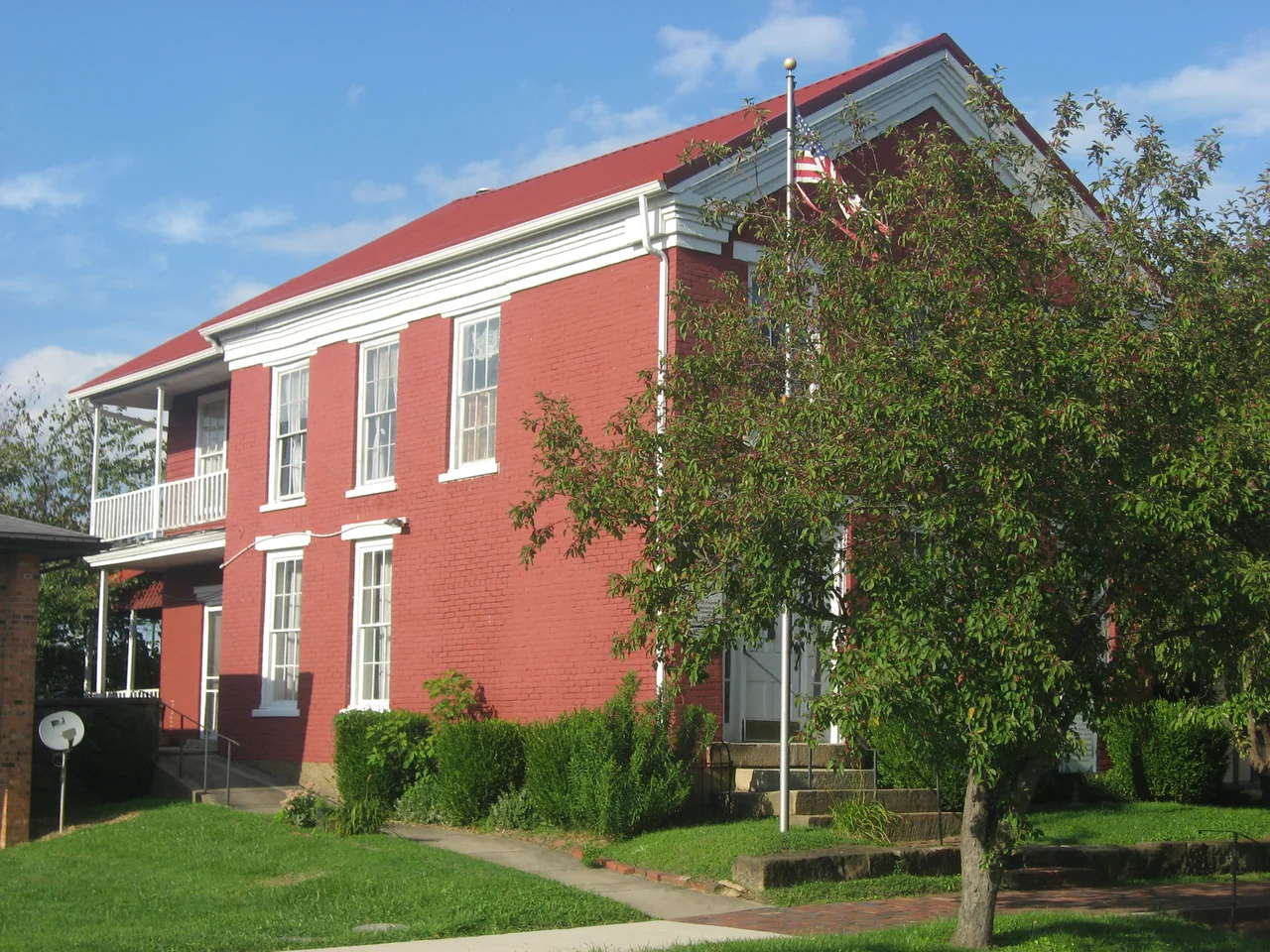

Z. D. Ramsdell House
An abolitionist named Eli Thayer founded the town of Ceredo, West Virginia, in 1857 with the explicit intention of planting a free-soil community on a slaveholding state's western edge. Two years later, a fellow abolitionist named Zophar D. Ramsdell - a shoemaker from Massachusetts - finished a two-story brick house on what locals believed to be an ancient burial mound at the edge of town. The Ohio River runs less than half a mile away. For a person fleeing slavery in Virginia or Kentucky and traveling north toward Ohio and freedom, the Ramsdell house was, by tradition, one of the last places to hide before the river crossing.
A Town Made on Purpose
Ceredo is one of the strangest civic experiments in West Virginia history. Eli Thayer, the Massachusetts congressman behind the Emigrant Aid Company that helped settle free-state Kansas, founded Ceredo in 1857 as a similar project - this time to establish an industrial, free-soil settlement inside Virginia. The name comes from Ceres, the Roman goddess of agriculture. Thayer brought in New England workers, abolitionists, and tradesmen. Ramsdell was among them. He arrived to set up a shoe and boot factory and built his house in 1857 and 1858: red brick and frame, thirty feet wide and forty-eight deep, two stories on a stone foundation, with the proportions and gable roof of Greek Revival design. The house went up directly on a low rise that local tradition identifies as an Indian burial mound - one of several ancient earthworks scattered through the Ohio Valley.
The Crossing
The Underground Railroad worked by geography. Anywhere along the Ohio River, the water itself marked the line between slavery and freedom. In 1850, the Fugitive Slave Act made even the free states dangerous, but for a person fleeing bondage in western Virginia or eastern Kentucky, reaching the north bank of the Ohio still meant the difference between hope and the certainty of recapture. Ceredo's free-soil community, planted right on the south bank, was a logical hiding place. The Ramsdell House is believed to have been one of the last stops before the crossing - a safe house run by a man who had moved south specifically to oppose the institution. The historical record on Underground Railroad stations is necessarily thin; people did not keep written ledgers of capital crimes. But the local tradition is well-documented enough that the house was added to the National Register of Historic Places in 1983 on the strength of its Underground Railroad connection.
The Civil War and After
When the Civil War began, Ramsdell served as a captain and quartermaster for the Union Army. Ceredo, like much of what would become West Virginia, sat in contested territory. The free-soil town that Thayer had founded as an industrial colony became a small but symbolically important Union outpost. After the war, with West Virginia now a separate state of the Union, Ramsdell stayed and continued his civic life. President Grant appointed him a postal inspector. In 1868 and 1869, he represented Wayne County in the West Virginia State Senate. Eli Thayer's grand vision for Ceredo as a free-soil industrial powerhouse never quite materialized - the war disrupted everything - but the town survived, and so did Ramsdell's house, and so did the house's quiet record of what had happened there.
The House Today
The Ramsdell House is now a small historic house museum, owned and operated by the town of Ceredo. The brick walls are still the original 1857 construction. The mound it sits on still rises low and unmistakable from the surrounding street grid. Visitors can walk through the rooms and look at the basement and crawl spaces that, according to local tradition, hid people fleeing slavery on the last leg of a long journey. Ceredo itself is now a small town of about 1,500, absorbed into the Huntington metropolitan area, the Ohio River industrial corridor humming just to the north. The grand experiment did not become a great American city. But it left behind a house that still tells, in brick and stone and the faint outline of an older earthwork beneath it, a story about who chose to live here and why.
From the Air
The Z. D. Ramsdell House sits in Ceredo, West Virginia at 38.40 degrees north, 82.56 degrees west, just south of the Ohio River about twelve miles west of downtown Huntington. Best viewed at 2,500 to 4,000 feet AGL: look for Ceredo's compact street grid along U.S. Route 60 on the south bank of the Ohio, with the river marking the boundary into Ohio just north. Tri-State Airport (KHTS) is about three miles south. The Big Sandy River's confluence with the Ohio, marking the Kentucky-West Virginia border, is the most distinctive nearby landmark.
Nearby Stories
- Battle of Scary Creek 6 km away
- Portsmouth 7.2 km away
- Fred M. Vinson Museum and Welcome Center 14 km away
- Staats Mill Covered Bridge 24 km away
- Lake Tight 25 km away
- Battle of Blair Mountain 32 km away
- Lower Shawneetown 35 km away
- The Kentucky Meat Shower: When Flesh Fell From a Clear Sky 68 km away