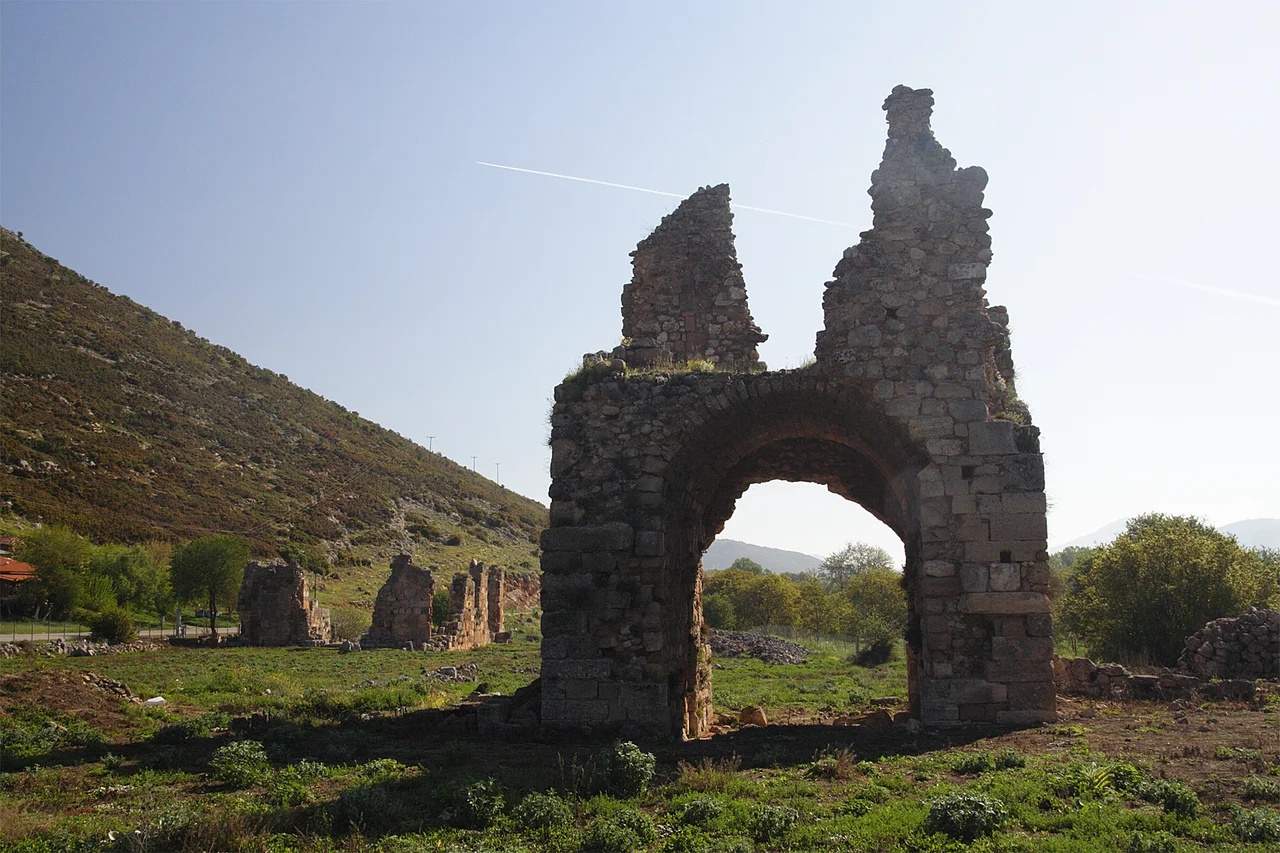

Zaraka Monastery
Gothic arches have no business standing beside a lake in the Peloponnese. The pointed vaults of Zaraka Monastery — roofless now, open to the Arcadian sky, the stones darkened by centuries — belong aesthetically to Burgundy or the Rhine valley, not to northeastern Greece. Yet here they are, about a kilometre from the shores of Lake Stymphalia, built around 1225 by Cistercian monks who had come east in the wake of the Fourth Crusade. Of the approximately 17 to 19 Cistercian houses established throughout Greece during the Frankish occupation, Zaraka is the only one the monks actually built themselves from the ground up. Every other house was a repurposed Greek Orthodox monastery. This one they made.
Franks in the Peloponnese
The Fourth Crusade in 1204 ended in the sack of Constantinople and the fragmentation of the Byzantine Empire into a mosaic of Frankish and Venetian possessions. In the Peloponnese, the Principality of Achaea emerged as the major Frankish power, and with it came a wave of Western religious institutions — churches, monasteries, and abbeys transplanted into Orthodox territory. The Cistercians, a reforming order from Burgundy known for plain architecture and self-sufficient agriculture, established a presence throughout Greece. But they generally moved into buildings others had left vacant: abandoned Orthodox monasteries were adopted, adapted, and filled with Latin monks.
Zaraka was different. The Cistercians chose a site near the ancient city of Stymphalus, beside a mythologically charged lake in a mountainous Arcadian plain, and they built. The result was a Gothic church and associated monastic buildings that stood as one of the rarest examples of Western Gothic architecture in Greece — in the company, scholars note, of the probably Benedictine monastery of Isova in the western Peloponnese.
Fifty Years, Then Silence
The monks occupied Zaraka for roughly half a century. The monastery appears sporadically in the Statutes of the Cistercian General Chapter — the order's governing body — and was granted a notable dispensation: unlike most Cistercian houses, which were required to send their abbot to the annual General Chapter meeting in Burgundy, Zaraka was excused, allowed to attend only once every seven years. The same exemption was granted to Cistercian houses in Syria and the Crusader States, recognizing the practical impossibility of frequent long-distance travel.
In 1276, the monks left. The reasons are not recorded, though the fragile political situation of Frankish Greece — the Principality of Achaea was under increasing pressure from Byzantine recovery — probably contributed. The imposing vaulted gatehouse and the western end of the church, the parts that survive best today, once presided over a working community of Latin monks who prayed, farmed, and corresponded with Burgundy. Then, quite abruptly, they did not.
Layers of Reuse
The story of Zaraka does not end with the monks. Excavations from 1993 to 1997 by the Pontifical Institute of Medieval Studies at the University of Toronto revealed that the abandoned abbey was resettled in the late 14th century and occupied intermittently until perhaps the mid-16th century. Whoever moved in was not Cistercian: graves from this later period were excavated in and around the cloister, including the burial of a headless man and another individual buried with a German banker's token dating to the mid-16th century — a small, strange piece of commerce found at the edges of the former monks' precinct.
The question of what lay beneath the monastery also intrigues scholars. Some believe Zaraka was built on or near an ancient Greek temple dedicated to Artemis — a goddess especially associated with Lake Stymphalia and the broader Stymphalian landscape. The evidence is circumstantial: column drums and other temple materials were reused in the monastery's construction. They could equally have come from the ancient city of Stymphalus a few hundred metres away.
What Remains
The main surviving structures at Zaraka today are the gatehouse, with its imposing vault, and the western end of the church, together with fragments of the defensive wall that once enclosed the monastery precinct. Parts of the eastern end were planned but possibly never completed — excavation to the northeast of the church revealed an arched entrance, probably to a refectory, which had collapsed in an earthquake. The cloister area, excavated by the University of Toronto team, produced the graves and the scattered evidence of later occupation.
Professor Anastasios Orlandos conducted the first excavations in the 1920s, followed by E. Stikas in the 1960s. A joint project by the Canadian Institute at Athens and the Archaeological Society of Athens produced the first detailed state plan of the church in 1984. Zaraka's ruins sit just north of the ancient Stymphalus site, the two archaeological zones separated by a few hundred metres of the same mountain plain, sharing the same lake and the same implausible air of impermanence.
From the Air
Zaraka Monastery is located at approximately 37.867°N, 22.458°E, on the northern shore of Lake Stymphalia in the Arcadian highlands of the Peloponnese. From the air, the elongated lake is the primary landmark; the monastery ruins sit at the lake's northern edge, close to the ancient Stymphalus archaeological site. Recommended viewing altitude: 2,500–4,000 ft to distinguish the ruined church walls from the surrounding terrain. Nearest airport: LGRX (Araxos / Patras), approximately 60 km to the northwest. The Stymphalian plain is a visually distinct flat basin enclosed by ridgelines, readily identifiable from altitude.
Nearby Stories
- Siege of Corinth (1463) 2.1 km away
- Aigeira 2.7 km away
- Oblou Monastery 3.7 km away
- Isova 4.9 km away
- Mantinea 5.2 km away
- Arkadiko Bridge 8 km away
- 1981 Gulf of Corinth Earthquakes 11 km away
- Battle of Lalas 20 km away