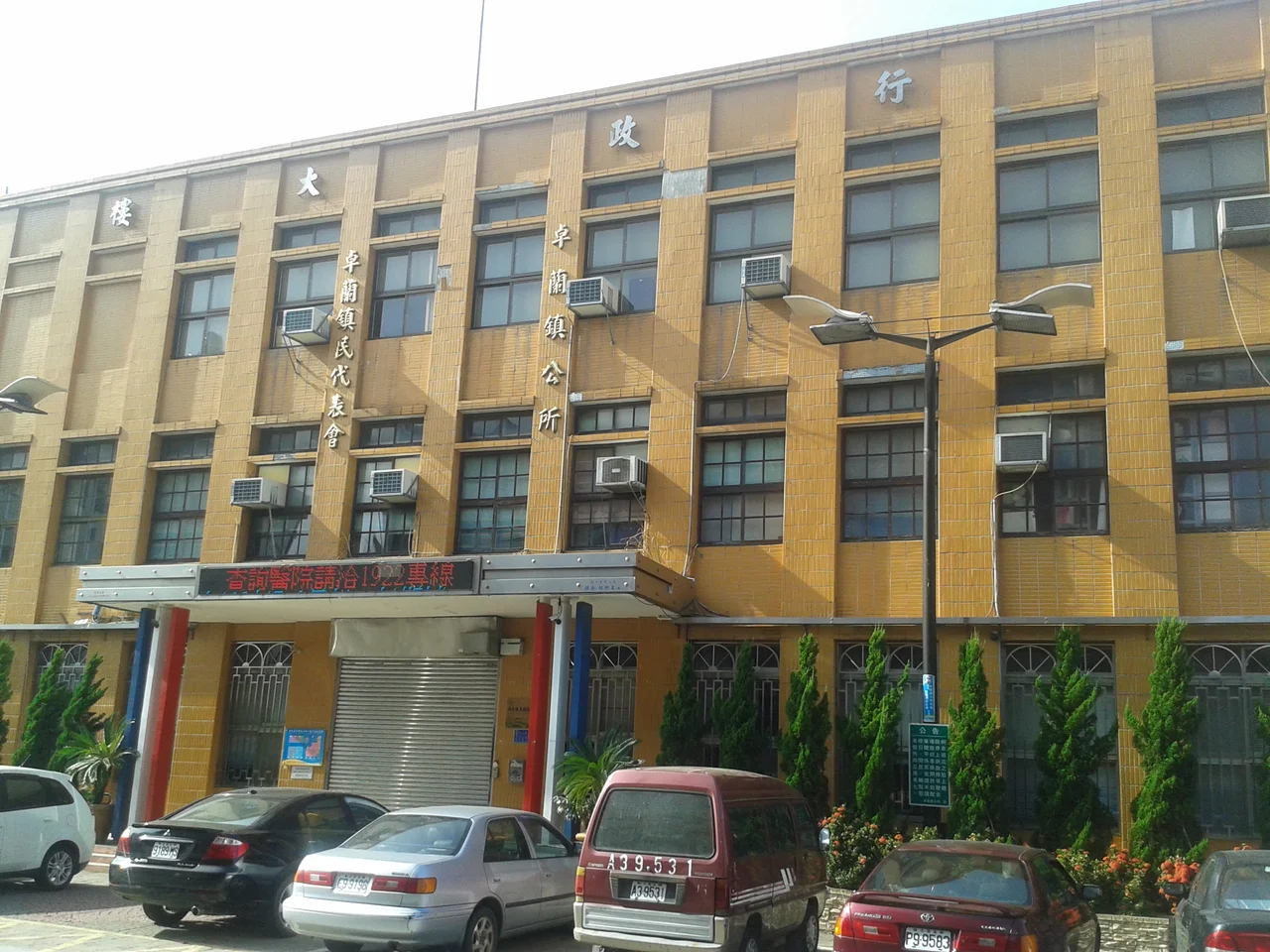

Zhuolan
Before it was called Zhuolan, it was called Talan. That older name comes from an indigenous Taiwanese language — the township sits in Miaoli County, where the transition between the coastal plain and the foothills of the central mountain range has been home to indigenous communities for far longer than any of the current township's records can reach. The name Zhuolan is the later, Sinicized rendering. Talan is the one that remembers something older. Today, Zhuolan is known primarily for fruit: pears and grapes and starfruits and tangerines grown in the hills and valleys of a township that receives about 2,100 millimeters of rain each year, most of it falling in the May–June and August–October rainy seasons — just enough moisture, in just the right pattern, for the orchards that define the landscape.
A Township in the Hills
Zhuolan occupies 76.33 square kilometers of Miaoli County in northwestern Taiwan, a landscape that belongs to the transitional zone between lowland coastal plain and the forested ridges of the central mountains. The terrain is hilly rather than dramatic — the kind of countryside where valleys hold farms and orchards while ridge roads offer long views across the basin toward the Taiwan Strait. Provincial Highway 3, the Old Mountain Road that runs along the western edge of the central range, passes through Zhuolan, linking it with Dahu Township to the north and Dongshi District in Taichung to the south.
The township comprises 11 villages: Fengtian, Jingshan, Laozhuang, Miaofeng, Neiwan, Pinglin, Shangxin, Xincuo, Xinrong, Xiping, and Zhongjie. As of January 2023, the population stood at 15,505 — a modest size that reflects the agricultural character of a place where orchards are the primary industry and city-scale development has never arrived.
Four Fruits
Ask what Zhuolan grows and the answer comes quickly: pears, grapes, starfruits, tangerines. These four fruits are the township's agricultural identity, shaped by the elevation, the rainfall, and the kind of patient farming that hill orchards require. Pears and grapes in particular do well in cooler hill conditions — Zhuolan's elevation protects them from the heat of the lowland summers. Starfruit and tangerines bring warmth and sweetness.
Fruit farming in Miaoli County has a long history, and Zhuolan sits comfortably within a regional agricultural tradition that has adapted over decades to changing markets and climate pressures. Visitors to the township during harvest seasons — which vary by fruit but run through much of the year — can find orchards open for picking, a quiet form of tourism that draws Taiwanese families from the nearby cities of Taichung and Miaoli.
Rain and Season
Zhuolan's 2,100 millimeters of annual rainfall sounds like plenty, and it is — but the distribution matters as much as the total. The heaviest rain falls during two windows: May through June (the plum rain season, when moist fronts stall over Taiwan for weeks at a time) and August through October (typhoon season, when tropical systems bring intense but shorter-duration rainfall). In between, the summer months can be dry enough to require irrigation.
This pattern is familiar throughout central western Taiwan, but Zhuolan's hill position gives it slightly more reliable rainfall than the flat coastal districts. The hills catch moisture from both directions — marine air from the strait and the wetter air masses that push against the central range from the east. It is a climate that rewards farmers who know it, and the orchards that have thrived here reflect generations of that knowledge.
Talan Remembered
The name Talan surfaces in historical records and in the category attached to Zhuolan itself: Taiwan placenames originating from Formosan languages. Formosan languages are the indigenous languages of Taiwan, spoken by the island's aboriginal peoples before Han Chinese settlement arrived in large numbers during the 17th and 18th centuries. The name Talan belongs to that world — a word applied to this place before the orchards, before the townships, before the roads.
How exactly the name Talan became Zhuolan is the kind of linguistic journey that happened across Taiwan as Mandarin and Hokkien and Hakka speakers adapted indigenous place names to the sounds of their own languages, sometimes preserving echoes of the original, sometimes losing them entirely. Zhuolan preserves something of Talan in its sounds, a faint connection across languages and centuries. The fruit grows in soil that was named long before anyone planted trees in it.
From the Air
Zhuolan Township is centered at approximately 24.322°N, 120.845°E in Miaoli County, Taiwan, in the hill country west of the central mountain range. From the air at 4,000–6,000 feet, the township appears as a patchwork of orchards, farmland, and forested ridge lines along the Provincial Highway 3 corridor. The Dahu area is visible to the north, and the broader Taichung basin opens to the south and southwest. Nearest major airport is RCMQ (Taichung International Airport), approximately 30 km to the southwest. Flying north from RCMQ along the foothills, the terrain rises gradually through Dongshi District before reaching Zhuolan's valley landscape. In the rainy season (May–June and August–October), clouds commonly build against the central mountain ridges to the east; the western slopes and townships often remain clearer.
Nearby Stories
- Wufeng Lin Family Mansion and Garden 6.5 km away
- Tapung Old Fort 9.4 km away
- 1991 Miaoli Train Collision 9.7 km away
- Taroko National Park 20 km away
- China Airlines Flight 204 21 km away
- Taiwan Strait 38 km away
- Taixi, Yunlin 43 km away
- China Airlines Flight 611 69 km away