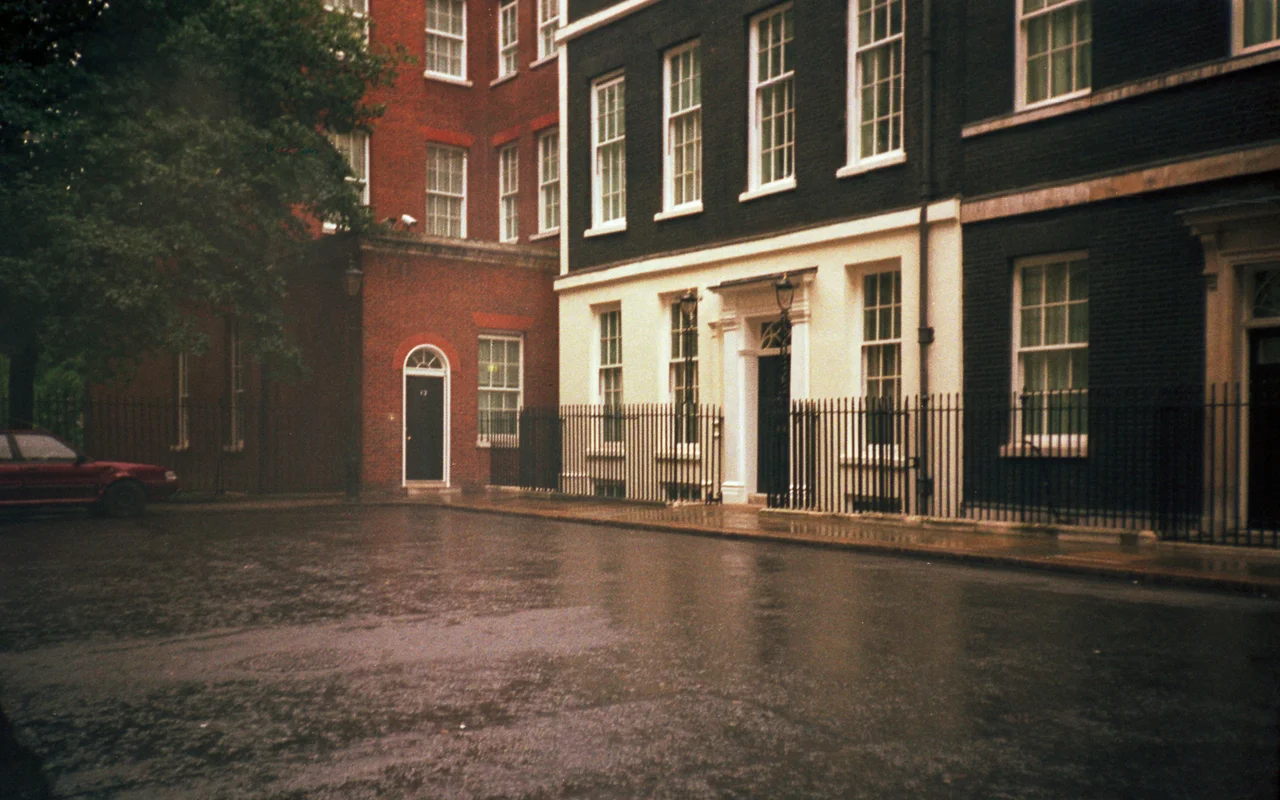

11 Downing Street
Tony Blair walked through the front door of Number 10 in 1997 and turned left. He had three young children. His family needed a larger flat than the cramped apartment above Number 10 could provide. So Blair did something unprecedented: he moved the prime minister into the residence above 11 Downing Street, traditionally the home of the Chancellor of the Exchequer. Gordon Brown, the new Chancellor and at the time a bachelor, swapped with him and took the smaller flat above Number 10. The arrangement worked. It was supposed to be temporary. Instead it lasted twenty-five years. Brown himself, then Cameron, May, and Johnson all kept the same swap. Only Rishi Sunak in 2022, with younger children but a different sense of decorum, moved back into the smaller Number 10 flat - and Keir Starmer, taking office in 2024, swapped right back to Number 11. The Chancellor's house, technically, has not housed the Chancellor in nearly three decades.
A Terrace, Internally One House
Numbers 10, 11, and 12 Downing Street look like three separate Georgian terraced houses. They are not. The interiors have been linked over centuries by doorways, corridors, and shared stairwells, so that one can walk from Number 11 to Number 10 without ever using the street doors. The Cabinet Office building behind them is connected at the rear, making the whole complex effectively a single executive office. From the outside, you see three doors with three brass numbers on a quiet cul-de-sac. From the inside, you walk through one building. Number 11 itself is the official residence of the Chancellor of the Exchequer, who traditionally also holds the title of Second Lord of the Treasury - the deputy to the First Lord, who is the prime minister. Number 12, to the left, was the residence of the Chief Whip until it became the prime minister's press office. The arrangement reflects how the British executive actually works: not as distinct offices but as a single woven institution operating behind three painted doors.
Wren, Couse, and Soane
Sir George Downing built Number 11 in the 1680s as part of his cul-de-sac of terraced houses, to designs by Christopher Wren - though, as with all the Downing houses, the construction was cheap and the foundations shallow. The house was altered between 1723 and 1735, then refaced in the 1760s and 70s by Kenton Couse, the same architect responsible for Number 10's iconic front door. Sir John Soane added the fine dining room of 1825-26, which still exists - one of the few rooms in the complex to survive with its early-nineteenth-century identity largely intact. The major reconstruction came in 1960-64, when the architect Raymond Erith effectively rebuilt all three houses on deep concrete pilings to fix the structural problems Wren's contractor had baked in three centuries earlier. Despite this near-total reconstruction, Number 11 retains a fine staircase with carved bracket tread ends and three slender turned balusters per tread - the kind of detail that survives because someone took the time to photograph it, measure it, and reassemble it after the new foundation went in.
The First Chancellor in Residence
Henry Petty-Fitzmaurice, the future 3rd Marquess of Lansdowne, was the first Chancellor of the Exchequer to live at Number 11 - in 1806. The official designation as the Chancellor's residence didn't come until 1828. For most of the nineteenth century, the use of the house was informal: Chancellors took it if they wanted to, ignored it if they didn't. The formal convention firmed up alongside the formalisation of Number 10 as the prime minister's residence. By the late Victorian era, the symbolism was clear: the man holding the public purse strings lived next door to the man holding political power. The arrangement made the Treasury physically what it had been institutionally since Robert Walpole's time - a partner of the prime minister's office, separated by a single internal door. Disraeli, Gladstone, Asquith, Lloyd George, Churchill, Macmillan - they all moved through these houses, sometimes living in Number 10, sometimes in Number 11, depending on their families and their tastes.
Cash for Curtains
In March 2020, just as Britain entered its first COVID-19 lockdown, Boris Johnson commissioned an expensive refurbishment of the residential flat above Number 11. The work included gold wallpaper, hand-painted murals, and reportedly expensive furnishings supplied by the designer Lulu Lytle. Costs ran well over the £30,000 annual public allowance available for prime ministerial home decoration. Reports emerged that the difference - the part the taxpayer wouldn't fund - had been quietly underwritten by Conservative Party donors and channelled through party accounts. The Electoral Commission opened an inquiry. Newspapers dubbed it the Cash-for-Curtains scandal. The story dominated the news in spring 2021. Johnson's standards adviser resigned over related issues. The wallpaper itself became almost mythic - photographs of it leaked, comparisons to gilded age excess multiplied, and the question of who had really paid for the gold motifs above the Chancellor's official residence became one of the small slow-burning stories that eventually shaped Johnson's downfall. Sunak in 2022 moved back to the more modest Number 10 flat. The wallpaper, presumably, remains.
From the Air
Number 11 sits on the left side of the Number 10 terrace as you face the building from Downing Street, so from above it occupies the centre of the three connected houses. The complex is invisible from any normal airspace - central London is permanently restricted at low altitude. The Downing Street gardens face north toward Horse Guards Parade and St James's Park, where the prime minister and family sometimes walk in the evenings under armed protection. The address is 51.5034 N, 0.1278 W, the same coordinates effectively as Number 10 because the buildings are internally one structure. From a passenger jet descending over central London toward Heathrow, the whole of Whitehall is visible as a wide ceremonial street running south from Trafalgar Square; Downing Street is the small fenced spur on its west side. The Chancellor's flat - which is now the prime minister's flat - sits above the front door painted with the brass number 11. The Chancellor of the Exchequer lives, at the moment, somewhere else.
From the Air
Located at 51.5034 N, 0.1278 W in the City of Westminster, on Downing Street off Whitehall. Number 11 is the central of the three connected Downing Street houses. Central London airspace is highly restricted at low altitude. Best aerial view is from commercial flights at altitude over central London. London Heathrow (EGLL) 14 nm west; London City (EGLC) 7 nm east. Restricted area R157 covers central London; any low flight requires Met Police and CAA clearance. The Downing Street complex is invisible from outside; the visible elements are the gate at Whitehall and the security fence.
Nearby Stories
- Battle of Britain, Northfleet 1.1 km away
- Bayham Old Abbey 5.4 km away
- Catharine Macaulay 6.4 km away
- Hatfield rail crash 8.8 km away
- Chequers 8.9 km away
- Chelmsford Cathedral 10 km away
- Queen Victoria Hospital 13 km away
- Fishbourne Roman Palace 36 km away