.jpg)
2001 Biggin Hill Airshow disasters
Biggin Hill had hosted air displays since 1963, when World War II Royal Air Force pilot Jock Maitland began what he called the Air Fair. By 2001 it had become one of Britain's most respected events, known for high entertainment standards and well-regarded commentators. The 2001 weekend, on 2 and 3 June, drew tens of thousands of spectators. By Sunday evening, three pilots were dead. The Air Accidents Investigation Branch would open three separate inquiries. Residents of Biggin Hill agreed that the weekend had been a terrible tragedy, and were divided over whether the airshow should continue.
The Saturday Vampire
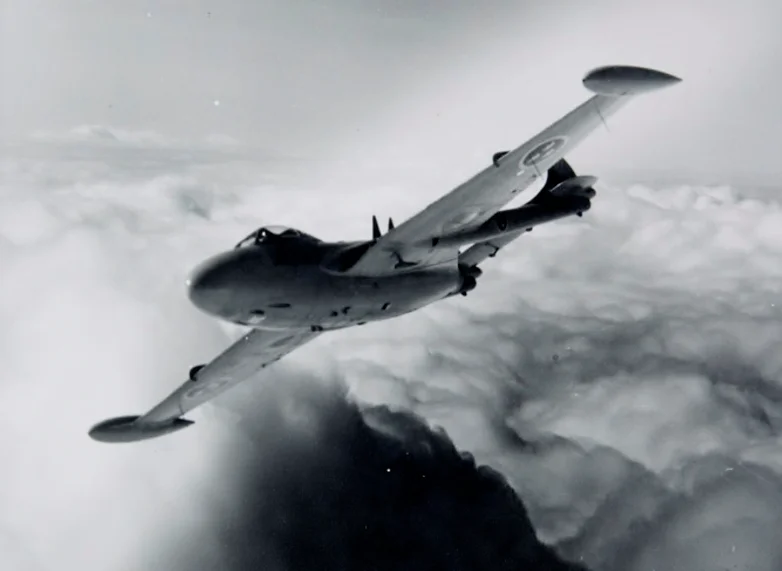
The morning of Saturday 2 June brought a wheels-up landing first - a de Havilland Venom, flown by company chief pilot Clive Rustin, came down with its landing gear retracted, suffering only minor fuselage damage. Nobody was hurt, but the incident put the day's display schedule under strain. Six hours later came the day's first fatality. A de Havilland DH-115 Vampire T11, registration XH308 - originally built in 1955 for the Royal Air Force, later sold to the Swiss Air Force, and returned to the United Kingdom in 1995 - was performing a routine display when it lost control during a wingover and dived into the ground. The aircraft was destroyed. Both pilots were killed: Sir Kenneth Hayr, with 4,398 flying hours (185 of those in the Vampire), in the left seat as pilot-in-command, and Jonathan Kerr, age 33, a safety pilot the Civil Aviation Authority had allocated to the flight after the morning's Venom incident. The Air Accidents Investigation Branch later determined that a Sea Vixen had passed by moments earlier, generating wake turbulence the AAIB modelled as quadruple the strength of the Vampire's own vortices. The Sea Vixen's roll acceleration exceeded the roll authority the Vampire could handle at its display speed. The witnessed 90-degree roll to the right was, the report concluded, the likely result of that invisible disturbance in the air.
The Sunday Kingcobra
The next day brought the second loss. A Bell P-63 Kingcobra - the American fighter that had served briefly in the US Air Force, then spent four decades as an air racer under the registration N52113 before being sold to Patina Ltd in Jersey in 1991 - was flown by Guy Bancroft-Wilson. He was an experienced professional pilot with 7,730 flying hours overall, though only 13 of them on the Kingcobra. Two days before the airshow he had logged 25 minutes of display practice in the type. He took off in a trio with two other warbirds, each performing a loop followed by a half cuban eight before the Kingcobra split off as planned. A minute later, following a flypast at 220 knots, Bancroft-Wilson pulled the aircraft up into a climbing maneuver. At the peak the Kingcobra was partially inverted and lost control, entering an incipient spin. He recovered, though with significant altitude lost. The display continued. Then, attempting a subsequent maneuver with insufficient speed, the aircraft crashed and the fire destroyed it. Bancroft-Wilson was killed.
What Could Not Be Stopped
The AAIB found that the airshow had established a Flying Control Committee to oversee display standards and ensure safety regulations were followed. A display could be stopped through a system linking the FCC by telephone or radio to air traffic control on the other side of the runway. When the Kingcobra lost control at the apex of its first rolling climbing maneuver, the committee member tried five times to reach ATC by radio, and twice more by telephone. No answer came. The display proceeded. Whether prompt intervention could have prevented the second accident is not something the report could definitively answer - but the communication failure was identified clearly as a cause of concern for future airshows.
The Aftermath
Two coroner's juries at the South London Coroner's Court eventually returned verdicts of accidental death. Sir Kenneth Hayr's son Julian was in attendance. Deputy Coroner John Sampson had adjourned both hearings until the crashes had been examined in detail. Public shock was wider than the airshow community alone. Airshows had always carried risk - that was part of their appeal, and the pilots who flew them knew it - but losing three pilots in two days, with 35,000 to 50,000 people watching, raised questions that wouldn't subside. The Biggin Hill airshow's spokesperson noted that the show has had a very good reputation for safety, and that safety is of paramount importance to us as owners and operators of Biggin Hill. The airshow continued annually until 2010, when the airport cancelled the licence after 47 years. A small community event followed in 2011, and a new, smaller-scale Festival of Flight was launched in 2014. Kenneth Hayr had been a distinguished Royal Air Force officer before retirement, with a long flying career behind him. Jonathan Kerr was 33. Guy Bancroft-Wilson, with thousands of hours behind him in modern aircraft, had taken on a vintage warbird in good faith. The three men are remembered now in aviation accident archives and in family memorials. The airshow they died at is gone.
From the Air
Located at 51.331°N, 0.033°E at London Biggin Hill Airport (EGKB), in the London Borough of Bromley, about 13nm south-southeast of Central London. London Biggin Hill (EGKB) is the airport itself, with runway 03/21. Nearby airfields include Redhill (EGKR) about 8nm west-southwest and London City (EGLC) about 14nm north-northwest. Recommended viewing altitude is 1,500 to 2,500 feet AGL outside the airport's traffic zone, which is class D airspace - check NOTAMs and contact Biggin Hill ATC if intending to operate nearby. Biggin Hill remains a working general aviation and business jet airport with significant historical association as a Battle of Britain station. The site holds an annual Festival of Flight rather than the original airshow.
Nearby Stories
- Hampton, London 1.1 km away
- Queenborough Castle 3.2 km away
- Groombridge Place 4 km away
- North Weald Airfield 4.9 km away
- Kings Langley Palace 8.3 km away
- White House Farm murders 11 km away
- Port Lympne Mansion 22 km away
- Amberley Museum & Heritage Centre 31 km away