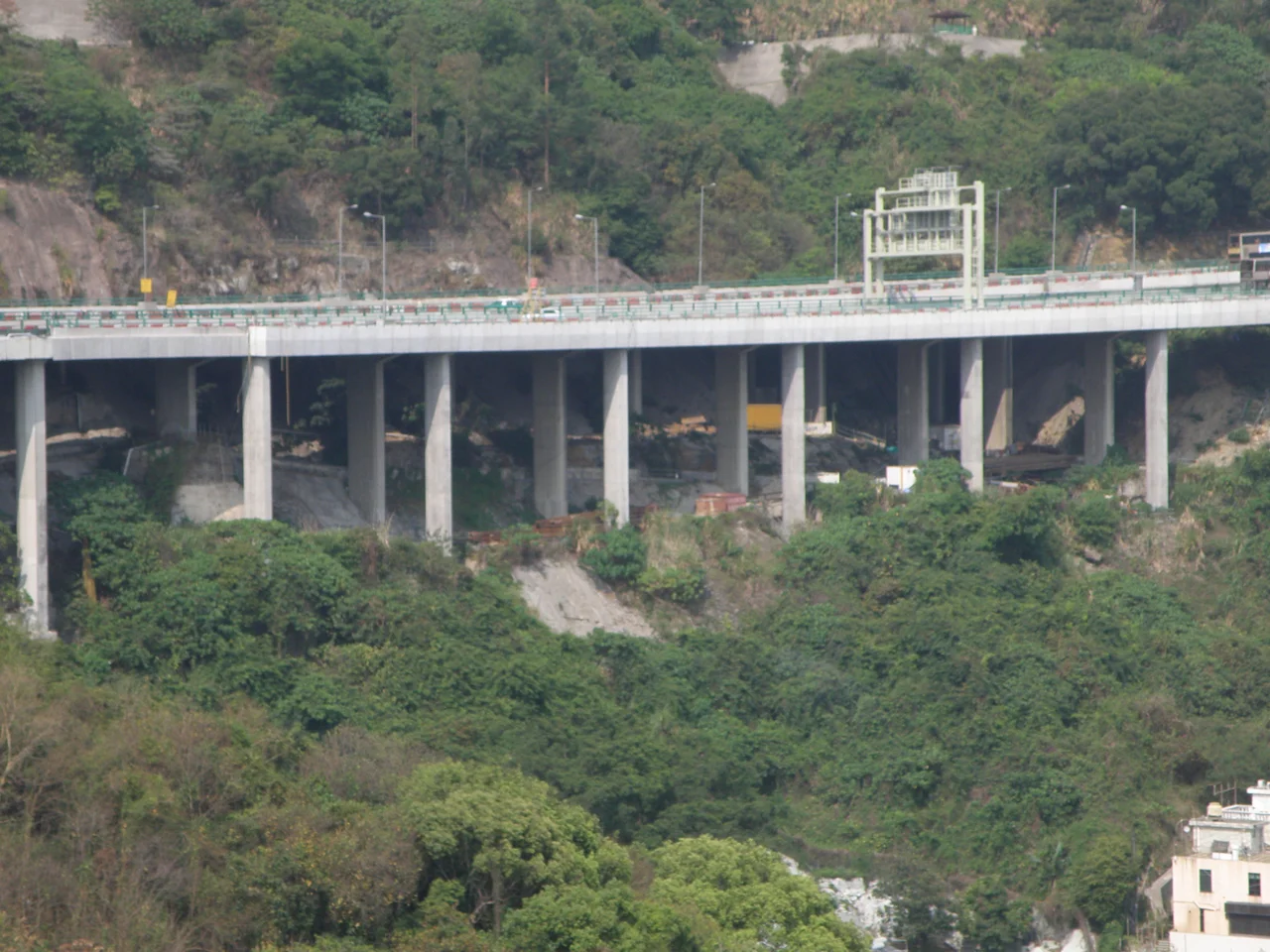

2003 Tuen Mun Road Bus Accident
The route 265M bus had left Lai Yiu Estate in Kwai Chung early on the morning of July 10, 2003, heading west toward Tin Heng Estate in Tin Shui Wai. The driver, Chan Wan-lin, had been with Kowloon Motor Bus for six years and knew the 265M well. He had taken two days off before the shift. The passengers settling into the seats of the Neoplan Centroliner double-decker had no particular reason to expect anything other than an ordinary commute. What none of them could have anticipated was that a lorry in the middle lane of Tuen Mun Road, near the junction with Tsing Long Highway, was about to lose control.
Thirty-Five Meters Down
When the lorry struck the bus, the impact drove it sideways into the viaduct parapet. The concrete barrier gave way. The double-decker, carrying its passengers through the early-morning air above Ting Kau Village, broke through and fell 35 meters. The bus driver, Chan Wan-lin, was 41 years old, a father with an 11-year-old daughter and a 5-year-old son; his wife was unemployed at the time of the accident. He died in the crash along with 18 passengers. Two more passengers died after being transferred to hospital, bringing the final death toll to 21. Twenty others were injured. The Ting Kau section of Tuen Mun Road, perched above a rural hillside village with no direct road access, could only be reached on foot from Castle Peak Road — conditions that fire services later described as the most challenging they had encountered since the 1996 Garley Building fire.
Reaching the Unreachable
Rescuers had to carry injured passengers down a steep hillside, on foot, through terrain that offered no vehicle access. The sheer number of severely wounded people compounded the difficulty — triage, treatment, and evacuation all had to happen simultaneously in a narrow space. Several of the passengers worked as teachers in Tin Shui Wai schools, and the Hong Kong Professional Teachers' Union launched a city-wide fundraising drive the day after the accident. That campaign ran for four years, closing in September 2007. The bus itself was eventually lifted back onto the road and transported to a vehicle compound, where it was written off. The lorry driver, Li Chau-wing, who was 53 at the time and had three prior traffic violations, was found guilty of causing death by dangerous driving. He was sentenced to 18 months in prison.
Lives Behind the Numbers
In the immediate news coverage of events like this, individuals can disappear into statistics. Chan Wan-lin, the bus driver, had a good professional record. Investigators found no evidence of fatigue or physical impairment; he had rested before his shift and was familiar with the route. The lorry's loss of control was the initiating event. The passengers on the bus that morning were heading to work, to school, to the ordinary business of a Thursday in July. Several were teachers. The Professional Teachers' Union's fundraising campaign — which raised significant funds over four years — was a response by colleagues who understood, concretely, who was on that bus. The twenty survivors carried injuries whose treatment stretched across weeks and months. The deaths were the loss of 21 specific people, each of them irreplaceable.
What the Accident Changed
The 2003 crash remained the worst road traffic accident in Hong Kong history for fifteen years. It prompted renewed examination of safety standards on the city's elevated road infrastructure, and the circumstances — a lorry losing control on a viaduct — raised questions about vehicle maintenance and driver accountability that the prosecution of Li Chau-wing partially addressed but did not resolve entirely. When a second major double-decker accident occurred in February 2018, commentators inevitably measured it against 2003. The viaduct section of Tuen Mun Road above Ting Kau continues to carry heavy traffic today. The village below has a clearer view of the road overhead than most commuters realize.
From the Air
The Ting Kau section of Tuen Mun Road sits at approximately 22.37°N, 114.08°E in the western New Territories, where the elevated highway crosses above Ting Kau Village near Tsing Ma Bridge. From the air at 2,000–4,000 feet, the Tsing Ma suspension bridge and the Ting Kau Bridge are visible as striking engineering landmarks spanning Rambler Channel. Hong Kong International Airport (VHHH) lies about 10 kilometers to the west-southwest. The accident site is on the viaduct section visible just northeast of Ting Kau Bridge.
Nearby Stories
- Chapel of St. Francis Xavier 3.5 km away
- Cuiheng 4.1 km away
- 2015 Shenzhen Landslide 16 km away
- Shunde 31 km away
- Wanshan Archipelago 37 km away
- Nanxiong Formation 96 km away
- Heyuan 149 km away
- Checheng Fu'an Temple 629 km away