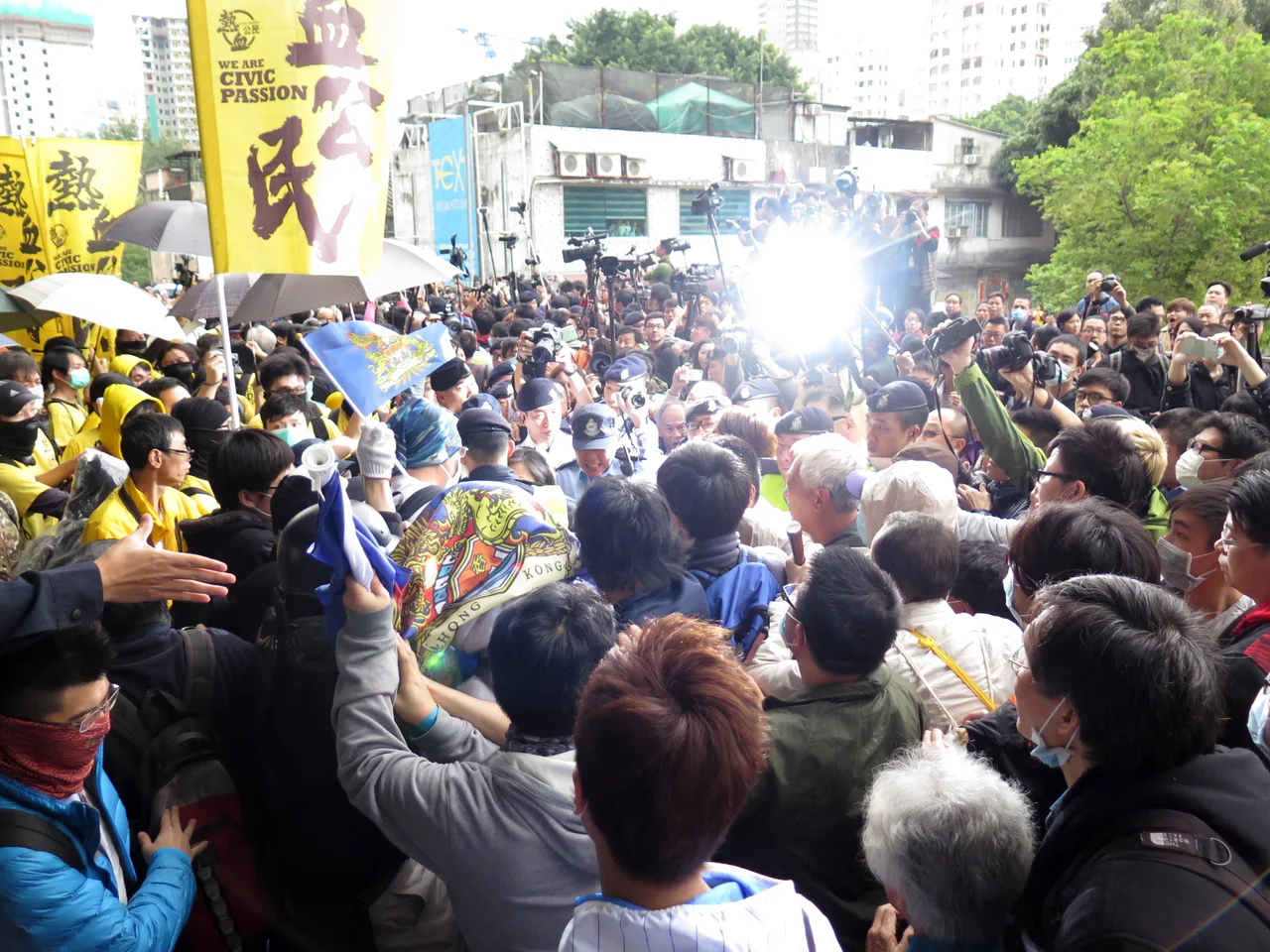

2015 Yuen Long Protest
By 2015, the shelves in Yuen Long pharmacies had a different look than they once did. Products that local families had always bought without a second thought — infant formula, shampoo, over-the-counter medicine — were often cleared out by the time ordinary shoppers arrived. The buyers weren't local. They were traders who crossed from mainland China under a multiple-entry visa policy that allowed them to enter and exit Hong Kong freely, often multiple times in a single day, filling rolling suitcases with goods to resell across the border at a markup. On March 1, 2015, a crowd organized under the banner "Liberate Yuen Long" gathered to say, loudly, that enough was enough.
The Border Economy That Divided a Town
Parallel trading — the practice of purchasing goods cheaply in Hong Kong for resale at a profit on the mainland — was not new in 2015, but the multiple-entry visa policy had made it dramatically easier. Traders needed only a valid visa and a rolling bag. The effects were felt unevenly: shop owners near the border benefited from heavy foot traffic and bulk purchases, while the same traffic clogged queues at the MTR, inflated local prices, and crowded out the kinds of shops that residents actually wanted. Yuen Long, close to the Lok Ma Chau crossing and the Lo Wu border, had become a particular focal point. A parallel campaign, "Recover Sheung Shui," had launched in 2012. By early 2015, similar protests had spread to Tuen Mun and Sha Tin. Residents' sentiment had hardened — many felt that repeated complaints to the government had gone nowhere.
March 1, 2015
The protest on March 1 was organized primarily by Civic Passion and Hong Kong Indigenous, two groups associated with a localist political current that had grown increasingly prominent. Ahead of the demonstration, the chairperson of the Shap Pat Heung Rural Committee issued a warning: if protesters stepped off the train at Long Ping station, villagers would surround them. He added, pointedly, that he could not be responsible for what those villagers might do. The protest proceeded anyway. Police used pepper spray 21 times during the day. Roughly 30 shops shuttered their gates as a precaution. Members of the Hong Kong General Chamber of Commerce later threatened to sue over business losses. In the end, police arrested 38 people — 36 men and 2 women, ranging from 13 to 74 years old — on charges including common assault, assaulting police, and possession of weapons. Five police officers required hospital treatment.
A Community Pulled in Different Directions
The protest laid bare a genuine division within Yuen Long itself. Some residents welcomed it: one local told reporters that parallel traders had caused road congestion, that gold shops and pharmacies catering to mainland customers were crowding out stores that served the neighborhood, and that he hoped the multiple-entry permits would be revoked. Others were hostile to the marchers. The Xinhua News Agency, reporting from Beijing, described the organizers as radical groups bringing nuisance to Yuen Long merchants. The Rural Committee's chairperson explicitly positioned the village establishment against the protesters. These weren't manufactured divisions — they reflected real differences in how people in the same community were experiencing the same trade flows, depending on whether their livelihoods depended on the traffic or on the daily texture of a functioning neighborhood.
Government Response and What Changed
Hong Kong's Secretary for Security, Lai Tung-kwok, emphasized that lawful protest was protected but illegal behavior would not be tolerated. The Secretary for Commerce and Economic Development, Gregory So Kam-leung, defended the Individual Visit Scheme as economically important and resisted calls to cancel the multiple-entry permits, calling any major adjustment something that required careful deliberation. But the protests had political weight. The government eventually sent a proposal to Beijing to regulate the multiple-entry permit scheme. Since 2015, parallel trading volumes have declined significantly, and travel patterns to Hong Kong from neighboring Shenzhen have shifted. The 2015 demonstrations were one part of a longer sequence — from the 2012 Sheung Shui protests through to the "Reclaim Yuen Long" action during the 2019 protests — in which the question of what Hong Kong's border towns are for, and for whom, was contested in the streets.
From the Air
Yuen Long sits at approximately 22.444°N, 114.026°E in the northwestern New Territories, near the Lok Ma Chau and Man Kam To border crossings with mainland China. From the air at 3,000–5,000 feet, the flat agricultural plain of the Yuen Long lowlands is distinctive — one of the few large areas of level ground in the New Territories, surrounded by hills. Long Ping MTR station, near the center of the protest events, is visible from altitude as part of the West Rail line running southwest toward Tuen Mun. Hong Kong International Airport (VHHH) lies approximately 15 kilometers to the southwest.
Nearby Stories
- Chapel of St. Francis Xavier 3.5 km away
- Cuiheng 4.1 km away
- 2015 Shenzhen Landslide 16 km away
- Shunde 31 km away
- Wanshan Archipelago 37 km away
- Nanxiong Formation 96 km away
- Heyuan 149 km away
- Checheng Fu'an Temple 629 km away