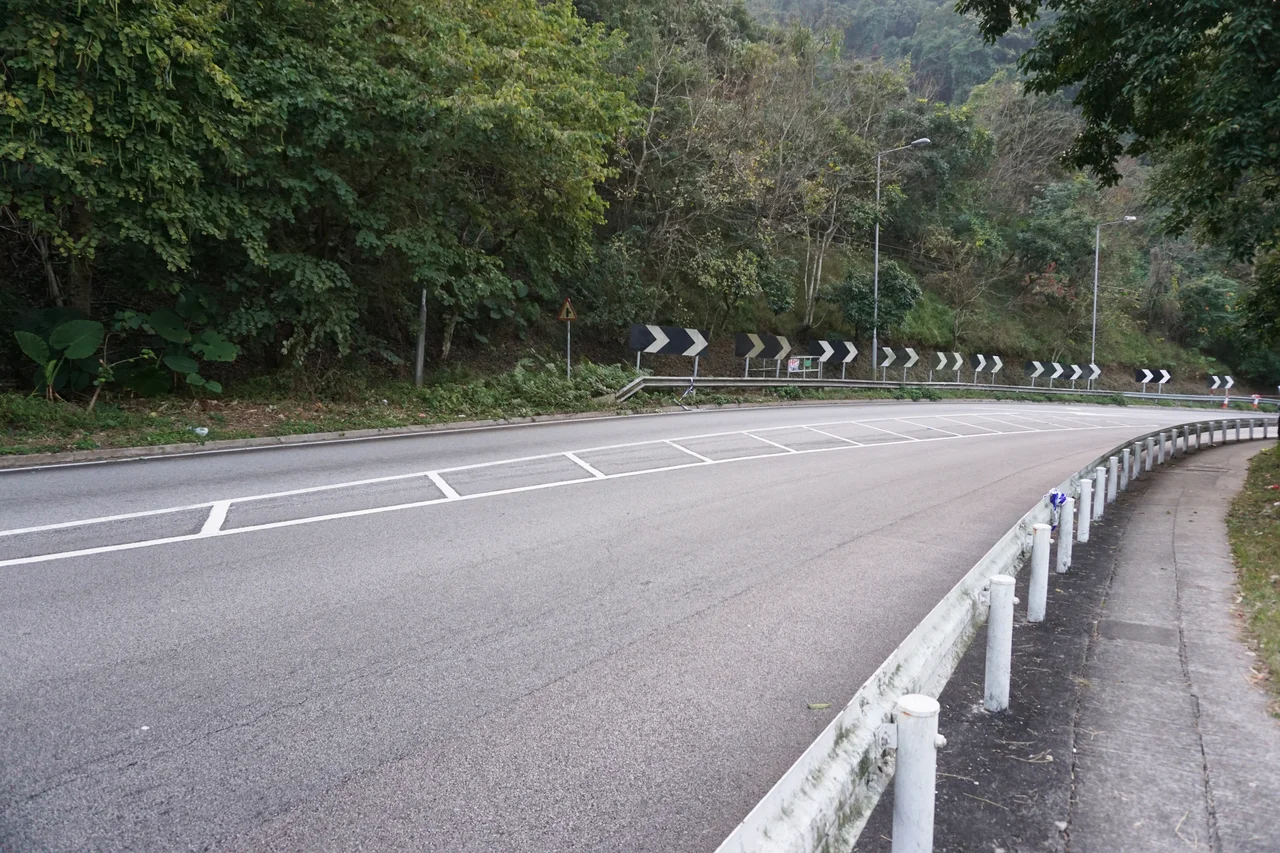

2018 Hong Kong Bus Accident
The bus had left Sha Tin Racecourse about ten minutes late, following the last race of the day. It was the eve of Lunar New Year, a Saturday in February, and passengers returning home had apparently exchanged sharp words with the driver over the delay. Bus AVW78 — a Volvo Super Olympian with fleet number LX 9991, photographed by a bus enthusiast just 32 minutes before the crash — was running route 872, a service that only operated on race days. At 6:13 p.m., as it descended a curving section of Tai Po Road near Tai Po Mei village, the bus flipped onto its left side.
The Bend at Tai Po Mei
Tai Po Road descends in a series of curves through hilly terrain between Sha Tin and Tai Po. The section near Tai Po Mei village is a downhill stretch where speed builds quickly if a driver fails to brake. When the bus went over, it struck a lamp post and destroyed the Tai Po Mei bus stop. Fire service officers had to cut into the vehicle's body with equipment to reach those trapped inside; the rescue operation took about 85 minutes. A makeshift morgue was established at the roadside. Nineteen people died in the accident and its immediate aftermath — making it the second-worst road traffic accident in Hong Kong history, behind the 2003 Tuen Mun Road crash that killed 21. Sixty-five people were injured. The road was closed for 12 hours. The following afternoon, it was closed again for a ceremony attended by around 200 mourners, government officials, and Kowloon Motor Bus management.
The Driver and the Questions That Followed
Chan Ho-ming was 30 years old. He had been with KMB since 2014, working part time since 2017, without a regular assigned route. Route 872 was a special race-day service, and media later reported that he had not driven this route during his training. Passengers told reporters immediately after the crash that the bus had been traveling too fast; police also suspected speeding. Chan was arrested, denied bail, and charged — his charges eventually upgraded to multiple counts of manslaughter. In July 2020, more than two years after the accident, Chan Ho-ming was sentenced to 14 years in prison and barred from driving any vehicle. The investigation also surfaced uncomfortable questions about KMB's staffing practices: the Motor Transport Workers General Union alleged that a shortage of qualified drivers, driven by low pay, had led the company to rely heavily on part-time workers who may not have been adequately prepared for the routes they were assigned.
The City Responded
The day after the crash, people formed hours-long queues at Hong Kong Red Cross blood donation centers, with thousands waiting to give blood for those injured. The Causeway Bay Donor Centre extended its hours; the Red Cross kept twelve donation centers open through the Lunar New Year holiday. Chief Executive Carrie Lam visited survivors at Prince of Wales Hospital that evening and announced a judge-led commission of inquiry into franchised bus safety. Families of those who died received HK$300,000 each; injured survivors received between HK$150,000 and HK$250,000, drawn from charitable organizations including the Jockey Club, Tung Wah Group of Hospitals, Yan Chai Hospital, and Pok Oi Hospital. Hong Kong canceled its Lunar New Year fireworks display. Flags flew at half-mast.
What Changed, and What Remained
KMB suspended new part-time driver hirings after the crash. Route 872 resumed on February 18 using single-decker buses only; a new express variant, 872X, was introduced on Tolo Highway to bypass Tai Po Road. The commission of inquiry, chaired by Court of Appeal Vice President Mr Justice Michael Lunn, examined the safety of Hong Kong's franchised bus network as a whole. In the aftermath, KMB explored spending HK$200 million to install seatbelts on older buses, tested anti-drowsiness detection systems using facial recognition, and announced 160 buses fitted with electronic stability systems would arrive by August 2018. Driver shift lengths for special services were reduced. These were meaningful changes — but they came after 19 people had been killed on a road they'd traveled before, heading home for the new year.
From the Air
The accident site is at approximately 22.420°N, 114.196°E on Tai Po Road in Tai Po, New Territories. Flying at 3,000–5,000 feet, the winding ridgeline road is visible cutting through the hills between Sha Tin and Tai Po, with Tolo Harbour opening to the east. Sha Tin Racecourse — where bus 872 originated — is clearly identifiable as a large oval track on reclaimed land beside the Shing Mun River. Hong Kong International Airport (VHHH) lies approximately 40 kilometers to the southwest; Shek Kong (VHSK) is roughly 25 kilometers to the west.
Nearby Stories
- Chapel of St. Francis Xavier 3.5 km away
- Cuiheng 4.1 km away
- 2015 Shenzhen Landslide 16 km away
- Shunde 31 km away
- Wanshan Archipelago 37 km away
- Nanxiong Formation 96 km away
- Heyuan 149 km away
- Checheng Fu'an Temple 629 km away