.jpg)
25 August 2019 Hong Kong Protest
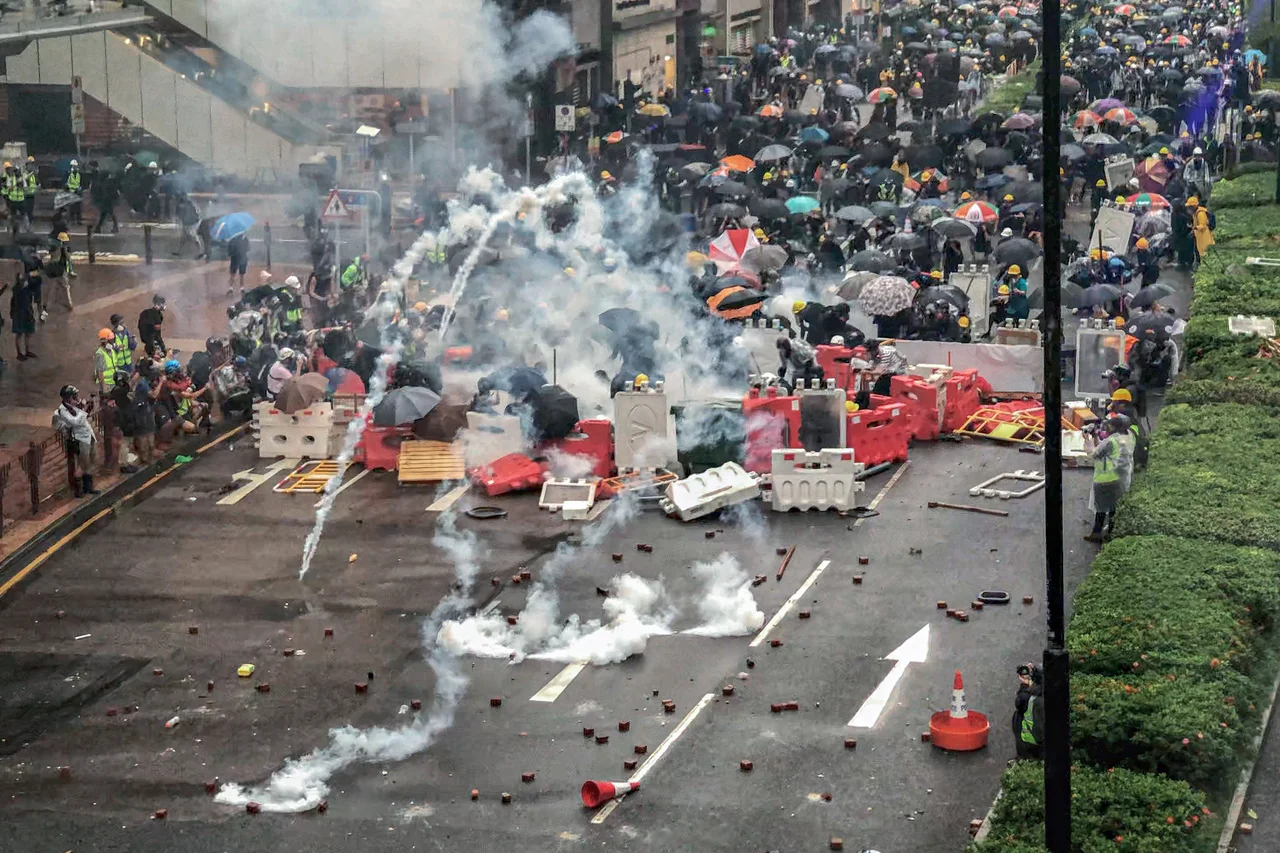
Many parents brought their children to the march. Before the official gathering time of 3 pm, people had already filled the stands at Kwai Chung Sports Ground, sheltering from the rain. The route had been negotiated with police over two days; the permits were in order. By late afternoon the front of the march had reached Tsuen Wan Park. By evening, tear gas canisters were arcing into residential areas and riot police were detaining a boy who told them he was 12 years old.
A Permitted March in the Rain
The Tsuen Kwai Tsing March was organised by a local preparation group, with Lam Kai-hong as applicant and Yu Ngai-ming as coordinator. After initial police objections to the gathering point, an agreement was reached on 24 August, and the march was approved — starting from Kwai Chung Sports Ground, proceeding along Kwai Fuk Road and Ma Tau Pa Road, and ending at Tsuen Wan Park. Thousands turned out despite steady rain, marching with umbrellas along sidewalks as agreed. Banners bearing the protest movement's call for "Five Demands, Not One Less" were visible along the route. Parents pushed strollers. At 4 pm, the organizers announced that participants could circulate freely through the rally area, noting that the tail of the march was still waiting to depart from the starting point.
Escalation by Degrees
Around 4 pm, some protesters began dismantling roadside railings near Texaco Road to set up roadblocks. At 4:40 pm, police announced that the Tsuen Wan Police Station report room was temporarily closed. Riot police arrived near Nina Tower on Yeung Uk Road at 4:48 pm. By 5:40 pm, officers raised an orange flag — warning of live ammunition — and fired multiple rounds of tear gas outside Yeung Uk Road Complex. Protesters responded with petrol bombs and laser pointers before withdrawing into the Tsuen Wan Plaza shopping centre, where they used fire hoses to wet the floors and block the entrances. Clashes moved between several neighbourhoods, with further confrontations in Sham Shui Po and Tsim Sha Tsui through the late evening. At the Cross-Harbour Tunnel toll plaza, protesters briefly blockaded the booths, allowing vehicles through without payment.
Water Cannons and a Gunshot
The day marked two firsts. The Specialised Crowd Management Vehicle — a water cannon — was deployed for the first time in the crackdown on the Anti-Extradition Law Amendment Bill movement, spraying twice within an hour. And in an alley near Sha Tsui Road and Chung On Street, as demonstrators confronted a group of about six police officers, a shot was fired into the air as a warning — the first use of live ammunition in the protest movement. Officers raised their firearms toward demonstrators and press. A middle-aged bystander spread his arms between the officers and the crowd, then knelt down pleading, "Don't shoot." An officer kicked him aside. He stood back up. Police later defended the kick as a "natural reaction" by an officer who believed his life was under threat. The three officers who had drawn weapons were quickly surrounded by journalists.
The Youngest Arrested
During police clearing operations around 7 pm, riot police surrounded and detained a 12-year-old boy near Yeung Uk Road, binding his hands with zip ties and ordering him to squat. His elbows were scraped and bleeding. A social worker on the scene shouted that the boy was under 16 and attempted to assist him. Officers told her this might constitute obstruction of justice. When reporters approached, they were threatened with batons and told to inquire with the public relations department. The boy was taken away in a private car. He was later confirmed to be a newly enrolled Form 1 student at Lingnan Hang Yee Memorial Secondary School. The school contacted his parents and arranged for social worker support. He became, at that moment, the youngest person arrested in the movement. Thirty-six people were arrested that day in total, ranging in age from 12 to 48.
Consequences in Court
The legal proceedings that followed the 25 August events stretched over years. A 25-year-old teacher who pleaded guilty to illegal assembly and assaulting a police officer was sentenced to ten months in prison, with the judge noting that a conviction would likely cost him his teaching post but declining to treat that as sufficient mitigation. A 21-year-old student who pleaded guilty to illegal assembly was sentenced to eight months. Among the seven defendants in the Yeung Uk Road illegal assembly case who went to trial, those convicted received sentences of around eleven months. The cases moved through Hong Kong's courts in the years that followed, each verdict accumulating into the broader record of what had happened that rainy Sunday afternoon in Tsuen Wan.
From the Air
Tsuen Wan and Kwai Tsing lie at approximately 22.37°N, 114.11°E in the western part of the Kowloon Peninsula and New Territories, roughly 12 km from Hong Kong International Airport (VHHH) at Chek Lap Kok. The districts are densely built and easily recognisable from the air by the clusters of high-rise residential towers rising from the coastal lowlands. Kwai Chung Sports Ground and Tsuen Wan Park are located in the flat valley floor between the ridgelines. The area is a major transport hub, with the Kwai Tsing Container Port visible to the southwest — one of the world's busiest container facilities. Best approached from the southwest along the Pearl River corridor at 8,000–12,000 feet in clear weather.
Nearby Stories
- Chapel of St. Francis Xavier 3.5 km away
- Cuiheng 4.1 km away
- 2015 Shenzhen Landslide 16 km away
- Shunde 31 km away
- Wanshan Archipelago 37 km away
- Nanxiong Formation 96 km away
- Heyuan 149 km away
- Checheng Fu'an Temple 629 km away