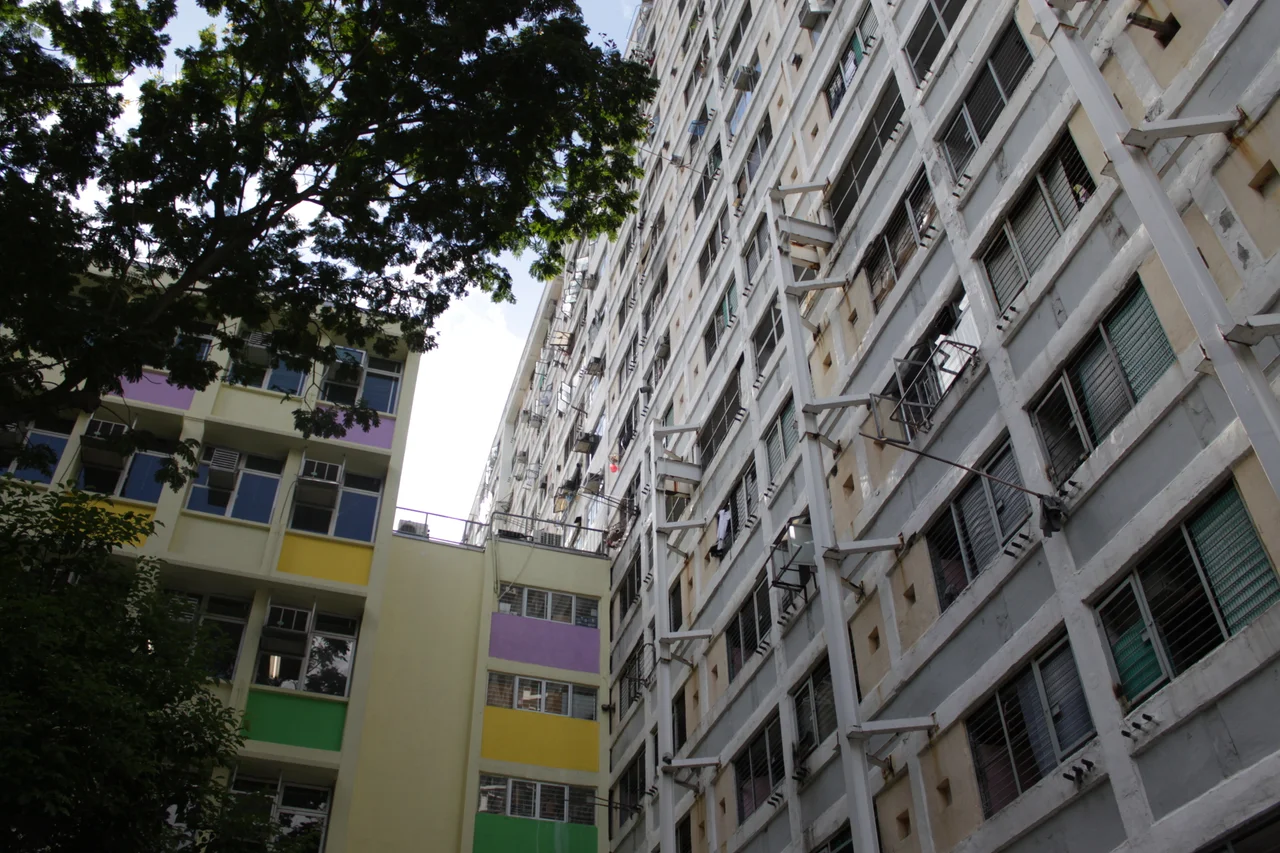

The 26 Blocks Scandal
In March 1980, workers inspecting blocks 5 and 6 of Kwai Fong Estate found concrete flaking from the ceilings and walls. The buildings were only eight years old. Testing showed that the concrete's strength was substantially below the required standard — the result, investigations concluded, of deliberate corner-cutting during construction. It was not an isolated problem. It was, as investigators would eventually discover, a widespread one, embedded into the foundations of Hong Kong's post-war public housing programme.
Built to Fall Short
By the late 1970s and early 1980s, Hong Kong had been racing to house a rapidly growing population in vast new public estates — towers of ten, twenty, thirty storeys rising across the New Territories and the older urban districts. Speed and cost were the pressures; oversight was the gap. What inspectors found at Kwai Fong Estate in 1980 pointed to something more deliberate than simple construction fatigue: the concrete mix had been adulterated, its strength reduced from what the specifications required. Block 6, the most seriously affected, was repaired at a cost of HK$50 million, with residents relocated temporarily to Tai Wo Hau Estate nearby. In January 1985, when the Housing Department announced that Block 5 would become the first government-built low-cost housing block to be demolished, it marked the public beginning of the scandal.
The Scale of It
The government's announcement on 21 November 1985 confirmed what the scale of the inspections had been hinting at: structural problems had been found in 577 blocks built between 1982 and 1984. Of those, 26 were deemed at imminent risk of collapse and would be demolished. The Tsuen Wan New Town was the hardest hit, with 11 blocks demolished there alone — affecting around 78,000 residents. Across Hong Kong, the rehousing effort was substantial. Families who had waited years for a place in public housing found themselves moving again, carrying what they owned out of buildings that had promised permanence and delivered something far less.
What the ICAC Found
The Independent Commission Against Corruption opened an investigation into the scandal, recognising that the defects were too systematic to be accidental. The breakthrough came in 1987, when two individuals agreed to testify as witnesses. What emerged was a pattern of bribery running across construction contracts and into the Housing Department itself: contractors paying officials to approve substandard work, and officials accepting those payments. Three contractors and seven current or former officials were charged. Two contractors received prison sentences — 33 months and 3 months (the latter suspended). Ho Leung, 70 years old at the time of charges and former owner of Yeu Shing Construction Company, was found to have bribed a Housing Department official named Lam on six separate occasions between 1966 and 1975, paying a total of more than HK$45,000 during construction of Ngau Tau Kok Estate and Lei Muk Shue Estate. Ho was not charged on health grounds and testified as a witness; he died in 1991. Another contractor, Poon Pak-shing, received a three-month suspended sentence and was fined HK$4,000 for bribing the same official during work on Upper Ngau Tau Kok Estate.
The Long Reckoning
The 26 Blocks Scandal became one of the defining examples of the ICAC's mandate in action — evidence that the commission, established in 1974, could reach into major public works contracts and produce accountability that had been absent before its creation. The Comprehensive Redevelopment Programme that eventually replaced the affected and degraded estates ran for decades; the last of the relevant clearances, Lower Ngau Tau Kok (II) Estate, was completed in 2010. The people who had lived in those towers — who had hung their laundry from the windows and raised children in the lifts and stairwells of blocks that were quietly failing around them — mostly moved without public acknowledgement of what had been taken from them. The buildings came down. The estates that replaced them rose, as they always had in Hong Kong, fast and tall.
From the Air
Kwai Fong Estate and the Kwai Tsing district lie at approximately 22.35°N, 114.20°E in the western New Territories, about 10 km from Hong Kong International Airport (VHHH) at Chek Lap Kok. The area is characterised by dense clusters of residential towers rising from a valley floor between hilly ridges, visible clearly from the air on approach to or departure from the airport. The Kwai Tsing Container Port — one of the world's busiest — lies immediately to the southwest. Approaching from the west at 5,000–8,000 feet, the scale of Hong Kong's public housing programme is visible across the skyline: tower after tower stretching from the waterfront into the hills, each block representing thousands of families and decades of the city's history.
Nearby Stories
- Chapel of St. Francis Xavier 3.5 km away
- Cuiheng 4.1 km away
- 2015 Shenzhen Landslide 16 km away
- Shunde 31 km away
- Wanshan Archipelago 37 km away
- Nanxiong Formation 96 km away
- Heyuan 149 km away
- Checheng Fu'an Temple 629 km away