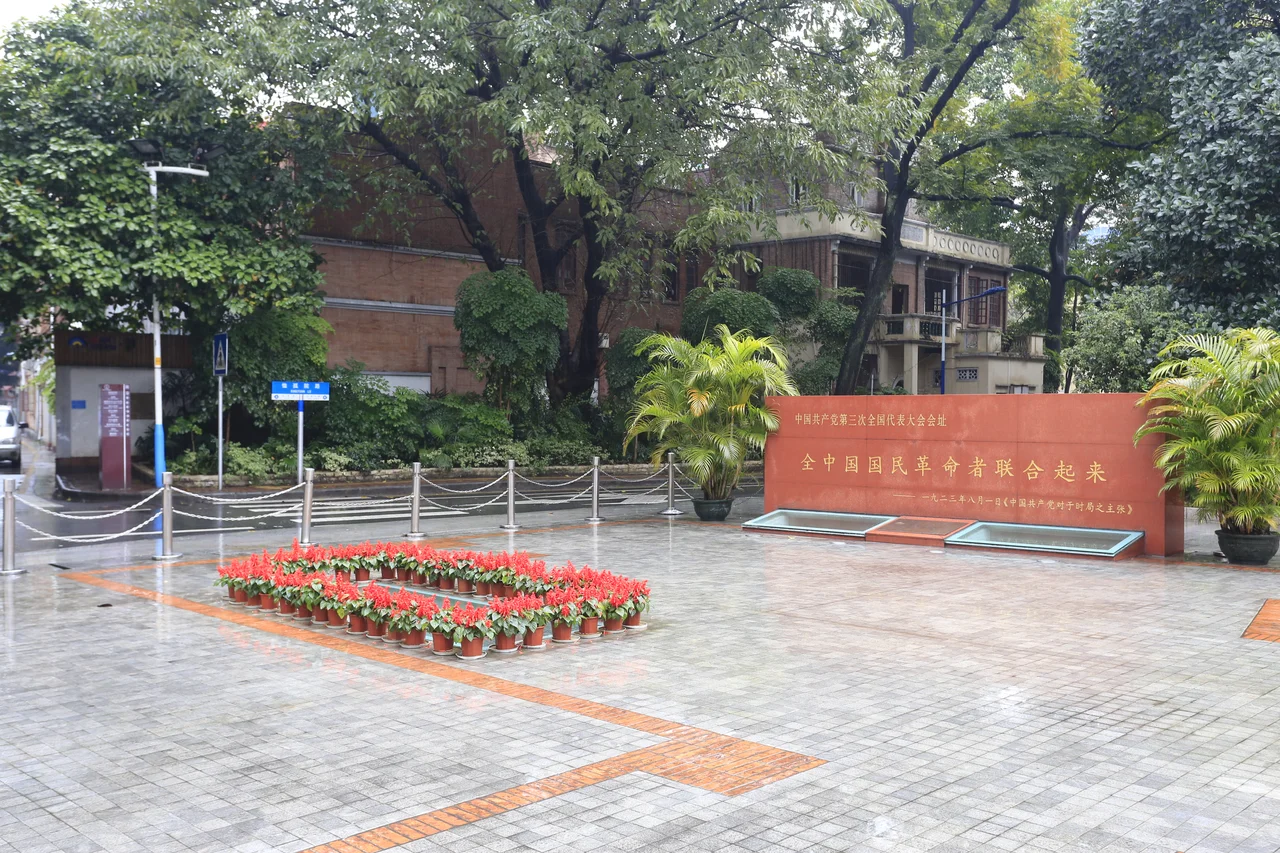

3rd National Congress of the Chinese Communist Party
More than thirty people sat down together at 31 Xuguyuan Road in Guangzhou over nine days in June 1923. They represented 420 members of the Chinese Communist Party — a party barely two years old, still finding its footing in a fractured republic torn by warlords and foreign concessions. Among them was a young Hunanese organizer named Mao Zedong, who had traveled down from Shanghai to make a speech about labor movements. What the congress decided in that room set the political direction of modern China.
The Room Where It Happened
The Third National Congress took place from June 12 to June 20, 1923. The address — 31 Xuguyuan Road in Guangzhou — was neither grand nor conspicuous. Guangzhou had become a haven for revolutionary politics under Sun Yat-sen's government, which made it the logical venue for a gathering that could not have happened safely in Shanghai or Beijing.
Chen Duxiu, the party's leading intellectual and organizational force, chaired the congress. Alongside him sat Li Dazhao, Cai Hesen, Zhang Guotao, Tan Pingshan, and Henk Sneevliet — a Dutch Communist representing the Comintern, the Moscow-based international body that had become the CCP's primary external sponsor. Sneevliet arrived with a specific mandate: to push the young party toward formal cooperation with Sun Yat-sen's Kuomintang.
The Question That Mattered
The central debate of the congress was whether CCP members should be permitted — or required — to join the Kuomintang while maintaining their Communist Party membership. The Comintern, looking at the relative weakness of the CCP's 420 members against the much larger and better-resourced Nationalist movement, believed that an alliance with the Kuomintang offered the best chance of achieving the immediate goal: unifying China and ending the era of warlord rule.
Chen Duxiu presented the case. Mao Zedong spoke about the possibilities of the workers' movement in Hunan. After debate, the congress passed the National Movement and Kuomintang Question Act. CCP members would be permitted to join the Kuomintang as individuals while the party maintained its separate structure and continued recruiting. It was a pragmatic calculation with enormous consequences.
Xiang Jingyu and the Women's Movement
One of the congress's less-remembered but significant acts was the passage of a resolution on the women's movement, drafted by Xiang Jingyu. The resolution argued that the fight against warlords and foreign imperialism could unite women across different political tendencies — from labor organizers to suffragists to those working to abolish prostitution — under a shared anti-feudal banner. Xiang Jingyu, who had co-founded the CCP's women's department and would be executed by the Nationalist government in 1928, understood that the revolution's reach would determine its meaning. The resolution was a marker of how seriously the early party took the question of who the revolution was actually for.
The Decisions Echo Forward
When the nine days concluded, the delegates sang The Internationale at the Martyr's Tomb in Huanghuagang Park. The new Central Committee comprised five members: Chen Duxiu as President and Mao Zedong as Secretary, alongside Luo Zhanglong, Cai Hesen, and Tan Pingshan. Several of them — including Mao and Chen — remained in Guangzhou after the congress ended.
The decision to cooperate with the Kuomintang bore fruit quickly. Sun Yat-sen reformed his party along the lines the CCP had been pushing for, and the following year, in 1924, the First National Congress of the Kuomintang formally established the alliance. For a brief period, the two parties shared a common project. That alliance would later fracture violently — but in June 1923, on Xuguyuan Road, the delegates who voted for cooperation could not have known what was coming. They voted for what seemed possible.
From the Air
The site of the 3rd National Congress lies at approximately 23.121°N, 113.291°E in the Dongshan district of central Guangzhou. A commemorative museum now marks the original building at 31 Xuguyuan Road. Viewing the broader Guangzhou cityscape is best from altitudes between 3,000 and 6,000 feet, where the Pearl River's loops through the city are clearly visible. The nearest major airport is Guangzhou Baiyun International Airport (ZGGG), approximately 20 kilometers to the north. On approach to ZGGG from the south, the dense urban grid of Dongshan and the Pearl River delta spread across the horizon.
Nearby Stories
- Shunde 12 km away
- 2015 Shenzhen Landslide 15 km away
- Mount Luofu 23 km away
- Qingyuan Maglev Tourist Line 32 km away
- Kaiping 56 km away
- Heyuan 90 km away
- Chikan, Kaiping 92 km away
- Erlitou Site Museum of the Xia Capital 1257 km away