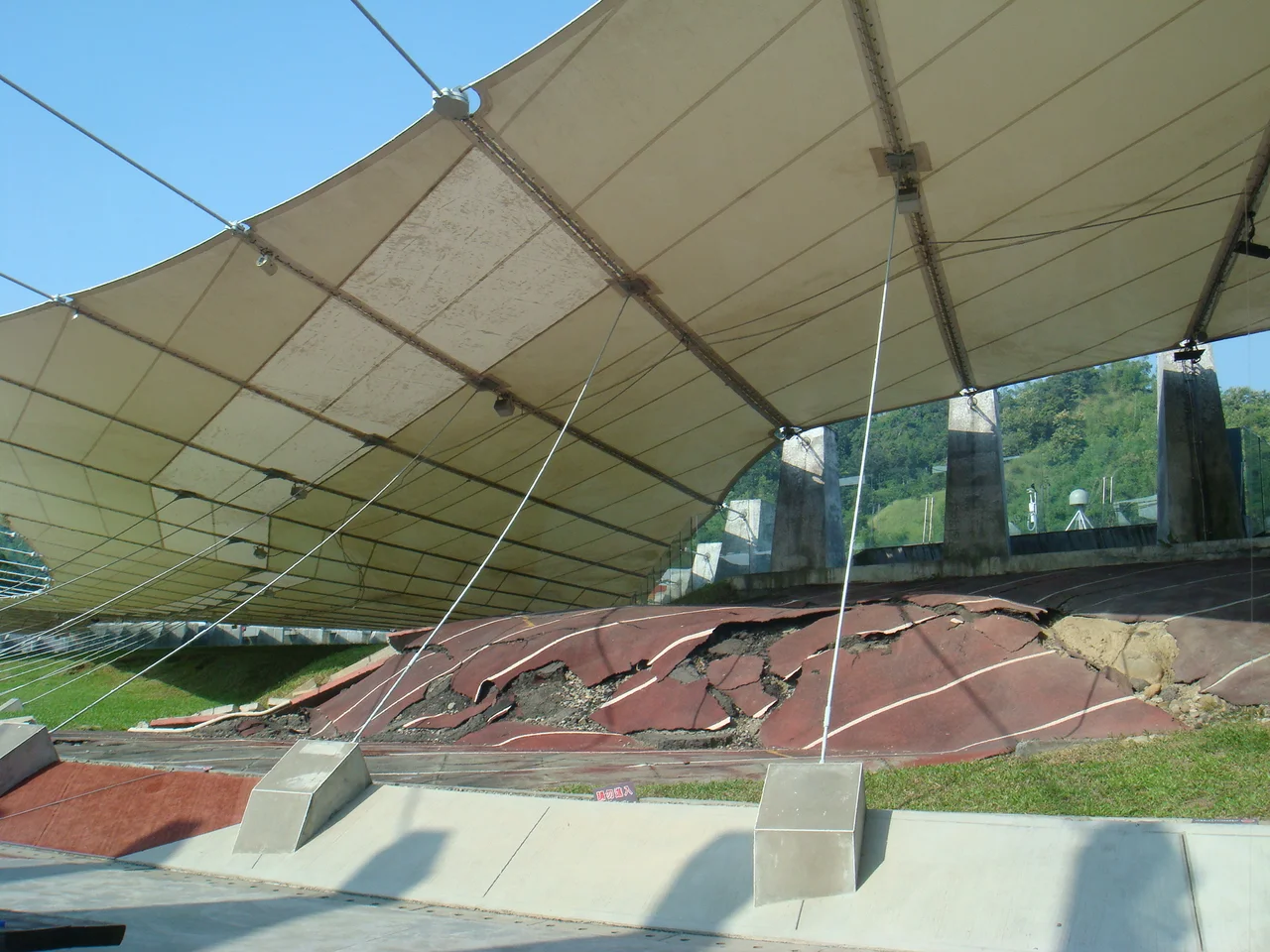

921 Earthquake Museum of Taiwan
At 1:47 in the morning on 21 September 1999, a magnitude 7.6 earthquake ruptured along the Chelungpu Fault beneath central Taiwan. In the seconds that followed, the ground shifted by meters. Buildings fell. Among them was Guangfu Junior High School in what is now Wufeng District, Taichung — its gymnasium collapsing inward, its running track heaving into a two-meter wave of frozen asphalt. Approximately 2,400 people died across Taiwan that night. Many thousands more were injured. The earthquake left behind not only grief but visible wounds in the earth itself. The 921 Earthquake Museum of Taiwan was built on those wounds — not to erase them, but to preserve them as permanent testimony.
The Night It Happened
The 921 earthquake — named for its date, September 21 — struck at a moment when most of Taiwan was asleep. Its epicenter was near Jiji in Nantou County, and the shaking was felt across the entire island. The Chelungpu Fault, which runs north-south through central Taiwan, ruptured along a length of roughly 100 kilometers. Surface ruptures appeared across the landscape: roads buckled, riverbanks shifted, and in some places the ground itself rose or dropped by several meters. At Guangfu Junior High School, the fault passed directly beneath the campus. The gymnasium did not survive. The school's running track, caught in the upward thrust of the fault scarp, folded into a ridge that still stands today — concrete and asphalt lifted and held in place as evidence of forces that operated far below any human scale. The approximately 2,400 people who lost their lives that night included students, parents, workers, and elderly residents across multiple counties. Each was a person with a life cut short by a few seconds of geological violence.
A Decision About What to Keep
In the aftermath, Taiwan faced a question that disaster-struck communities have faced before: what to do with the ruins. The instinct is often to clear them — to rebuild, to reclaim, to move forward. Local officials in the Wufeng area chose differently. They decided to preserve the ruins of Guangfu Junior High School, and to build a museum around what remained. The collapsed gymnasium shell became the museum's exterior walls. The fault scarp that raised the running track was left where geology made it, enclosed and protected under a long gallery. The museum, then called the Earthquake Memorial Museum, opened on 13 February 2001 — less than 17 months after the earthquake. That speed was itself a statement: the wounds were too fresh and too instructive to cover over. Taiwan is one of the most seismically active places on earth, and the decision to preserve rather than demolish was, among other things, a decision about what the country owed its future generations.
What the Galleries Hold
The museum is organized around several distinct galleries, each serving a different purpose within a unified act of remembrance and education. The Chelungpu Fault Gallery is the museum's most visceral space: it crosses the fault line itself, displaying the uplifted ground and deformed structures as they were found. The Earthquake Engineering Hall examines how buildings behave under seismic stress — what fails, what holds, and why — translating destruction into the technical language of structural understanding. The Image Gallery documents the human experience of the disaster through photography. The Disaster Prevention Hall addresses practical preparedness: what individuals and communities can do to reduce their vulnerability when the next earthquake comes. The Reconstruction Records Hall traces the long process of rebuilding, a story that unfolded across years and required collective effort on a scale that matched the scale of what was lost.
Memory as Obligation
There is a particular quality to museums built on the sites of disasters — a quality different from institutions that merely display artifacts about events that happened elsewhere. At the 921 Earthquake Museum, the event is present in the architecture. The fractured ground, the twisted gymnasium, the raised running track: these are not reconstructions or scale models. They are the actual thing. Standing in the Chelungpu Fault Gallery, the visitor is standing on the fault. The museum is open Tuesday through Sunday, from 9:00 a.m. to 5:00 p.m. for the indoor galleries and 6:00 a.m. to 10:00 p.m. for the outdoor sections. It is visited by schoolchildren, engineers, researchers, and the families of those who died. For each group, the building means something different. What it means to all of them is that the earthquake is not finished — that it is still teaching, still asking to be understood, still carrying the weight of approximately 2,400 lives.
From the Air
The 921 Earthquake Museum of Taiwan is located at approximately 24.04°N, 120.70°E in Wufeng District, Taichung. From the air, the Wufeng area sits along the transition zone between the Taichung basin and the foothills of the Central Mountain Range — the same geographic boundary that corresponds to the north-south alignment of the Chelungpu Fault below. Taichung International Airport (RCMQ) is approximately 15 km to the northwest. A viewing altitude of 2,000–4,000 feet on approach from the northwest offers perspective on how the flat urban basin meets the corrugated terrain of the foothills. In satellite imagery and from low altitude, the museum's distinctive footprint — the elongated fault gallery running parallel to the former school's track — is recognizable within the Wufeng township grid.
Nearby Stories
- Shigang Dam 2.7 km away
- Taixi, Yunlin 4.9 km away
- Xitou Nature Education Area 7.2 km away
- Lintianshan Forestry Culture Park 11 km away
- Taroko National Park 20 km away
- Smangus 36 km away
- China Airlines Flight 611 56 km away
- Taiwan Strait 69 km away