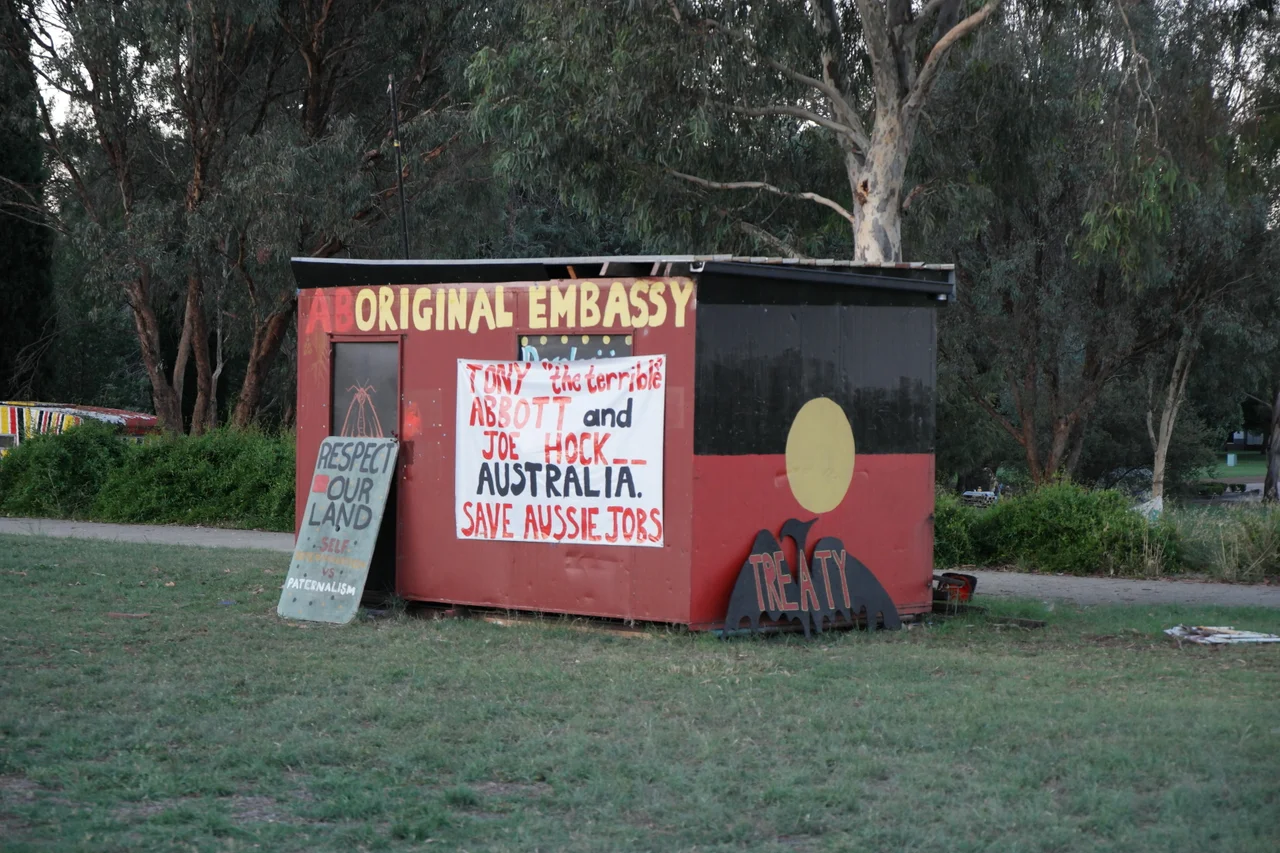

Aboriginal Tent Embassy
It began with a beach umbrella. On 26 January 1972, the date white Australia calls Australia Day, four young Aboriginal men, Michael Anderson, Billy Craigie, Tony Coorey and Bertie Williams, drove down from Sydney, walked onto the lawn in front of Parliament House in Canberra, and pushed an umbrella into the grass. Williams suggested they call their little camp an embassy. The word was a deliberate provocation. Every other people in Australia had an embassy; the First Peoples, who had never signed a treaty and never ceded their land, did not. More than fifty years later, the Aboriginal Tent Embassy is still there, the longest running protest for Indigenous land rights anywhere on Earth.
Why an Umbrella Became an Embassy
The protest had a precise trigger. In April 1971, a judge had ruled against the Yolngu people in the Gove land rights case, declaring in effect that Aboriginal people belonged to the land but the land did not belong to them. Then, on the eve of Australia Day 1972, Prime Minister William McMahon announced a policy that offered leases rather than land rights, a door quietly closing. For a generation that had watched the Gurindji walk off Wave Hill station and had marched against apartheid and the Vietnam War, it was the final insult. The embassy answered law with theatre. Calling a tent an embassy made a sharp point: Aboriginal people were being treated, as activist Gary Foley later put it, like aliens in their own land.
Six Months That Woke a Country
The umbrella was soon a cluster of tents, and the camp drew activists who would shape Aboriginal politics for decades: Foley, Isabell Coe, John Newfong, Chicka Dixon, Kevin Gilbert, the beloved Shirley Smith known as Mum Shirl. They printed their own newspapers because the mainstream press would not carry their words. The story reached The New York Times and the BBC, and the world began comparing Australia's treatment of its First Peoples to South African apartheid. In July 1972, after the government amended the law to make the camp an illegal squat, police moved in and tore it down. Three days later two hundred activists returned, met by two hundred officers. In barely six months, a few tents had united Aboriginal Australia behind a single demand for national land rights and pulled a wave of non-Indigenous support along with it.
Torn Down, Always Returning
The embassy refused to stay gone. It was removed, relocated, and re-erected through the 1970s, its pressure helping carry the Aboriginal Land Rights Act of 1976 into law. On the twentieth anniversary in 1992, it returned for good to the lawns of what is now Old Parliament House, and a sacred fire was lit there in 1998 that has become its heart. The site has weathered eviction attempts, official reviews, and suspicious fires, and it has answered with defiance and occasional dark humour. When Prime Minister Julia Gillard lost a shoe fleeing a 2012 protest nearby, the embassy joked online that she could have it back in exchange for stolen land. The shoe went back. The demand did not.
Still We Rise
Half a century on, the camp on the grass opposite the old Parliament remains a working centre of Aboriginal sovereignty rather than a monument to it. Its anniversaries draw thousands. Ghillar Michael Anderson, the last surviving member of that original 1972 party, still speaks at its gatherings. Filmmakers keep returning to it: the 1972 documentary Ningla A-Na captured the police marching on the first protesters, and the 2022 film Still We Rise, made by Torres Strait Islander director John Harvey, gathered the elders to mark fifty years. The embassy's endurance is its argument. It stands as an unhealed reminder that the question it raised under a beach umbrella, the question of unceded sovereignty, has never been answered.
From the Air
The Aboriginal Tent Embassy sits on the lawn opposite Old Parliament House in Canberra's Parliamentary Triangle, at 35.30 degrees south, 149.13 degrees east, elevation roughly 1,900 feet. From the air it is a cluster of tents on green grass between the white Old Parliament House and the flag-masted new Parliament House on Capital Hill, with Lake Burley Griffin and the Anzac Parade axis nearby for orientation. Canberra Airport (YSCB) lies about 7 kilometres east; note that the Parliamentary Triangle is restricted airspace, so this is a landmark to identify rather than overfly. Clear, calm conditions over the inland capital give the best view.
Nearby Stories
- Mount Kosciuszko summit trails 69 km away
- Hive shipwreck 79 km away
- Snowy Mountains Scheme 89 km away
- Wollongong 119 km away
- Murray River 179 km away
- Royal National Park 191 km away
- Warangesda Aboriginal Mission 250 km away
- 2003 Fiordland Earthquake 1800 km away