
Adelaide Fringe
For four weeks every Australian summer, Adelaide stops being a quiet, well-mannered city and becomes something else entirely. Spiegeltents rise in the parks. A fenced garden fills with circus tents, cabaret bars, and the smell of fried food. Comedians, acrobats, magicians, puppeteers, and musicians - more than seven thousand of them, from across Australia and the world - pour into theatres, pubs, warehouses, laneways, and disused buildings. Locals call this stretch "Mad March," and they mean it fondly. This is the Adelaide Fringe, the largest arts festival in the Southern Hemisphere and the second-largest annual fringe on Earth, behind only Edinburgh.
Born on the Edge
The Fringe began, as fringe festivals do, by crashing someone else's party. In 1960, when Adelaide launched its official Festival of Arts, local artists started staging their own unofficial events alongside it - a scrappy, uninvited shadow program. By 1962, observers were already arguing that these "ancillary" activities mattered as much as the official ones. The unofficial events kept growing, became an incorporated body in 1975 under founding chairman Frank Ford, and ran for years under shifting names - Focus, the Adelaide Festival Fringe, the Adelaide Fringe Festival - before settling, in 2000, on simply the Adelaide Fringe. What started as an afterthought to the main festival long ago outgrew it.
No One Is in Charge
The Fringe's defining principle is that nobody curates it. It is an open-access festival: there is no selector deciding which shows are worthy, no gatekeeper turning artists away. If you can find a venue and register, you are in the program, whether you are a touring international headliner or a first-timer with an hour of jokes and a borrowed room. That openness is the whole point. It means the program is enormous, uneven, surprising, and democratic - a sixteen-year-old's school play listed a few pages from a sold-out cabaret star. The festival sprawls across cabaret, comedy, circus, physical theatre, dance, film, theatre, puppetry, music, visual art, and magic, with free events running alongside ticketed ones for the entire month.
Gardens and Gluttony
Because Adelaide's centre is compact and ringed by parklands, the Fringe clusters into temporary "venue hubs" carved out of the green. The Garden of Unearthly Delights began in 2000 with a single Spiegeltent in Rundle Park and was officially born as a hub in 2002; today it is the festival's beating heart, a fenced wonderland of tents and bars. Across the road, Gluttony does much the same in Rymill Park. Beyond them, buskers work Rundle Mall, and established rooms like the Holden Street Theatres, the Odeon, and the live-music venue affectionately known as "The Gov" fill with shows. Half of all ticket sales come from small venues - proof that the Fringe's scale rests on its smallest acts as much as its biggest names.
A Million Tickets
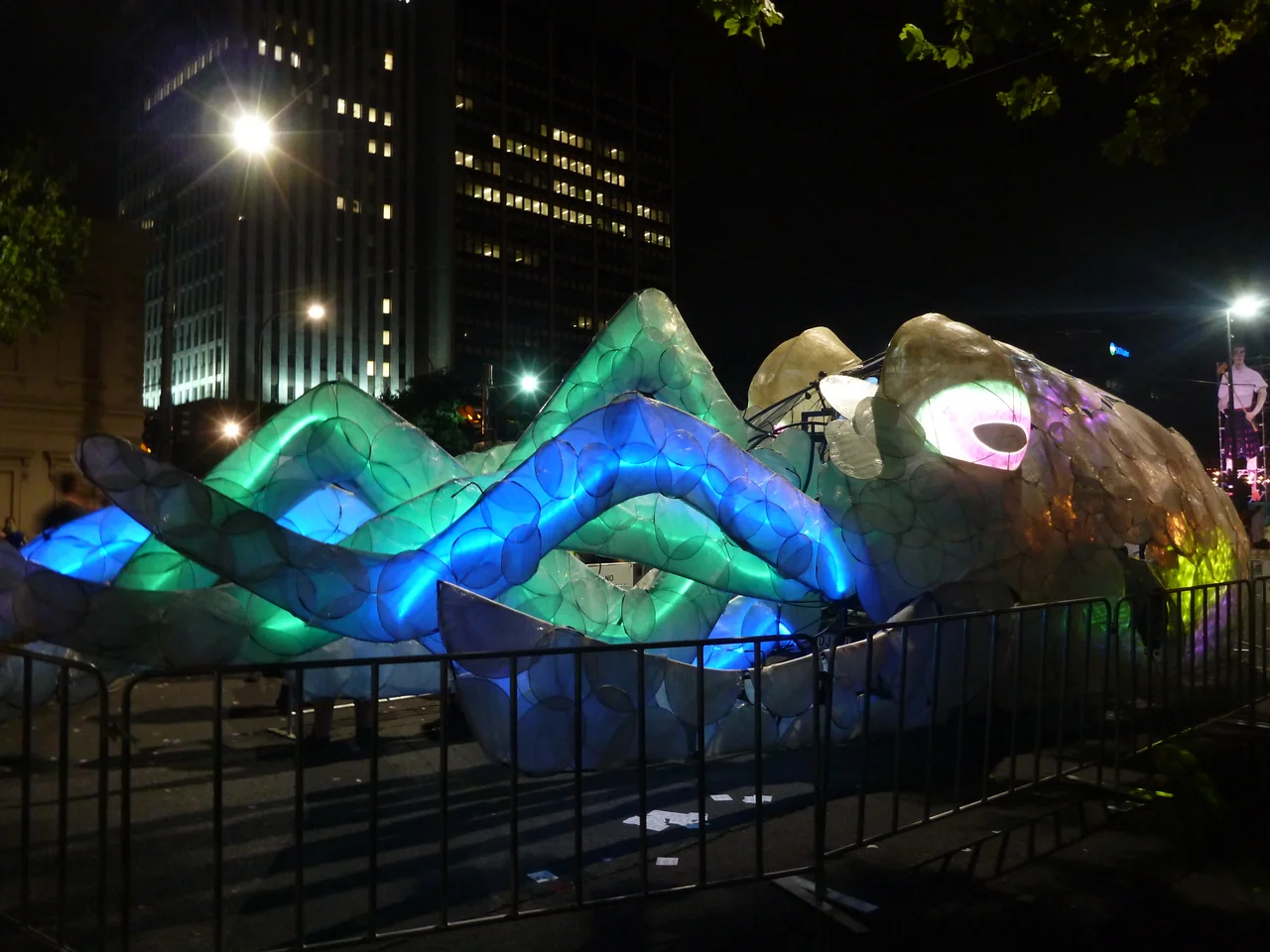
The numbers have become staggering. In 2023, the Adelaide Fringe became the first festival in Australia ever to sell more than one million tickets - 1,000,916 of them - and poured an estimated 105.5 million dollars into the South Australian economy. Through the COVID years of 2020 and 2021, when much of the world's live arts went dark, Adelaide's relative safety let the Fringe carry on, briefly making it the largest arts festival on the planet. It even has mascots: a thirteen-metre street puppet called Stobie the Disco Cuttlefish in 2014, eight giant inflatable astronauts for the fiftieth anniversary in 2010. From a handful of uninvited artists in 1960, the Fringe has grown into a month-long argument for the idea that art belongs to everyone willing to make it - and that a small city, for a few wild weeks, can be the most exciting place to be.
From the Air
The Adelaide Fringe takes over central Adelaide, South Australia, around 34.92 degrees south, 138.60 degrees east, with its main venue hubs in the parklands ringing the city centre - the Garden of Unearthly Delights in Rundle Park and Gluttony in Rymill Park on the east side. From the air, Adelaide is famously legible: a planned grid of wide streets wrapped entirely in a green belt of park lands, the River Torrens curving through, and the Mount Lofty Ranges rising to the east. Adelaide Airport (YPAD) lies about 6 km west of the centre, placing the whole city in controlled terminal airspace - clearance is required for any low approach. Best viewed at 2,000 to 3,000 feet; expect calm, hazy summer mornings during the February-March festival season.
Nearby Stories
- Barossa Valley 26 km away
- Hindmarsh Island Bridge Controversy 40 km away
- Coorong National Park 104 km away
- Kangaroo Island 106 km away
- Baudin expedition to Australia 175 km away
- Avenue Range Station massacre 219 km away
- Port Augusta 240 km away
- Radium Hill 292 km away