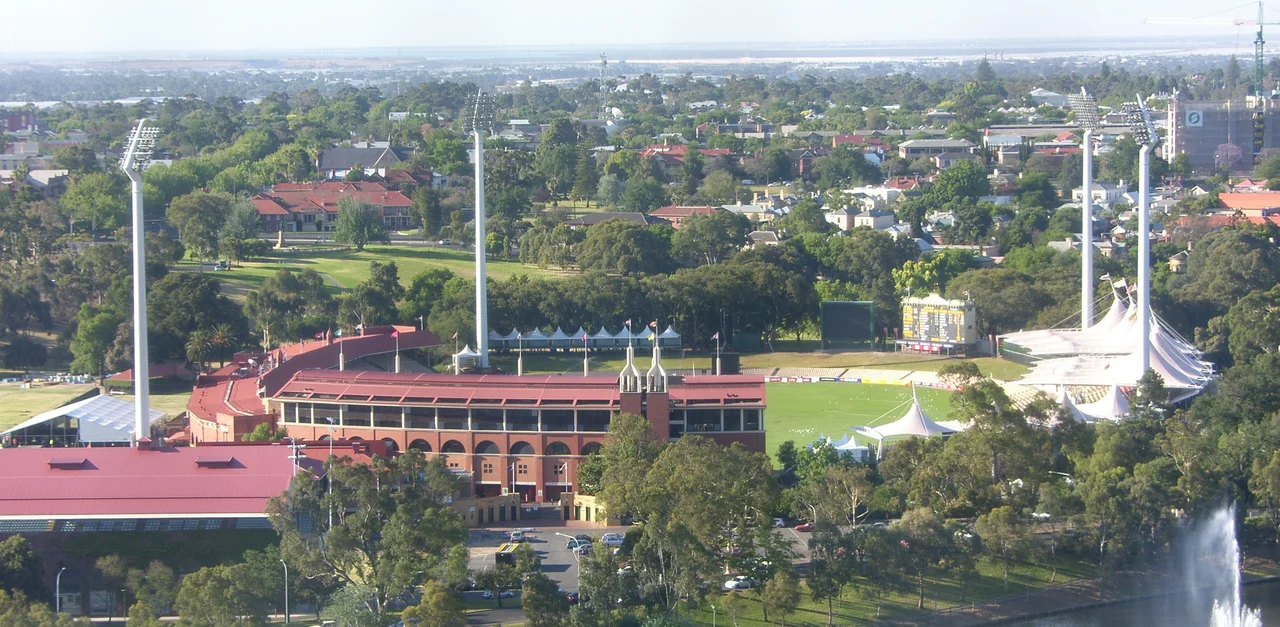

Adelaide Oval
A man climbs four storeys of timber to change the numbers by hand, slotting painted plates into a scoreboard that has done the same job since 1911. While stadiums everywhere have switched to LED panels, Adelaide Oval keeps its heritage scoreboard, known to locals as The Old Girl, working alongside the digital screens. Below it spread the green slopes of The Hill and a stand of Moreton Bay fig trees planted in the 1890s. Established in 1871 in the parklands beside the River Torrens, the Oval has been called one of the most beautiful Test cricket grounds on earth. It has also seen mounted police clear a furious crowd and watched Don Bradman build some of his most famous innings.
The Old Girl
Architect F. Kenneth Milne designed the scoreboard, and it began service in 1911. More than a century later it is one of the world's last manually operated scoreboards still in regular use at a major cricket ground. During play, a crew works inside its four levels, hauling number plates into place to track every run, wicket, and bowling change in the intricate detail the old boards were built for. There is a charming constraint to the thing: names are limited to ten letters, so longer surnames get truncated or swapped for nicknames on the board. When the rest of the Oval was rebuilt between 2012 and 2014, the scoreboard, the grassy Northern Mound, and the Moreton Bay figs were deliberately left untouched, the past anchoring the new.
Bodyline at Boiling Point
In the summer of 1932, Adelaide Oval became the flashpoint of cricket's ugliest controversy. England's bowlers were aiming fast, short deliveries at the bodies of Australian batsmen, a tactic the press dubbed Bodyline. When Australia's captain Bill Woodfull was struck over the heart and wicketkeeper Bert Oldfield had his skull fractured by a ball from Harold Larwood, the crowd of nearly 51,000 turned dangerous. Mounted police patrolled the boundary on the third day to keep order. The series strained relations between Australia and England to the point of diplomatic cables. It remains one of the most studied moments in the sport, and it happened here, in front of a record cricket crowd that nearly boiled over into a riot.
Bradman's Ground
Few grounds carry as much cricket history per square metre. In 1931, Don Bradman scored 299 not out against South Africa here, for decades the highest Test score made at the Oval. The first Test match on the ground was played in 1884, when England beat Australia, and the venue has hosted firsts ever since: the first day-night Test in 2015 against New Zealand, the first day-night Ashes Test in 2017. In 1992 the West Indies beat Australia by a single run, the narrowest victory in the history of Test cricket, decided when a bouncer brushed a glove. In December 2025, a record cricket crowd of 56,298 packed in for the opening day of an Ashes Test, part of more than 223,000 spectators over five days who watched Australia retain the urn.
More Than Cricket
The Oval has never belonged to one sport. Australian rules football was played here from 1877, and the ground's record crowd of any kind, 62,543, came for the 1965 SANFL Grand Final when Port Adelaide beat Sturt by three points. After decades away at a suburban stadium, AFL football returned to the Oval in 2014, and the AFLW Grand Final has been held here too. The ground has hosted rugby league and union, soccer matches against Liverpool and Manchester sides, and the 1888 visit of American baseball teams brought to Australia by Albert Spalding. Concerts have filled it since Fleetwood Mac played in 1977, with David Bowie, Paul McCartney, Madonna, and the Foo Fighters following over the years.
Gates and Memory
At the south-eastern corner, off King William Road, stand the Victor Richardson Gates, five iron gates raised in 1967 to honour the South Australian cricketer and footballer. They carry bronze reliefs by sculptor John Dowie showing footballers leaping for a mark and cricketers at the crease, the batsman modelled on Richardson himself. His grandsons Ian and Greg Chappell, themselves Test cricketers, helped form the guard of honour at the opening. Since 2021, the Bradshaw Bell, cast in Victoria and named for a former cricket administrator, has been rung to start each day of a Test. These small ceremonies tie the modern stadium to its long memory, the same memory the old hand-cranked scoreboard keeps changing, one number at a time.
From the Air
Adelaide Oval lies at 34.916 degrees south, 138.596 degrees east, in the North Adelaide parklands immediately across the River Torrens from the city centre. From the air the ground is unmistakable: a broad green oval ringed by white grandstand roofs, with the Torrens curling along its southern edge and the footbridge linking it to the Adelaide railway station precinct. Adelaide Airport (ICAO YPAD) sits about six kilometres southwest, and Parafield Airport (YPPF) lies roughly fourteen kilometres north. Adelaide's clear, dry summers offer excellent visibility; viewed from two to three thousand feet, the oval and the green belt of parklands stand out crisply against the surrounding grid of streets.
Nearby Stories
- Barossa Valley 26 km away
- Hindmarsh Island Bridge Controversy 40 km away
- Coorong National Park 104 km away
- Kangaroo Island 106 km away
- Baudin expedition to Australia 175 km away
- Avenue Range Station massacre 219 km away
- Port Augusta 240 km away
- Radium Hill 292 km away