
Aegean Maritime Museum
Most museums put history behind glass. The Aegean Maritime Museum decided to switch some of it back on. In a garden in the heart of Mykonos town stands the Armenistis Lighthouse, built in 1890, restored to working order rather than left as a hollow relic. It was the first time a Greek museum had brought living historical exhibits back to the condition for which they were originally built. The idea is simple and quietly radical: a lighthouse is not really a lighthouse if its light is dead, and a sailing ship is not a ship if it cannot float.
One Man's Mission
The museum exists because of George M. Drakopoulos, who founded it as a non-profit institution in 1983 and opened its doors to the public in 1985. He set it up inside a 19th-century Mykonian building in Tria Pigadia, in the town center, where the whitewashed walls and narrow lanes feel of a piece with the seafaring past on display. Drakopoulos did not approach the work as a hobbyist. For founding the museum he received the Athens Academy Award and the World Ship Trust's Award for Individual Achievement, recognition that a single person had done what institutions usually take to mean a national effort. His specialty was narrow and deliberate: the merchant-ship history of the Aegean Sea, the working vessels that carried goods and people between the islands for centuries.
Ships That Still Float
The museum's commitment to living restoration goes beyond the lighthouse in the garden. Two historic ships belong to its collection: the Thalis o Milesios, built in 1909, and the Evangelistria, built in 1940, both restored as they were originally designed and now kept at the Naval Tradition Park in Palaio Faliro, near Athens. These are not models or scale replicas but actual vessels, given back their seaworthiness. To restore a ship to floating condition is a different order of work than dusting an artifact in a case. It means rope and tar and timber, the same skills the original builders used, kept alive by people willing to learn them again.
From Gorgons to Heroines
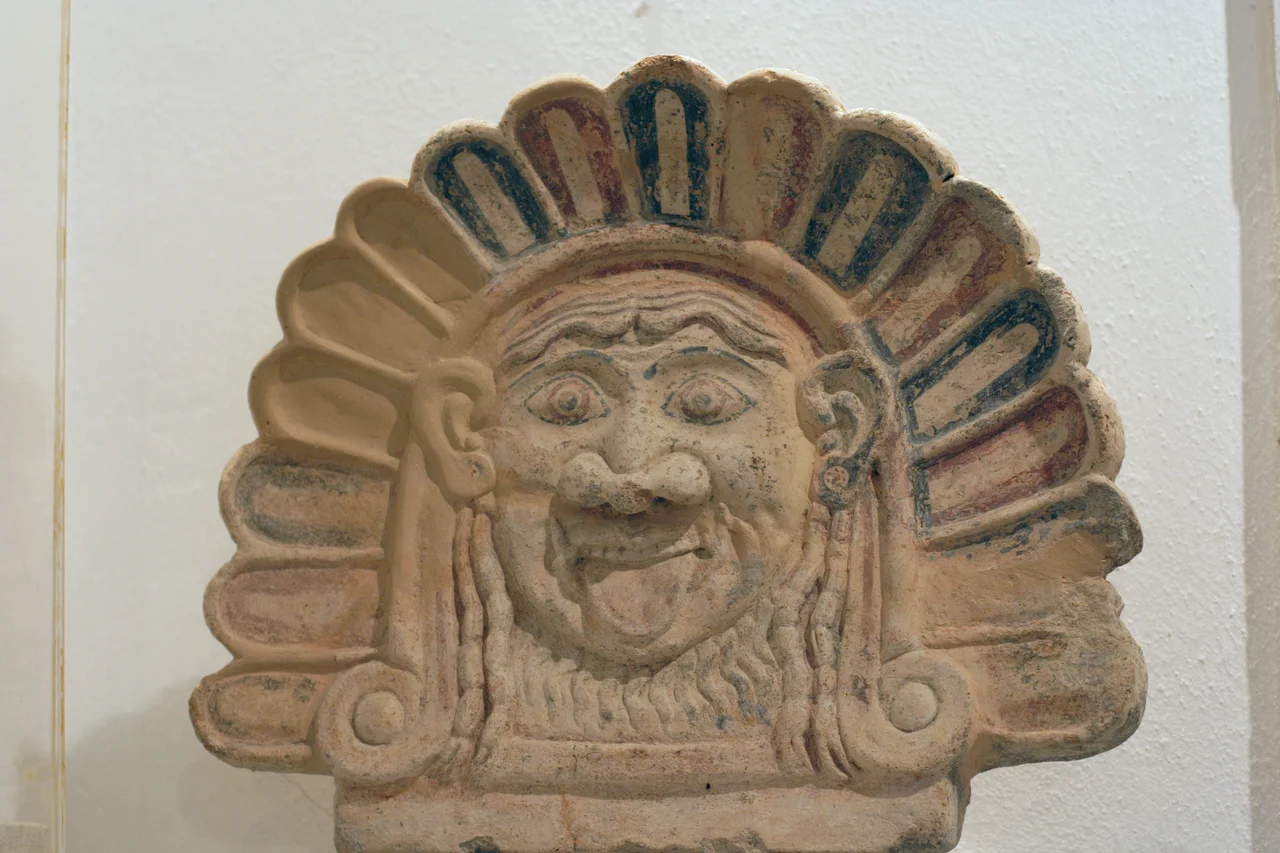
Inside, the collection reaches far past the age of steam. There is an antefix from the 6th century BC, the carved ornament from the eaves of a temple, bearing the face of a Gorgon. There is the tomb of a sailor, probably from Roman times, a reminder that the Aegean has been claiming and honoring its mariners for thousands of years. The walls also remember two women who shaped Greek maritime history during the War of Independence: Manto Mavrogenous, the Mykonian heroine who spent her fortune arming ships for the revolution, and Laskarina Bouboulina, who commanded vessels in battle. In a museum devoted to the working sea, their portraits insist that the story of these waters was never only a story of men.
From the Air
The Aegean Maritime Museum sits in central Mykonos town at roughly 37.445°N, 25.328°E, in the Tria Pigadia quarter near the Old Port. From the air, Mykonos is unmistakable: a low, treeless Cycladic island dense with white buildings, ringed by famous beaches, with its iconic windmills above the waterfront. Mykonos Airport (LGMK) lies just south of town; Naxos (LGNX), Paros (LGPA), and Santorini (LGSR) are all short hops away across the Cyclades.
Nearby Stories
- Andros 5.1 km away
- Chalandriani 5.7 km away
- Kouros of Apollonas 11 km away
- Ikaria 15 km away
- Archaeological Museum of Sifnos 38 km away
- Emporio, Chios 44 km away
- Archaeological Museum of Andros 49 km away
- Astypalaia 83 km away