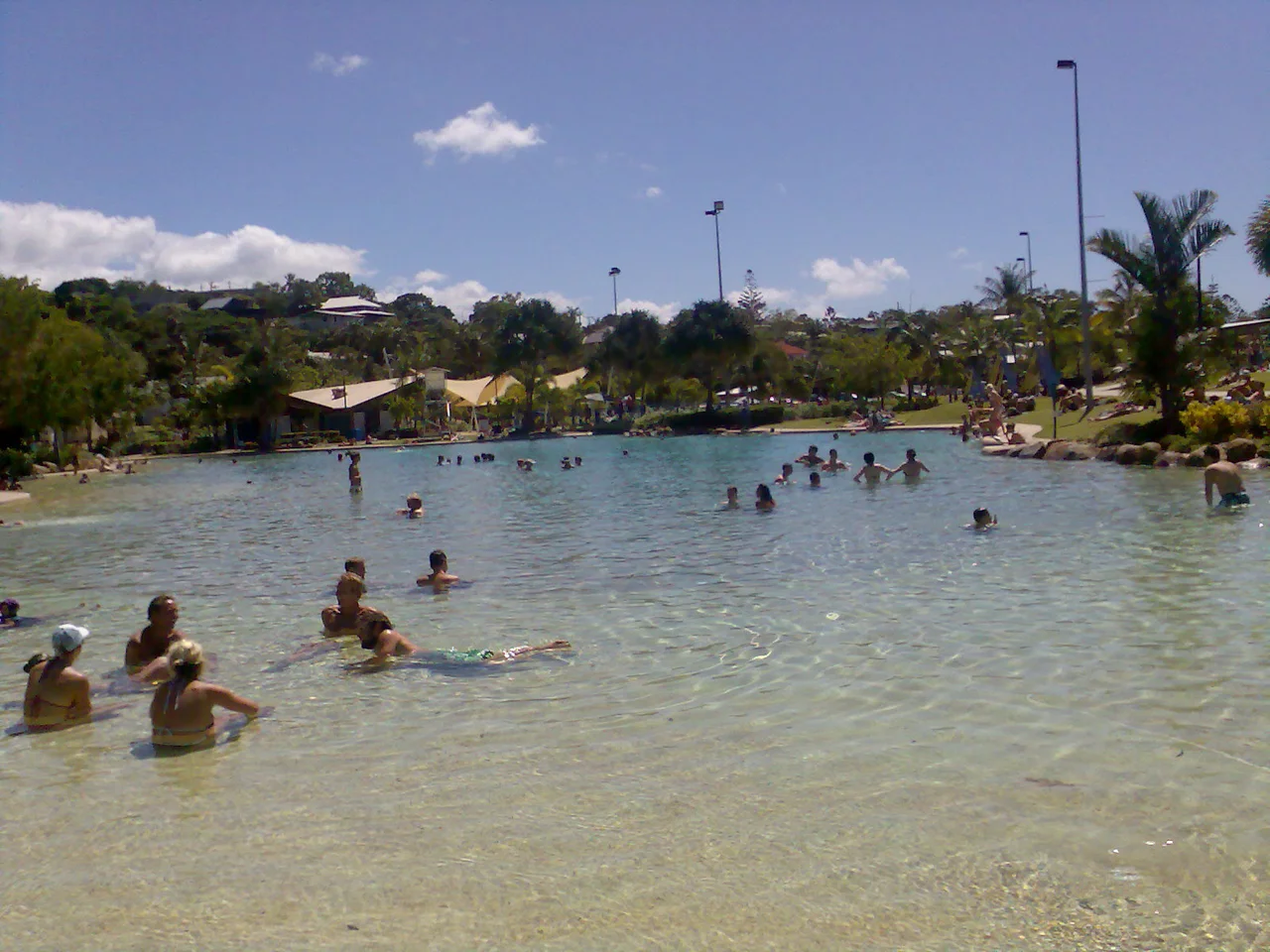

Airlie Beach
Airlie Beach has a secret that the name tries hard to hide: it is not really about the beach. The town's own foreshore is a thin, pretty thing, and for half the year nobody swims off it, because from October to May the water fills with box jellyfish and the far deadlier irukandji. So Airlie did something unusual. It built a beach of its own. The foreshore lagoon, opened in 2001, is a free, lifeguard-watched pool of more than four and a half million litres, landscaped with lawn and a footbridge, where you can float in safety while looking out at the very ocean you cannot enter. Almost everything about Airlie makes sense once you understand that the town is not a destination so much as a launch pad.
The Gateway
Pull back the map and Airlie Beach reveals its real purpose. It is the closest mainland port to the Whitsunday Islands and the Outer Great Barrier Reef, and the whole town leans toward the water as a result. The marina sits a brisk fifteen-minute boardwalk stroll from Shute Harbour Road, the high street, and from its berths the day boats fan out each morning toward Whitehaven, Hook Island and the reef beyond. Some 25,000 people live here, but the daytime population breathes in and out with the tides of sailing charters and dive trips. By morning the marina empties; by late afternoon it fills again with sunburnt arrivals comparing notes on the day's reef.
Backpacker Boomtown
For decades Airlie was a name whispered along the east-coast trail, a scruffy, cheerful waypoint where travellers between Brisbane and Cairns stopped to crew a sailing trip or simply to rest. Then the rest of Australia found it. The hostels are still here, stacked along the main road with their cheap beds and louder nights, but they share the strip now with smarter resorts and waterfront restaurants. Something of the old wanderer energy survives. On Saturday mornings a market unfolds along the waterfront, full of local food and crafts, and the foreshore fills with the particular crowd a sailing town attracts: half of them about to leave, half of them just back, all of them talking about the islands.
Cast Off
Sailing is the reason most travellers come, and the Whitsundays are made for it: 74 islands strung across sheltered, reef-protected water, navigable by people who have never crewed a boat in their lives. Airlie is the heart of Australia's bareboat charter trade, where you can rent a yacht without a skipper and island-hop for days, anchoring off empty beaches each night. There is one firm rule the sea keeps. Bareboats are forbidden by law from sailing out to the Outer Great Barrier Reef itself, which requires a licensed vessel and a qualified local skipper, so the truly far reef, Hardy Reef, Heart Reef and the rest, is reached on a day boat or a scenic flight lifting off from the edge of town. Whatever the vessel, the pattern is the same: Airlie is where the journey starts.
Up to the Lookout
The best view of the Whitsundays from the mainland is not from the marina at all but from above the town. A walking track climbs through the national park behind Airlie, a steady ninety-minute pull through dry tropical forest to a lookout that opens onto the whole scattered archipelago, the harbour glittering below and the green humps of the islands strung out toward the horizon. From up here the geography clicks into place. You see why the boats go where they go, how the sheltered passages thread between the islands, and just how close that famous water really is. Then you walk back down, because in Airlie the lookout is never the point. The boat leaves in the morning.
From the Air
Airlie Beach lies at 20.27 degrees south, 148.72 degrees east, on the central Queensland coast facing the Whitsunday Passage. From the air the town wraps a small bay, with the marina and its breakwater on the western side and the green ridge of Conway National Park rising immediately behind. The Whitsunday Islands scatter offshore to the east. The nearest airport is Whitsunday Coast (Proserpine) Airport (YBPN), about 35 kilometres southwest, served by Virgin Australia and Jetstar; Hamilton Island Airport (YBHM) lies offshore to the southeast. Approach by day for the best read of the passage; expect afternoon convection and reduced visibility during the November-to-April wet season, and brisk southeasterly trade winds through the cooler months.
Nearby Stories
- Bowen 13 km away
- Cape Hillsborough National Park 39 km away
- Collinsville, Queensland 60 km away
- Great Barrier Reef 92 km away
- Pine Islet Light 147 km away
- Brigalow Belt 160 km away
- Coral Sea Islands 188 km away
- Canal Creek Air Crash 317 km away