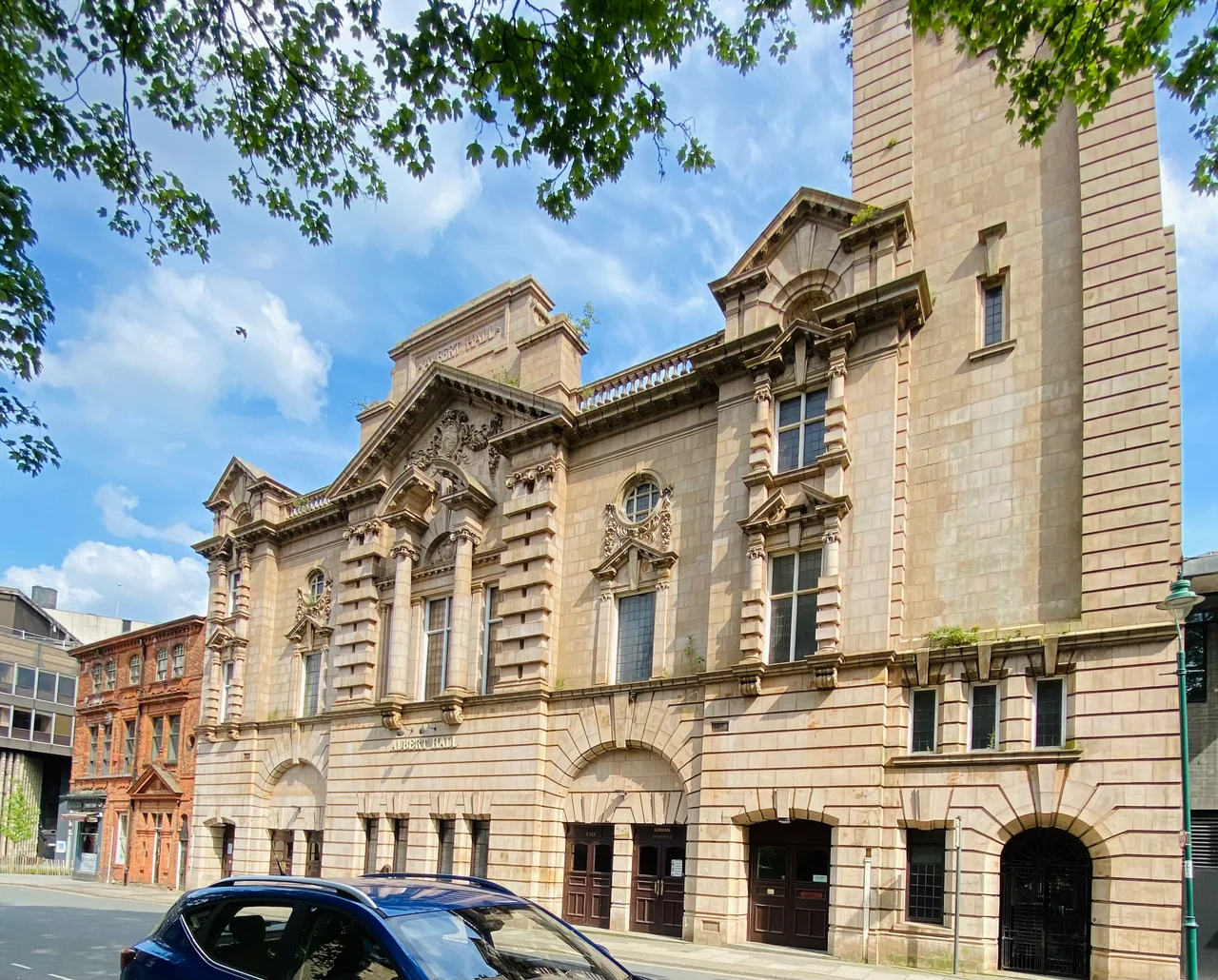

Albert Hall, Nottingham
On 9 October 1970 a young band called T. Rex played the Albert Hall in Nottingham. Three months later, on 19 January 1971, Black Sabbath brought the Paranoid tour to the same stage. Six years before that, on 2 March 1964, the Rolling Stones had played their second British tour there. And on 21 March 1938, Sergei Rachmaninoff sat at its piano for an evening recital. The building had been put up to keep working-class Nottingham off the drink. By the time the rock bands arrived, almost no one remembered that.
Temperance and Watson Fothergill
The original Albert Hall went up in 1873 as a Temperance Hall - one of the wave of municipal alcohol-free entertainment venues that the Victorian temperance movement had been building since the 1830s, an attempt to give the urban working class somewhere to spend their evenings that was not a pub. Watson Fothergill, Nottingham's distinctive Gothic Revival architect, won the commission. The hall opened on 26 September 1876 with the Mayor of Nottingham presiding, even though the entrance hall and corridors were not yet finished and the gas lighting was temporary. It cost about £15,000, which proved more than the temperance society could service. Financial crises followed almost immediately. By 1901 the hall was on the market. A syndicate of local businessmen bought it for £8,450 and reopened it in September 1902 as a Wesleyan Methodist mission. The drink-free principle survived the change of owner.
Fire and Florence Boot
On 22 April 1906 the building burned. The Methodists, examining the wreckage, discovered they had been under-insured. They turned to one of their own, the architect Albert Edward Lambert - the man responsible for Nottingham's Midland railway station - and asked for something new. Lambert produced an Edwardian theatre dressed up as a Methodist mission, dedicated on 17 March 1909 and officially opened on 15 September 1910 by Lady Florence Boot, wife of Jesse Boot of the chemist's chain. The cost had risen to £40,000. From the day it opened, the hall did both jobs at once: Wesleyan worship on Sunday, concerts and meetings the rest of the week. It was the largest concert venue in Nottingham, and it stayed the largest until 1982.
The Guest List
The names move chronologically through the twentieth century. Yehudi Menuhin in 1934, only eighteen and already touring as a violinist. Sir Oswald Mosley addressing the British Union of Fascists in March 1936, seven months before Cable Street and three years before the war that would discredit him for good. Rachmaninoff at the piano in 1938. Benjamin Britten conducting the London Philharmonic in 1945, then returning in 1952 with Peter Pears and Kathleen Ferrier - the contralto whose voice Britten said was the greatest of his generation, dead from cancer the following year. Then the bands: the Stones, Jethro Tull, T. Rex, Black Sabbath, Tangerine Dream. Then the politicians: Margaret Thatcher in 1989, John Major in 1992, Tony Blair in 2006, Gordon Brown bringing his Cabinet to the East Midlands for the first time in 2009. Benazir Bhutto spoke to Nottingham's Pakistani community on Independence Day in 2003, five years before her assassination. Each generation thought it was the headline act.
The City Organ
Jesse Boot - by then the first Baron Trent - gave the Hall its organ in 1909. Built by J.J. Binns at a cost of £4,500, it was billed as the City Organ, intended as a gift to Nottingham as much as to the Methodists. The Italian and Spanish walnut casework was made in the Boots shop-fitting workshop in the city; the carving was by Fitchett & Woollacott. Harrison & Harrison restored it in 1993, under the direction of David Butterworth, paid for by a group of enthusiasts who called themselves the Binns Organ Company. The British Institute of Organ Studies later gave the instrument a Grade 1 listing, the highest historic-organ designation - reserved for organs of outstanding historic and musical importance in essentially original condition.
From Mission to Multipurpose
The Methodist mission closed in 1982, the congregation merging with Parliament Street Methodist Church. Nottingham City Council bought the hall in 1987 and refurbished it, inserting a floor at the level of the front of the circle to create a separate ground-floor hall and linking the building to the neighbouring Nottingham Playhouse so the two could share a bar. Diana, Princess of Wales unveiled a plaque on 23 February 1989 to mark the work. The Playhouse ran the hall until 1990, when Nottingham City Council leased it to Albert Hall Nottingham Ltd as a commercial conference and entertainment venue. Today it offers the Great Hall and ten smaller conference rooms, hosts orchestras and corporate events, and still sounds the City Organ on Sundays for the occasional recital. From temperance hall to fascist rally to Black Sabbath concert to Prime Minister's address - all on the same stage, all to the same accidental music of a city changing around the building.
From the Air
The Albert Hall is at 52.95°N, 1.16°W in central Nottingham, on North Circus Street west of the Old Market Square, alongside Nottingham Playhouse. From cruise the city sits in the Trent valley with Nottingham Castle on its sandstone outcrop immediately south of the hall. East Midlands Airport (EGNX) is 8 nm southwest, Nottingham Airport (EGBN) is 5 nm east-southeast. Recommended viewing altitude 1,500-2,500 ft AGL. The hall's distinctive Edwardian profile is just west of the city's main civic block.
Nearby Stories
- Rutland Railway Museum 2.4 km away
- Welbeck Abbey 5 km away
- Lichfield rail crash 6 km away
- Peveril Castle 8.8 km away
- Grantham Rail Accident 11 km away
- Croxden Abbey 11 km away
- RAF Scampton 11 km away
- Leicester Abbey 11 km away