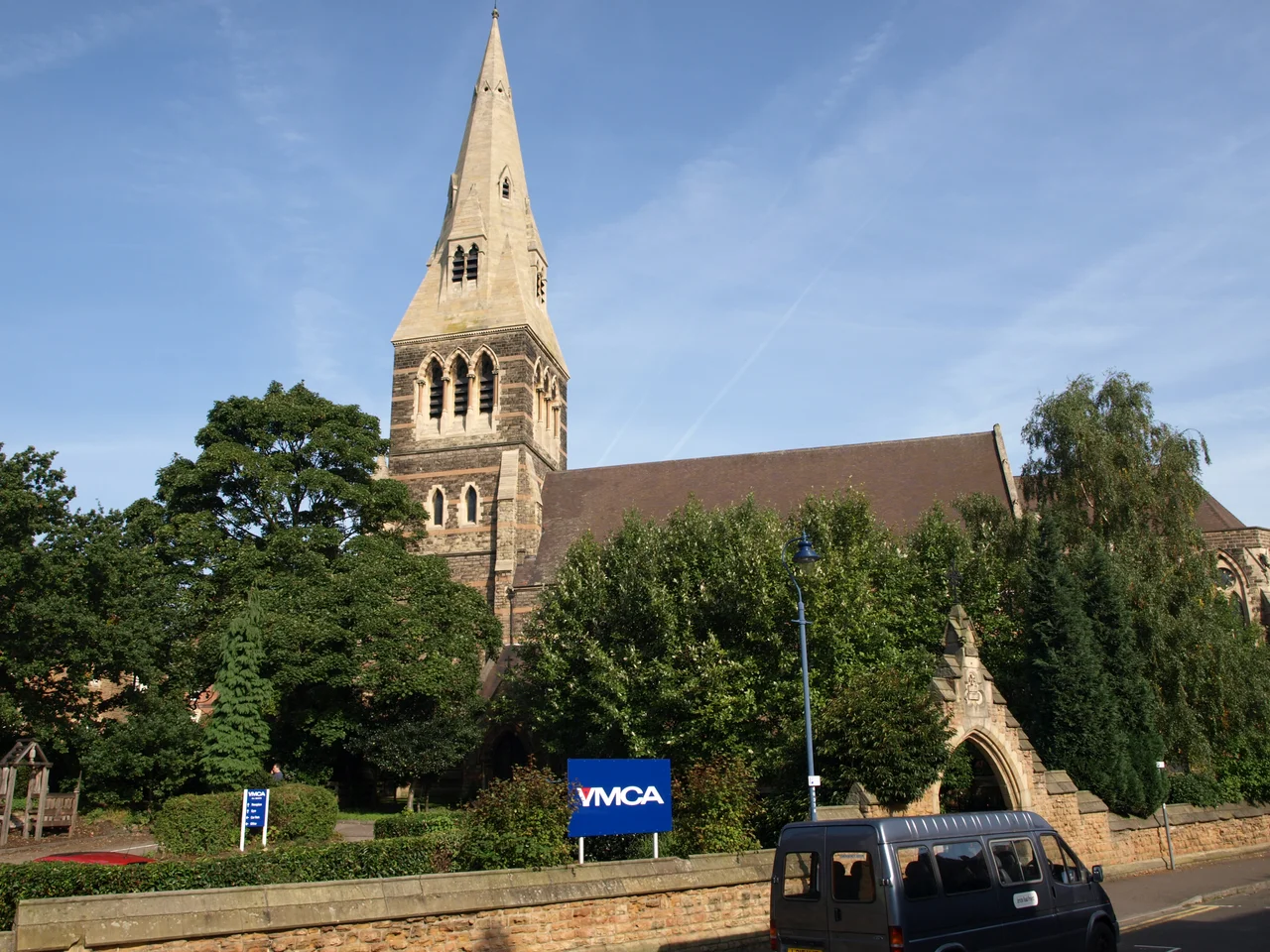

All Saints' Church, Nottingham
In 1830 cholera came to Nottingham. The wealthier families fled the old crowded centre of the city for higher ground, settling on a new suburb above the Sandfield - a green strip on the northern edge of town where the air was thought to be safer. Within thirty years they needed a church. All Saints' was the answer: a Gothic Revival nave consecrated in 1864 with money from a single philanthropist, a 175-foot broach spire, and ten bells cast in Loughborough. The cholera epidemic that built the parish has been gone for a century and a half. The bells nearly stopped ringing in 2019, defeated by pigeon droppings.
Built by One Man
William Windley, a Nottingham JP and silk manufacturer, paid for the church himself. The building alone cost about £10,000; with the parsonage and the church school added, his total bill came to roughly £25,000 - a sum that would buy several large London houses at the time. He commissioned Thomas Chambers Hine, the same Nottingham architect who designed the Adams Building in the Lace Market, and Hine produced a confident Gothic Revival church in sandstone. The nave seats five hundred. The broach spire rises 175 feet above the surrounding rooftops, the eighth-tallest structure in the city. Inside, ten bells hang in the tower, the heaviest weighing sixteen hundredweight. They were originally six, cast by John Taylor & Co of Loughborough on an oak frame in 1864, then expanded to make room for an eight; the modern peal of ten arrived with the 1999 rehang.
Consecration Day
On 3 November 1864 the church was consecrated. The Right Reverend John Jackson, Bishop of Lincoln, came up to perform the service - the new Diocese of Nottingham would not be created for another fourteen years. The 800-seat church was packed: 1,200 people crammed in. The choir of St Mary's Church across town sang, accompanied by Miss Fanny Brookes on the harmonium, because the church's own organ had not yet been built. The new pastor, Joshua William Brooks, took possession of his parish in front of the largest congregation it would ever hold. The first organ was installed the following summer, built by Lloyd & Dudgeon of Nottingham and opened on 6 July 1865. The current instrument is a Norman and Beard of 1906.
From Wealthy Suburb to Urban Priority Area
The wealthy suburb did not stay wealthy. The Industrial Revolution swallowed the green spaces between All Saints' Parish and the old city centre; by the late nineteenth century the parish was indistinguishable from the urban grid around it. The Second World War accelerated the decline. By the 1980s the area around the church was designated an Urban Priority Area, the official label given to England's poorest inner-city neighbourhoods. The parsonage that had once housed a single vicar's family was converted in the early 1980s into shared housing for young single people. The old church school, closed since the 1920s, became small workspaces, then in 2006 the New Deal for Radford bought it for community use. Sunday-morning congregations at All Saints' fell to thirty or forty. The church was merged with St Peter's in 2002 and then with St Mary's in 2007 to form a single combined parish covering three of Nottingham's oldest church buildings.
The Bells Stop, the Bells Return
On 19 May 2019, ringers at All Saints' fell silent. Damage to the spire had allowed pigeons into the bell tower, and the floor above the bells had rotted from years of accumulated guano. About 2.2 tons of bird waste was eventually removed during the restoration that followed. The Nottingham University Society of Change Ringers took on the project with the church's support: a complete clean of the tower, the dismantling of the old floor, and the construction of a new load-bearing platform above the bells designed to support any future spire repairs and to control sound output. The ringing chamber itself was refurbished. On 8 February 2020 the bells were heard again during a test ring, and three days later, on 11 February, they were officially handed back to the ringers. The first proper peal in nine months rang out into the streets of Hyson Green and Arboretum ward.
Survival
There is no permanent vicar now and no regular organist; a team of musicians under Peter Siepmann, the Director of Music, rotates between All Saints' and St Peter's. Sunday services continue. The parish is exploring shared uses for the building - the kind of arrangement that English churches across the country are negotiating as small congregations meet large maintenance bills. The William Windley who paid for all of this in 1864 has been dead for well over a century. The names of the incumbents he installed run on a list inside: Edwin Gyles, Alfred Pearson, Hubert Arnold Gem, Thomas Wilson Windley (the founder's son, who took the parish in 1902). The church has outlived nearly everyone who knew why it was built. The ten bells, when they ring, are louder than they used to be.
From the Air
All Saints' Church is at 52.96°N, 1.16°W in the Hyson Green and Arboretum ward of Nottingham, just north of the city centre. The 175-foot broach spire is the most obvious landmark in the immediate area. From cruise the church sits in the dense Victorian terraced grid between Forest Road West and the Nottingham Arboretum. East Midlands Airport (EGNX) is 9 nm southwest, Nottingham Airport (EGBN) is 5 nm east-southeast. Recommended viewing altitude 1,500-2,500 ft AGL.
Nearby Stories
- Rutland Railway Museum 2.4 km away
- Welbeck Abbey 5 km away
- Lichfield rail crash 6 km away
- Peveril Castle 8.8 km away
- Grantham Rail Accident 11 km away
- Croxden Abbey 11 km away
- RAF Scampton 11 km away
- Leicester Abbey 11 km away