
Alotau
The town has never wanted the highway. For decades, successive Papua New Guinea governments have floated the idea of connecting Alotau by road to Port Moresby, 200-odd miles to the west over mountains and swamps and the tangled geography of the southern coast. The proposal keeps dying. The people of Alotau keep voting it down, politely, and then getting on with their day. The reasons depend on who you ask. Some cite the rascal problem in the capital - the urban crime that has made Port Moresby difficult to live in. Others, more honestly, say they like the quiet. You arrive by air at Gurney Airport, named for a young Australian fighter pilot killed here in 1942, and the town you walk into is the one Alotau intends to keep being.
The Gateway Nobody Paves
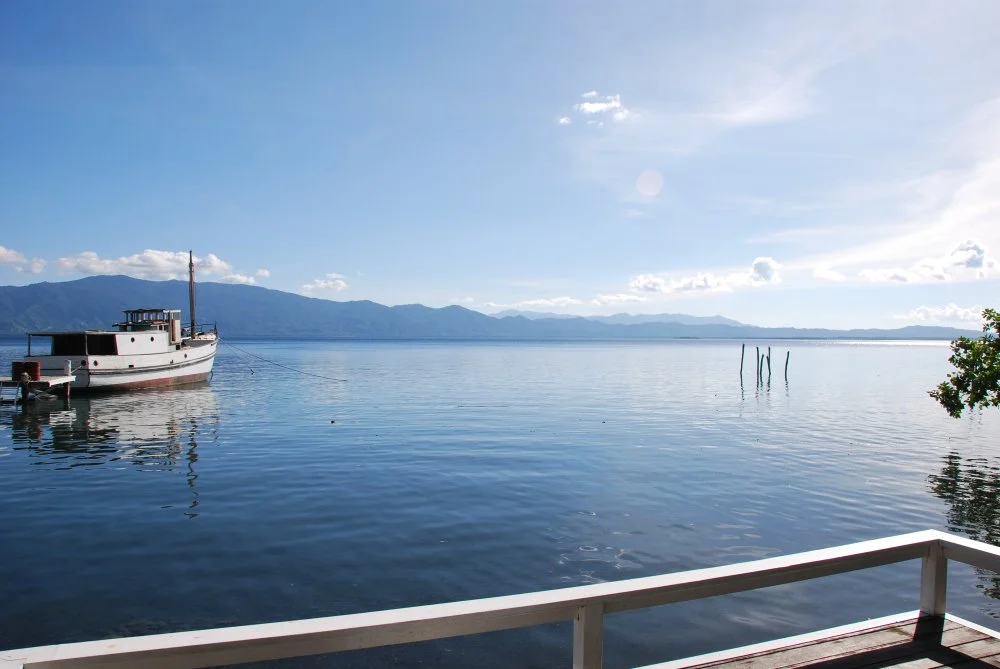
Alotau sits on the north shore of Milne Bay, at the head of an enormous natural harbor - the same protected anchorage that made this place strategically priceless during the Second World War. Today the harbor is full of coastal freighters and banana boats, and the town strings itself along the waterfront in a low, walkable arc. The official population is small. The pace is slower. From here, you can reach some of the most extraordinary islands in the Pacific: the Trobriands to the north, where Bronislaw Malinowski wrote down the anthropological theories that founded a discipline; the Louisiades to the east, where yachts crossing from Australia pause for water and mangoes; the D'Entrecasteaux chain, where Fergusson Island still has active volcanism and the rainforest holds rare birds-of-paradise. Alotau is how you get to all of them. And it is content to be that - a hinge, not a destination in its own right.
Walking and DimDim
The best way to see Alotau is on foot. The town is not large, the people are friendly, and the children tend to call out "DimDim" at passing foreigners, which Wikivoyage notes gently: it does not mean they think you are stupid. DimDim is simply the local word for outsider, a noun, a greeting, an observation. The greeting carries no malice. It carries curiosity. You walk past houses on stilts, past the market, past the churches and the small grocery stores that double as fast food counters, and the day begins to have a different shape than the one you planned. Afternoon rain is common. Shade is precious. Most practical business happens between six and eleven in the morning, when the heat still allows it.
The Market and the Betel
At the Alotau market, down near the water, the fresh food is excellent most days of the week - bananas, sweet potatoes, yams, greens, green beans, and seafood including crabs. Saturday afternoons are slow. Sundays are slower still; the market essentially closes. What does not close, ever, is the chewing of betel nut. The people of Milne Bay are major consumers of buai, the areca nut, chewed with lime and mustard leaf until the mouth floods red. The red stains mark the sidewalks, the steps of every public building, the doorways of shops. A mild stimulant. A social glue. Also, as the Wikivoyage entry bluntly notes, addictive, carcinogenic, and implicated in cardiovascular disease. It is a habit that predates European contact and will likely outlast many European visitors. Try it, or decline it politely - but either way, expect to be offered.
A Dive Shop with No Customers
The diving off Alotau is, by the accounts of those who have done it, fantastic. The reefs of Milne Bay are among the most biodiverse in the world, with muck diving sites that marine biologists travel from three continents to photograph. And yet Alotau gets few visitors. The town's one dive shop closed for lack of customers. This is the paradox of Milne Bay tourism: the place is extraordinary, the logistics are hard, and the town itself has never invested in pulling visitors in the way that Bali or Cairns have. Yachts arrive in season, mostly bound for the Louisiades. Research expeditions pass through. Occasional adventurous divers find operators in other provinces who will charter down. But the infrastructure has stayed small, and with it the town has stayed itself.
Going Next
What Alotau offers best is onward passage. A short boat ride puts you on Samarai, the old colonial capital, which you can walk around in twenty minutes - a boom town in the 19th century with five hotels to serve gold prospectors, now mostly quiet, still worth the trip. Fergusson Island has hot springs and rare birds. The Trobriands have their own version of cricket, introduced by missionaries and adapted into something fierce and ceremonial and unlike anything played anywhere else. Goodenough and Normanby are still largely unspoilt, with very limited accommodation and some of the best birdwatching in the region. Misima, in the Louisiades, had a brief gold-mining boom from 1989 to 2004 and is now easing back into its former quiet. All of these places are accessible from Alotau by plane or boat. None of them, probably, would be easier if the highway to Port Moresby were ever built. That, quietly, is the point.
From the Air
Located at 10.32°S, 150.43°E on the north shore of Milne Bay, at the eastern tip of Papua New Guinea. Gurney Airport (AYGN) is the main airfield, named for Flight Lieutenant Bob Gurney of the RAAF, killed in May 1942. Served daily by Air Niugini from Port Moresby (AYPY), roughly 200nm west, and by PNG Air from Lae (AYNZ) to the northwest. PNG Air also flies twice-weekly to the Trobriand Islands (Losuia, AYKI) and Misima (AYMS) in the Louisiades. Recommended viewing altitude 6,000-10,000 feet to appreciate the protected natural harbor, one of the finest in the Pacific. Morning visibility typically excellent; afternoon thunderstorms common, especially December through March.
Nearby Stories
- Normanby Island (Papua New Guinea) 34 km away
- Samarai 42 km away
- D'Entrecasteaux Islands 61 km away
- Tufi 115 km away
- Trobriand Islands 154 km away
- Kokoda Track 180 km away
- Misima Island 211 km away
- Raine Island Beacon 636 km away