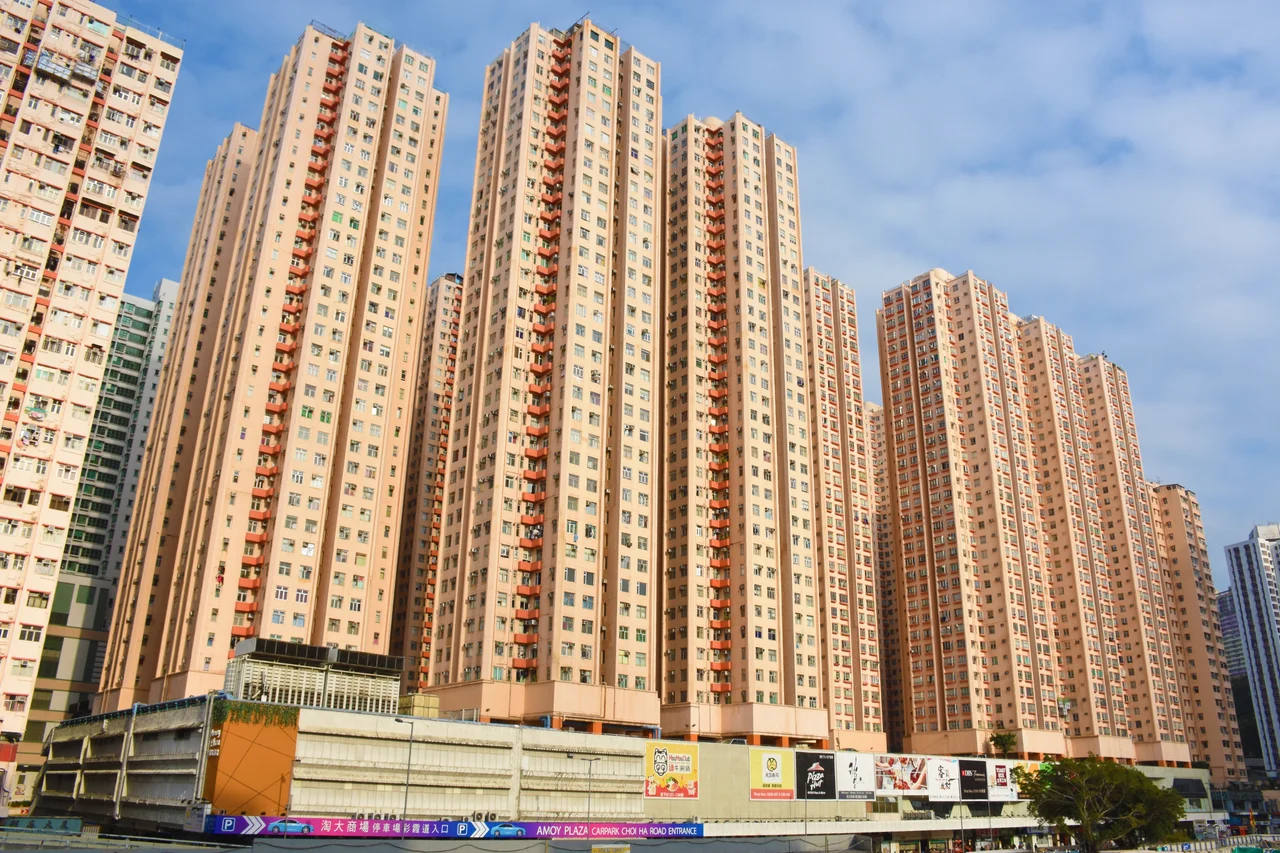

Amoy Gardens
In late March 2003, the residents of Amoy Gardens went to bed in an ordinary housing estate and woke up in the middle of an epidemiological mystery. Within days, a respiratory illness was moving through the 19 towers of this Kowloon complex with a speed and pattern that baffled Hong Kong's health authorities — not floor by floor, not block by block, but in narrow vertical columns, as if the buildings themselves were breathing the disease upward. What investigators eventually found in the pipes beneath their feet would change how the world thinks about viral transmission in dense urban housing.
From Factory to Home
The land beneath Amoy Gardens has an older story. The Amoy Canning company purchased this patch of Ngau Tau Kok in the 1920s to use as a factory site, and for decades it produced the soy sauce and condiments whose branding became familiar across Southeast Asia. By the 1970s, the economics of manufacturing in central Kowloon no longer made sense. When Amoy put the site — roughly 222,000 square feet — up for auction in March 1977, the reserve price went unmet. Hang Lung Development stepped in, signing a purchase agreement in April 1977 for approximately HK$200 million, with Amoy retaining a share of redevelopment profits.
Construction began in earnest in October 1979, with the first phase of seven residential blocks awarded to Shui On Construction. The estate rose in four phases between 1981 and 1987, eventually comprising 19 towers — lettered A through S — ranging from 30 to 40 floors each. Amoy Plaza, a shopping arcade, anchored the complex at street level. By any measure it was a successful transformation: a canning factory becoming home to more than ten thousand people.
The Columns of Infection
The SARS outbreak that began at Amoy Gardens in late March 2003 had a precise, unsettling geometry. By 15 April 2003, there had been 321 confirmed cases in the estate. Block E alone accounted for 41 percent of them — and within Block E, the cases weren't random. They clustered in specific flats arranged in a straight vertical line from low floors to high, one above another, as if mapped with a ruler.
Amoy Gardens' more than ten thousand residents lived in tight proximity, as residents of Hong Kong housing estates always do. They shared lifts, stairwells, and a shopping arcade below. Yet the virus was not spreading through those obvious channels. Something else was directing it. Health officials began looking at the infrastructure underneath the floors, at the pipes connecting bathroom to bathroom, at the traps designed to hold water and keep sewer gases from rising into living spaces. What they found became one of the defining environmental health discoveries of the epidemic.
What the Drains Revealed
In mid-2003, investigators identified a cascade of failures in Amoy Gardens' bathroom plumbing. The floor drain traps — U-shaped water seals meant to block gases and aerosols from traveling back up through the pipes — had dried out. Without a replenishment system to keep them filled, they offered no barrier. Bathroom exhaust fans, drawing air out of rooms, created exactly the kind of negative pressure needed to pull virus-laden aerosols upward through those empty traps and into flats above.
A single index patient who visited Block E in late March had shed virus through diarrhea — a less-discussed symptom of SARS. That viral load entered the drainage system, and the dried-out traps did the rest, distributing it through the building's respiratory system into the bathrooms of his neighbors above and below. The geometry of the outbreak — those eerie vertical columns of infection — matched the layout of the drainage stacks precisely.
Authorities evacuated all residents to Lei Yue Mun and Lady MacLehose Holiday Village for quarantine. After the estate was decontaminated, residents returned. Amoy Gardens was subsequently retrofitted with an auxiliary floor drainage system incorporating fresh water interlocks to keep traps perpetually sealed.
A Lesson Written Into Every Building Code
The investigation's findings rippled outward far beyond Kowloon. The Amoy Gardens outbreak confirmed that SARS could spread not just through direct respiratory contact but through plumbing systems in high-density housing — a transmission route few had seriously considered before 2003. Public health agencies across Asia and beyond reviewed their building codes. Plumbers and building engineers found themselves unexpectedly at the center of an infectious disease crisis.
Amoy Gardens itself recovered quietly. Its towers still stand in Ngau Tau Kok, served by the MTR's Kowloon Bay station, its shopping arcade still busy. The 2016 by-census counted 10,721 residents, with a median household income of HK$34,000 per month and a median age of 37.7 — younger, in fact, than Hong Kong's citywide median. For most of its residents, it is simply home. The estate's story is a reminder that the built environment — the unseen pipes, the U-bends that must hold water, the exhaust fans pulling air through walls — is not merely infrastructure. In the wrong circumstances, it can become a vector.
From the Air
Amoy Gardens sits at approximately 22.3244°N, 114.217°E in the Ngau Tau Kok district of eastern Kowloon. Flying west from Hong Kong International Airport (VHHH) at 2,000 to 3,000 feet, the complex is visible as a cluster of 30- to 40-story residential towers just northeast of Kowloon Bay. The MTR Kowloon Bay station and the distinctive grid of industrial and residential blocks in Ngau Tau Kok help orient the eye. Victoria Harbour and the Central skyline are visible to the west. The estate's 19 towers, lettered A through S, are most easily distinguished from the air by their consistent height and shared commercial podium base.
Nearby Stories
- Chapel of St. Francis Xavier 3.5 km away
- Cuiheng 4.1 km away
- 2015 Shenzhen Landslide 16 km away
- Shunde 31 km away
- Wanshan Archipelago 37 km away
- Nanxiong Formation 96 km away
- Heyuan 149 km away
- Checheng Fu'an Temple 629 km away