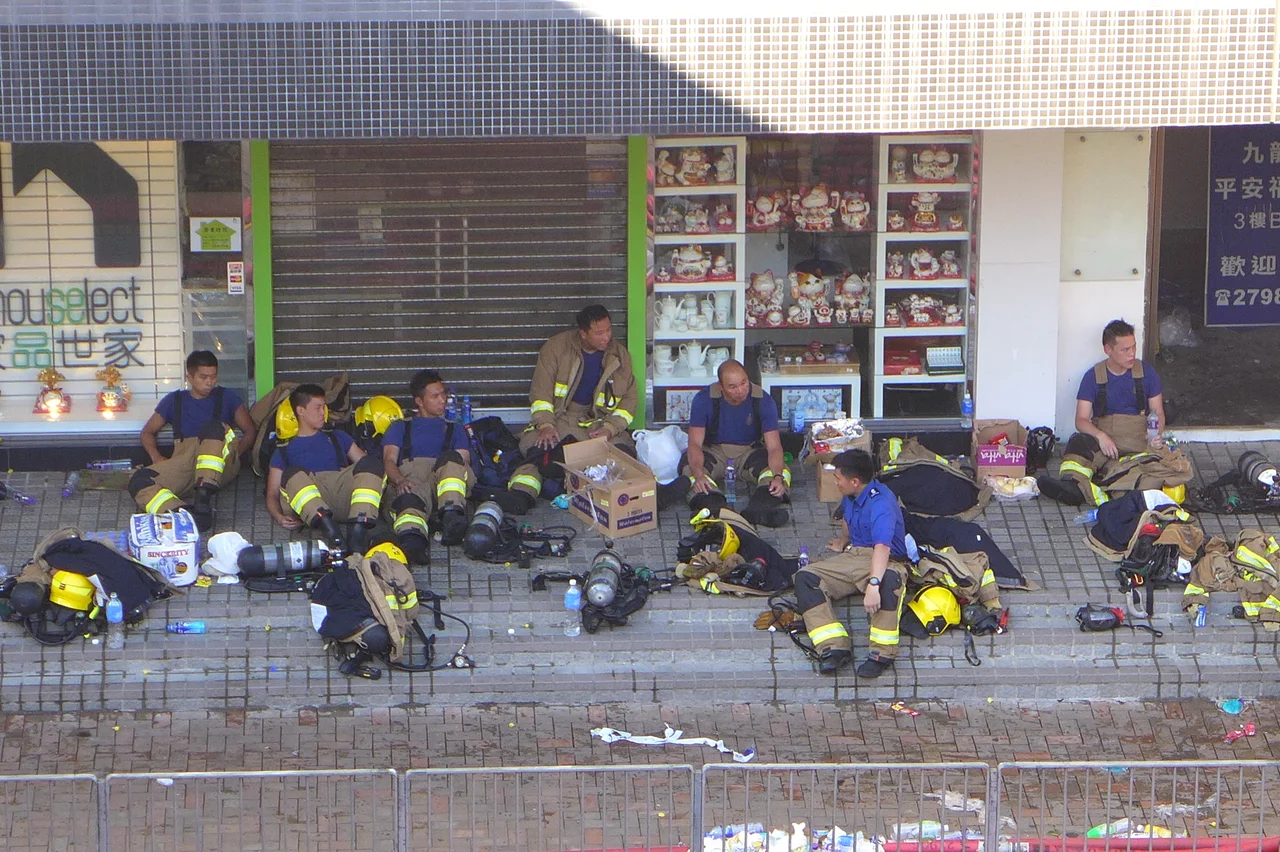

Amoycan Industrial Centre Fire
Thomas Cheung Yiu-sing was 30 years old, a senior officer at the Fire and Ambulance Services Academy in Tseung Kwan O, when he entered the Amoycan Industrial Centre as part of the first breathing apparatus team on the night of 21 June 2016. The inferno inside — fed by the densely packed contents of a self-storage facility in a building that legal exemptions had left without sprinklers — intensified suddenly. Cheung was lost in the smoke. His colleagues found him and rushed him to United Christian Hospital, where he was certified dead at 9:54 pm. He was the first of two firefighters who would not come home from what became the longest-burning fire Hong Kong had seen in twenty years.
A Building With a Long History
The Amoycan Industrial Centre Block No. 1 was 66 years old when it caught fire — old enough that the law did not require it to be retrofitted with a sprinkler system. The building had been developed by Amoy Canning, the same company whose soy sauce factory site nearby was later redeveloped into the Amoy Gardens housing estate. By 2016, ownership had passed to Hang Lung Group, which had acquired Amoy Food's property investment arm.
The building's age and industrial origins shaped the conditions inside: thick concrete floors, few windows, a warren of tenanted spaces. At the time of the fire, it housed small factories, a church, and SC Storage — a mini-warehouse self-storage facility. Self-storage units pack an extraordinary fuel load into a confined space: furniture, clothing, paper, electronics, chemicals, all sealed inside individual units where a fire can smoulder undetected and build heat without suppression. When it ignited on the evening of 21 June, the fire had everything it needed to endure.
One Hundred and Eight Hours
The fire burned for 108 hours — four and a half days. Hong Kong's firefighters mounted one of the most sustained operations the city had seen in a generation, working in rotation through heat that storage contents continually replenished. The decision to keep fighting was deliberate. Secretary for Security Lai Tung-kwok stated plainly that halting the effort was not a responsible option, and so the crews continued.
The second firefighter to die was Senior Fireman Samuel Hui Chi-kit, 37, also attending the blaze. The combination of an elderly building without automatic suppression, a fuel-dense storage facility, and the unpredictable progression of a confined fire created hazards that even the most experienced crews could not fully anticipate. Smoke and structural uncertainty made every entry a calculated risk. Both men knew this. They entered anyway — because that is what the work requires, and because people's property and the building's neighbours depended on the fire being brought under control.
Gold Medals and a Coroner's Finding
In July 2016, a month after the fire was finally extinguished, the two firefighters who died were posthumously awarded Hong Kong's gold medal for bravery. The medals recognized what their colleagues already knew: that both men had performed their duties under conditions of extreme danger, without hesitation.
The question of how they died took longer to resolve. In 2022, the Coroner's Court handed down its finding: death by misadventure. In legal terms, misadventure describes an accidental death resulting from a lawful act carried out without negligence. The finding did not attribute fault to any individual. It acknowledged, as such findings always must, that the men had not done anything wrong — that their deaths were the consequence of a dangerous job, a building that age had exempted from modern protections, and a fire that burned longer and hotter than anyone could have predicted from the street.
The Question of Old Buildings
The Amoycan fire renewed a debate in Hong Kong that resurfaces after nearly every major blaze in an aging industrial or commercial building: what obligations exist toward buildings that predate modern fire safety codes? Hong Kong has hundreds of old flatted factory buildings — mid-century industrial structures that once produced goods for export and now house a miscellany of small businesses, artists' studios, churches, and storage operators.
The legal exemptions that allowed Amoycan to operate without sprinklers were not unusual. They reflected a policy of grandfathering older buildings rather than requiring costly retrofits. Whether that policy strikes the right balance is a question Hong Kong's legislators and fire safety regulators continue to revisit. The names of Thomas Cheung Yiu-sing and Samuel Hui Chi-kit — who gave their lives inside a building that the law had decided did not need automatic suppression — remain part of that conversation.
From the Air
The Amoycan Industrial Centre stands at approximately 22.3264°N, 114.2144°E in Ngau Tau Kok, eastern Kowloon. Approaching from Hong Kong International Airport (VHHH) eastbound at low altitude, the industrial district of Ngau Tau Kok is visible on the north side of Kowloon Bay — a dense mix of mid-century flatted factory buildings and newer residential towers. The industrial centre itself is a multi-storey building typical of the area's post-war manufacturing heritage. Victoria Harbour lies to the southwest; the Kowloon Bay MTR station provides a ground-level landmark nearby.
Nearby Stories
- Chapel of St. Francis Xavier 3.5 km away
- Cuiheng 4.1 km away
- 2015 Shenzhen Landslide 16 km away
- Shunde 31 km away
- Wanshan Archipelago 37 km away
- Nanxiong Formation 96 km away
- Heyuan 149 km away
- Checheng Fu'an Temple 629 km away