
Archaeological Museum of Mykonos
In 426 BC, the Athenians decided that the sacred island of Delos was too holy to hold the dead. They dug up every grave on the island and carried the bones across the water to the neighboring islet of Rheneia, sealing them into a single pit. More than two thousand years later, when archaeologists reopened that purification pit, the finds needed a home. So in 1902 the Greek Archaeological Service built one on Mykonos, a Neoclassical building near the Old Port, raised specifically to shelter the relocated dead of Delos. The museum exists because of an ancient act of reverence, and an ancient act of disturbing the graves it was meant to protect.
Built for the Displaced Dead
The collection's foundation is the material brought from Rheneia, where Delos's graves were reburied in the 5th century BC. The museum grew up around it. The original building was refurbished and expanded in the 1930s and again in the 1960s, and the large eastern room was added in 1972. Inside, the cases trace the long arc of Cycladic life: ceramic pottery from the 9th and 8th centuries BC, works from across the Aegean dating to the 7th and 6th centuries, funerary urns and sculptures from the Cycladic, Geometric, and Classical periods. It is a small museum, but a dense one, where nearly every object carries the weight of having once accompanied someone into a grave.
The Oldest Trojan Horse
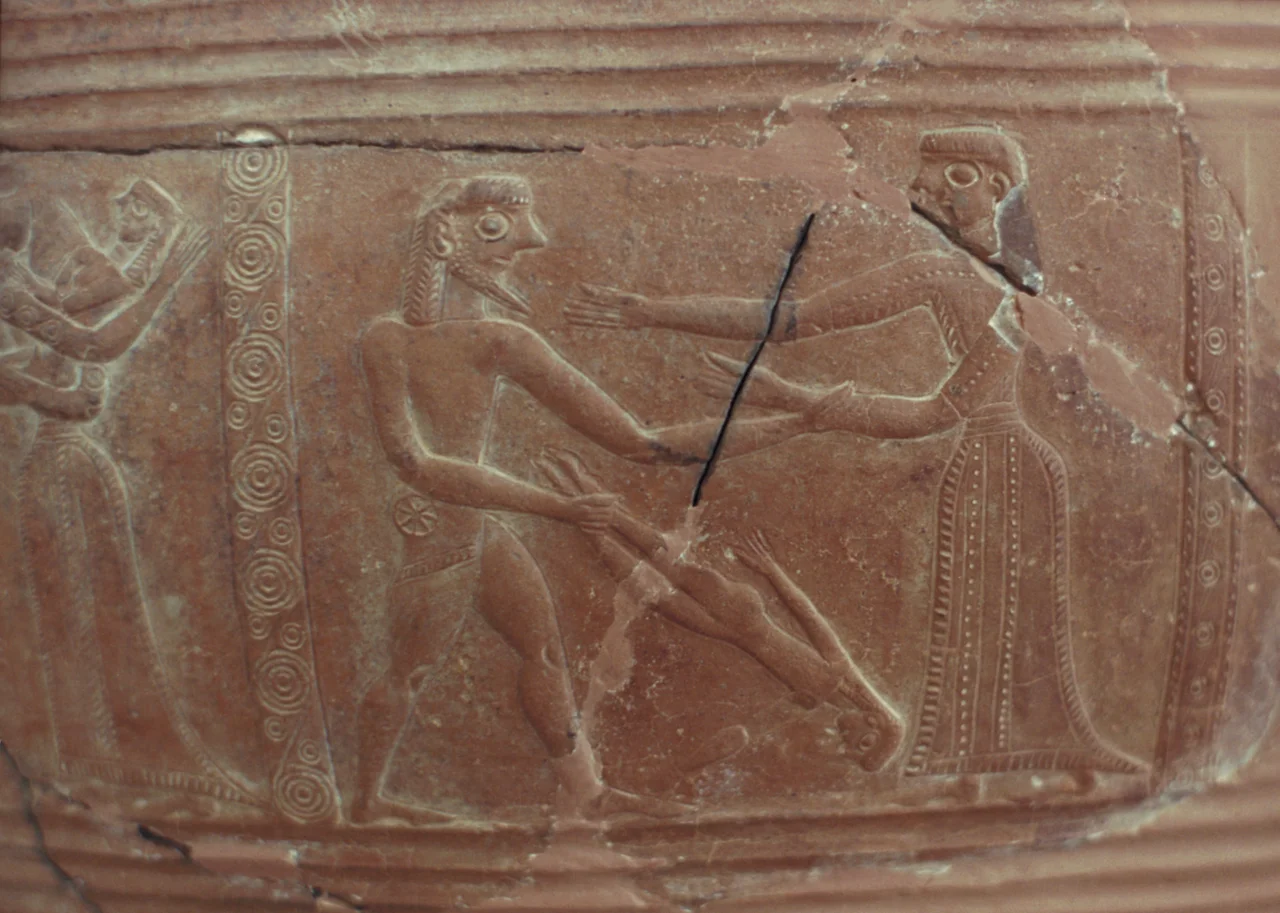
One object outshines the rest. It is a large relief pithos, a storage vessel taller than a child, made on the nearby island of Tinos around 675 BC and decorated with scenes from the fall of Troy. On its neck, Greek warriors crowd around a wooden horse, and if you look closely you can see more of them peering out through tiny portholes in the horse's flank. This is the Mykonos vase, and it holds the oldest known depiction of the Trojan Horse anywhere in the world. It predates the written versions of the story that survive to us. When a local resident unearthed it on Mykonos in 1961, alongside human remains, he had found the earliest image of one of humanity's most enduring legends, made by an artist who knew the tale centuries before it was set down in the form we read today.
The Suffering in the Clay
Look past the famous horse and the vase tells a harder story. Beneath the neck, rows of small panels show figures frozen in combat, and the scenes do not celebrate victory so much as catalog its cost. The artist dwelled on the violence of the city's last night, and especially on its most vulnerable victims: the women and children of Troy. It is a remarkably unsentimental thing for a vase nearly twenty-seven centuries old, a refusal to look away from what the sack of a city actually meant for the people inside its walls. Standing before it, you are looking at one of the earliest works of art to insist that the losers of a war were human beings too.
From the Air
The Archaeological Museum of Mykonos stands near the Old Port of Mykonos town, at roughly 37.45°N, 25.33°E. From the air, the cluster of Mykonos, Delos, and Rheneia sits at the center of the Cyclades, with low, treeless Mykonos densely built in white. The source of the museum's collection, the islet of Rheneia, lies just west of Delos, southwest of Mykonos town. Mykonos Airport (LGMK) is immediately south of town; Naxos (LGNX) and Santorini (LGSR) lie within a short hop.
Nearby Stories
- Andros 5.1 km away
- Chalandriani 5.7 km away
- Kouros of Apollonas 11 km away
- Ikaria 15 km away
- Archaeological Museum of Sifnos 38 km away
- Emporio, Chios 44 km away
- Archaeological Museum of Andros 49 km away
- Astypalaia 83 km away