.jpg)
Archaeological Museum of Tegea
In April 1941, with German forces days away from completing their invasion of Greece, the staff of the Archaeological Museum of Tegea did something drastic: they buried the collection. The exhibits went into the museum floor, sealed against whatever was coming. The act was called apokrypsis — hiding. When the war ended and the objects were dug back up, most survived. It is the kind of institutional memory that does not make it into the standard museum brochure, but it tells you something important about the people who have cared for these objects across a century of turbulent Greek history.
A Museum Born from a Bishop's Gift
The museum's origins trace to 1906 and 1907, when Bishop Neilos Smyrniotopoulos donated a plot of land at Piali — modern-day Alea — to the Archaeological Society at Athens. The society accepted the donation and approved construction costs. By 1909, Konstantinos Romaios, working with the support of the Athens Archaeological Society, had completed the building and organized the first exhibition. It was a modest beginning for a collection that would grow to represent one of antiquity's most significant cities: Tegea, which had been the most powerful city in Arcadia before the founding of Megalopolis in 370 BC. The museum sits about two hundred meters from the site of the Temple of Athena Alea, whose ruins are still visible and visitable. That proximity is the point — the museum was always meant as the scholarly companion to an active archaeological site.
Skopas and the Temple of Athena Alea
The centerpiece of the collection is a group of sculptures connected to the great fourth-century BC architect and sculptor Skopas, who designed and oversaw construction of the Temple of Athena Alea at Tegea. Skopas was one of the most celebrated sculptors of the classical world, known for introducing a new emotional intensity into Greek sculpture — faces turned, lips parted, eyes that seem to search rather than simply gaze. The temple's sculptural program depicted two mythological hunts: the Calydonian Boar Hunt on the east pediment and the battle between Telephus and Achilles in Mysia on the west. Fragments of these sculptures survive in the museum, and among them was a head of Telephus that scholars identify as a Skopas original. That head was stolen in 1992. Eight of the stolen objects were recovered and returned in 1994; the marble head of Asclepius and a relief depicting Dionysus, Artemis, and Heracles came back in 1998. The Telephus head's fate remains a matter of record.
Four Galleries, Three Thousand Years
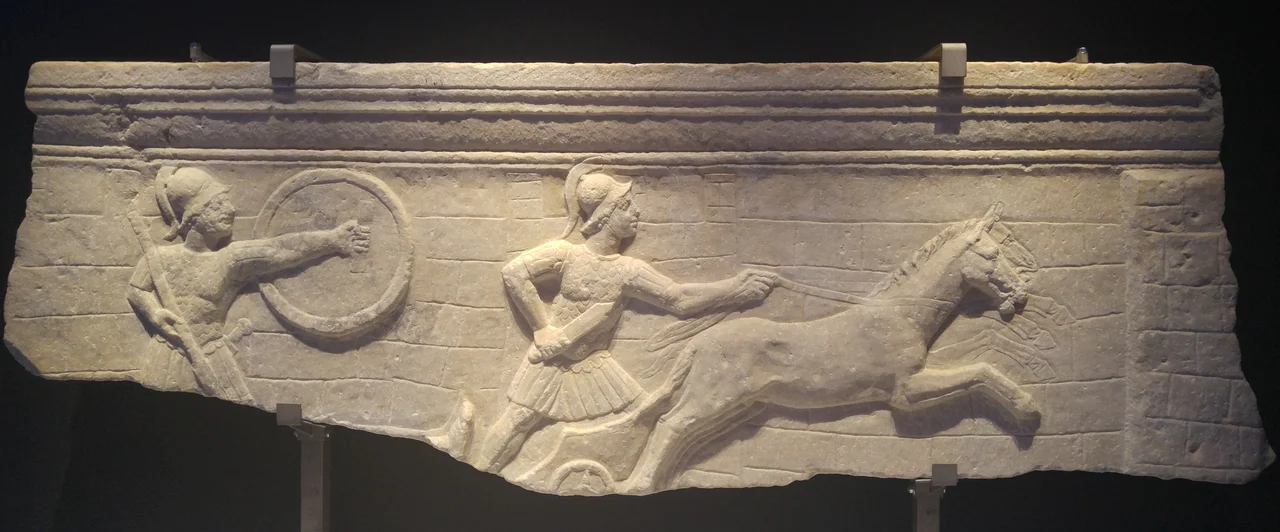
The permanent exhibition is organized into four interior galleries that trace Tegea's history from the Neolithic period to the Roman era. The first gallery covers the Neolithic and Early Bronze Age, with material from sites including Agiorgitika and Asea, and tracks the development of the polis. The second focuses on Arcadian Herms — private votive dedications to sanctuaries found exclusively in the Tegea region, a reminder of how localized religious practice could be even within a single city-state. The third gallery follows the evolution of Tegea through the Greek classical period and into Rome's long shadow. The fourth, perhaps the richest, is dedicated to the sanctuary of Athena Alea: its architecture, its cult objects, its sculptural remains. An outdoor section rounds out the visit with material organized around 'Public Life' and 'The Hereafter' — the civic and the funerary, which between them account for most of what ancient cities produced and left behind.
Collapse, Repair, Continuity
The museum's physical history has been eventful. In 1935 and 1936, the roof collapsed, damaging antiquities. Curator Markelos Mitsos undertook the repairs and reorganized the exhibition, and during that restoration a fourth gallery was added. After the war and the recovery of the buried collection, extensive repairs ran again from 1967 to 1968, supervised by curator Angelos Delivorias and architect Dionysios Triantafyllidis. More recent renovations, supported by the European Union's structural funds programs in the 2000s and early 2010s, brought the building up to modern museum standards. An attempted burglary in 1990 preceded the successful theft in 1992 — two moments that forced the museum to reckon seriously with security. The story of this small regional museum, over a century of existence, is one of repeated damage and patient reconstruction, matching the longer story of Tegea itself.
From the Air
The Archaeological Museum of Tegea sits at approximately 37.45°N, 22.42°E, just southeast of the modern city of Tripoli on the Arcadian plateau. The site of the Temple of Athena Alea is 200 meters from the museum entrance. From the air, the Tegea plain is the most visibly flat terrain in the central Peloponnese — it reads as a pale agricultural expanse surrounded by mountain ridges. The nearest major airport is Kalamata International (LGKL), roughly 55 kilometers to the southwest. The airport at Tripoli (a small civil airfield) is closer but not regularly served by commercial traffic. Flying in from Athens (LGAV), the approach over the Argolid and across the Arcadian highlands offers a striking aerial view of exactly the terrain the ancient city of Tegea chose for its location: defensible, well-watered, and commanding the road north toward Corinth.
Nearby Stories
- Araklovon Castle 4.8 km away
- Pellana 6.6 km away
- Arkadiko Bridge 10 km away
- Siege of Corinth (1463) 11 km away
- Leonidio 11 km away
- Kyparissia 11 km away
- Pheneus 14 km away
- Santameri Castle 29 km away