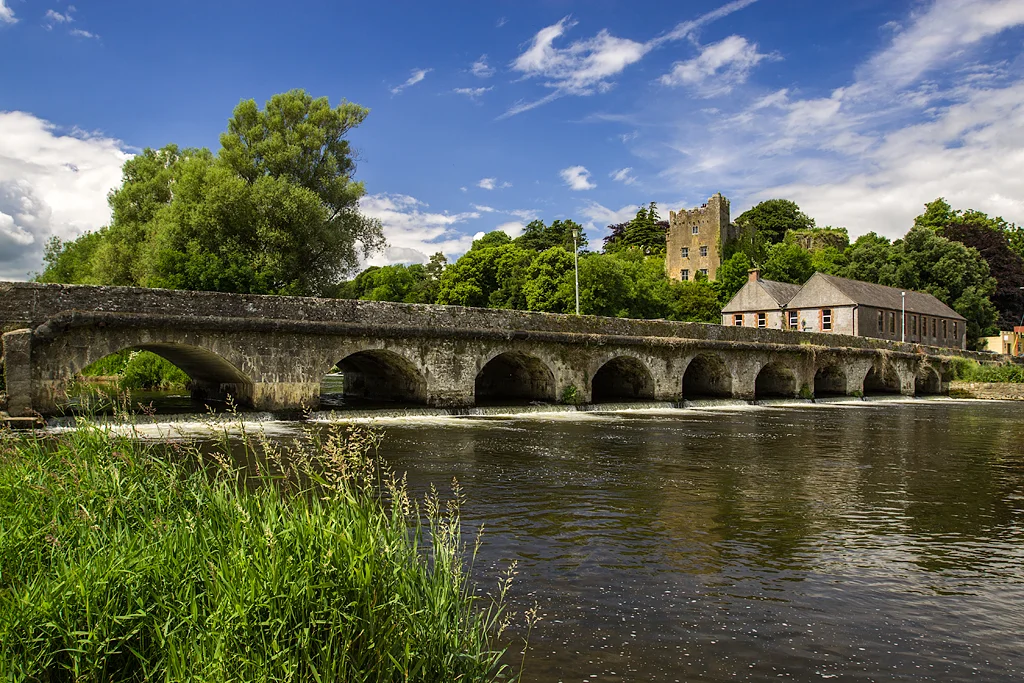

Ardfinnan Castle
In April 1185 the future King John of England landed at Waterford. He was eighteen years old, the fourth son of Henry II, and he had been made Lord of Ireland as a way of giving him something to do. His instructions from his father were clear: secure the Suir crossings and the Blackwater valley. By the end of the year he had built two castles. One was at Lismore, on a bluff above the Blackwater. The other - its sister, twelve miles north - was at Ardfinnan, on a rocky incline above a ford in the River Suir. Both rose on the sites of Christian monasteries founded by Saint Mochuda around 632. Both still stand. Together they are reckoned the oldest castles built by the English Crown in Ireland - the first stone projections of a conquest that would shape the island for the next eight hundred years.
Where two mountain ranges meet a river
The site Henry II had chosen with Hugh de Lacy in 1171 was almost a textbook lesson in medieval strategy. The Suir flows in a wide arc here, threading between the Knockmealdown Mountains to the south and the Galtee Mountains to the northwest. A natural ford carried the road. Whoever held this rock held the route west into Thomond. Prince John's masons built a parallelogram of curtain walls with square battlements at the corners, a fortified entrance gateway, and - within a generation, in the early 13th century - a circular keep that survives today. Round keeps are unusual in Ireland. The orchard of trees that now surrounds the castle hides most of its structure from the road. But the silhouette of the round tower above the water is much as the Knights Templar saw it when they took over guardianship of the pass between the great ecclesiastical centres of Cashel and Lismore.
Knights and weavers
By 1210 Ardfinnan and its cantred had passed to Philip of Worcester, with a permanent garrison of Knights Templar and later Knights Hospitaller. The knights did not only fight. They built a fulling mill on the riverbank to finish locally woven cloth, a corn mill upstream, and probably reused the mill race and weir from the older monastery on the site. The 13th century brought a boom in exports of Irish woollen cloaks to mainland Europe through the port of Waterford, accessible from here by direct navigation down the Suir. A freeman recorded in the village in 1295 carried a name that tells the whole story of the trade: William le Teynturer - William the Dyer, in Norman English. He was the man who coloured the cloth, and his trade survived the Templars, the Hospitallers, and the Reformation. The Mulcahy family's nineteenth-century woollen mills below the castle are the direct heirs of his work.
Ireton's eight shots
On Saturday 2 February 1650, Henry Ireton came up the river. Oliver Cromwell's son-in-law and lieutenant could not cross the Suir in the weather and without boats, so he marched on Ardfinnan to take its bridge. The castle was held for the Catholic Confederacy by David Fitzgibbon, called the White Knight, with a small garrison. Around four in the morning Ireton placed his cannons on the hill opposite and opened fire. The walls had been called impenetrable for four hundred years. They held for about eight shots. The breach was made. Thirteen of the out-guard died, ten Parliamentarians were wounded, two were killed. Fitzgibbon surrendered fast enough that Ireton spared his life. He lost his lands instead - transplanted to Connacht in 1653, like thousands of other Irish Catholic landowners after the Cromwellian conquest. When the New Model Army finally departed Ireland, they slighted Ardfinnan - knocking down enough of the walls to render it useless. The castle was a partial ruin for the next century and a half.
A summer camp for two thousand soldiers
In 1795, with revolutionary France threatening invasion, the British Army came back to Ardfinnan. The ruin still commanded the river crossing, and around it the British set up a summer training camp for fencible regiments - militia organised against the French. The temporary encampment became permanent in March 1796 by order of John Pratt, the 1st Marquess Camden. At its peak the Ardfinnan camp held 2,740 mainly Protestant soldiers, drilling in firing and marching in the meadows below the old Templar walls. The camp disbanded in 1802. A few decades later a descendant of Maurice de Prendergast - the Norman knight to whom Prince John had granted the Manor of Ardfinnan back in 1185 - reclaimed the castle, restored its tower-house around 1846, and turned it into a country house. The Prendergasts hung the Union Jack over the village green. They tried to build a wall around it. The local response was not friendly.
A Spanish helmet and a private home
In 1921, with the Irish War of Independence drawing to its close, the castle was bought by John Mulcahy, the local owner of the Ardfinnan Woollen Mills below the bridge. He restored what the Cromwellians had broken. During the work, his son William turned up a Spanish helmet in the grounds dating to the 1601 Siege of Kinsale - a relic of an earlier failed Catholic rising that had passed through here on its way south. The latest addition, a three-storey gable-ended wing, went up in the 1930s. The castle and its grounds remain a private home today, not open to the public. From the bridge you can see the round keep above the water, the curtain walls, the watermill on the bank below. Eight hundred and forty years after Prince John's masons raised the first walls, the building still does what it was built to do: it watches the river crossing.
From the Air
Ardfinnan Castle sits at 52.31 N, 7.88 W on a rocky incline above the River Suir in County Tipperary, 4 miles south of Cahir and 7 miles west of Clonmel. Waterford (EIWF) is 32 nm east-southeast; Cork (EICK) 35 nm southwest; Shannon (EINN) 50 nm north-northwest. Recommended viewing altitude 2,000-3,000 ft AGL. The castle is best seen from the south, with the medieval 14-arch bridge in the foreground and the Knockmealdown Mountains rising behind. The Galtee Mountains - the highest inland range in Ireland - dominate the northwestern horizon, with Galtymore reaching 919 m / 3,015 ft.
Nearby Stories
- All Together Now (festival) 1 km away
- Molana Abbey 4.1 km away
- Castle Oliver 4.7 km away
- Holy Cross Abbey 9.4 km away
- Siege of Kilkenny 9.4 km away
- Waterloo Round Tower 13 km away
- Castletroy 14 km away
- Ramsey Island 141 km away