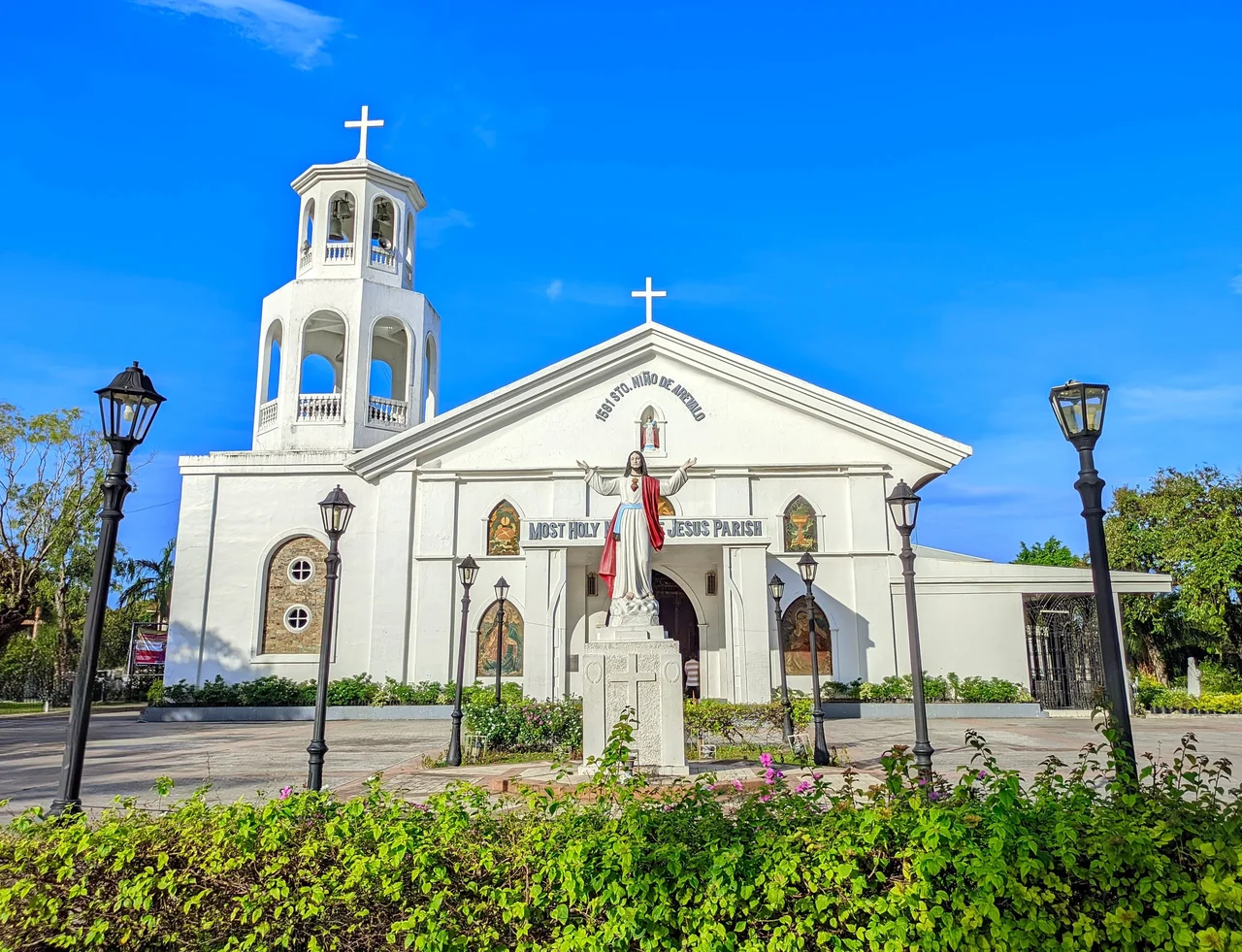

Arevalo Church
Most Philippine churches anchor the edge of their town plaza. Arevalo Church sits squarely in the middle of it. This simple inversion of convention, a building positioned at the heart rather than the margin, says something about the role this church has played in the life of Iloilo City's Arevalo district since the parish was first established in 1582. Fr. Diego Velasquez was appointed the first parish priest that year, and by the late 16th century, Arevalo had eclipsed the older settlement of Oton to become the administrative and religious center for Spanish officials on Panay Island. The church that stands today is the product of multiple rebuildings, but the image it shelters is far older than any of its walls.
The Third Oldest Child
Inside Arevalo Church resides the Santo Nino de Arevalo, the third oldest image of the Holy Child in the Philippines. The inscription above the facade's niche reads '1581 St. Nino de Arevalo,' marking the year the image was brought to the town, a year before the parish itself was formally established. The original image is kept in the Convento de Arevalo for safekeeping, while a replica is enshrined in the church for public veneration. Across four centuries, the Santo Nino has been credited with protecting Arevalo from Moro raids, droughts, locust infestations, and other calamities. During World War II, American forces set the convent on fire to prevent it from being used by advancing Japanese troops. The church and the image survived. In 1948, a devastating earthquake struck the region. The image remained intact. On January 16, 2022, Archbishop Jose Romeo Lazo declared the church an Archdiocesan Shrine, the third such designation in the Archdiocese of Jaro.
Three Orders and a Shortage of Friars
The early history of Arevalo's parish reads like a relay race of religious orders. The Augustinians took over in 1584, appointing Fr. Juan Montoya as parish priest. Three years later, a shortage of friars forced them to leave, and the parish was handed to the Jesuits, who eventually passed it to the secular clergy. This rapid succession of custodians left its mark on the church's character, each order contributing something before departing. The current structure dates largely from a major reconstruction in 1868 and 1869 under Fr. Anselmo Avancena, who also built the Convento de Arevalo and erected a monument honoring Spain's Queen Isabela II. The parish has been tended continuously for more than 440 years, making it one of the oldest in Western Visayas.
A Tower Built for Sound
The church's bell tower dominates the Arevalo skyline. It is a massive four-bodied structure positioned on the gospel side of the building, its quadrangular base supporting two levels of octagonal belfries pierced with arch openings. The lower belfry is larger than the one above it, creating a visual tapering that draws the eye upward to the pyramidal roof and its crowning cross. The facade below is simpler than many colonial Philippine churches, clean lines ornamented with four pilasters and five lancet windows filled with stained glass. A portico marks the entrance, bearing the inscription 'Most Holy Name of Jesus.' The restraint of the exterior makes the tower's mass all the more striking. It was built not for decoration but for function: to project the sound of its bells across the plaza and the surrounding district, calling the faithful in a voice that carries.
The Plaza at the Center
The decision to place the church at the center of the plaza rather than at its edge created a different kind of public space. Instead of fronting onto a gathering area, the church is surrounded by it. A statue of the Sacred Heart of Jesus stands in the plaza as an additional focal point, and the open ground around the church becomes the setting for processions, festivals, and daily life. The Convento de Arevalo, despite its partial destruction in the war, has been rebuilt and continues to house parish functions. Arevalo itself has grown from a colonial administrative center into a residential district of modern Iloilo City, but the plaza and its centered church remain the gravitational core, a layout that visitors from other parts of the Philippines often find disorienting precisely because it defies the spatial grammar they expect from a church and its town.
From the Air
Coordinates: 10.688N, 122.516E, in the Arevalo district of Iloilo City on the southeastern coast of Panay Island. The church and its central plaza are visible in the Arevalo district layout. Nearest major airport: RPVI (Iloilo International Airport) in Santa Barbara, approximately 19 km north. From altitude, Arevalo sits at the southwestern edge of the Iloilo City urban area, near the Iloilo Strait separating Panay from Guimaras Island.
Nearby Stories
- Hacienda Rosalia 11 km away
- San Jose de Buenavista 13 km away
- Guimaras Oil Spill 17 km away
- Northern Negros Natural Park 19 km away
- Jalaur Dam 31 km away
- 2012 Negros Earthquake 50 km away
- Maniguin Island Lighthouse 84 km away
- Tubbataha Reef 281 km away