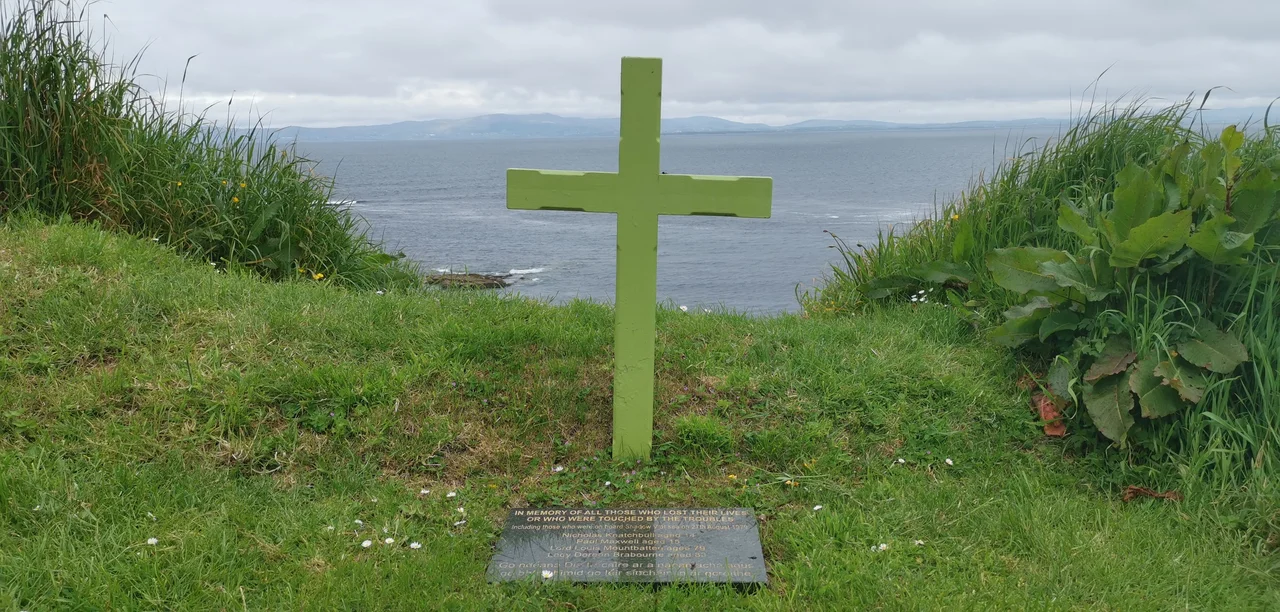

Assassination of Lord Mountbatten
At 11:25 on the morning of 27 August 1979, a 28-foot cabin cruiser called Shadow V slowed beside its lobster pots in the calm water off Mullaghmore, County Sligo. A man on the cliffs above flicked the modified controls of a model aeroplane. The radio signal reached the gelignite hidden under the deck. The boat lifted into the air and disintegrated, and four people died: Louis Mountbatten, who was 79 and at the helm; Nicholas Knatchbull, his fourteen-year-old grandson; Paul Maxwell, a fifteen-year-old boy from Enniskillen who was working as a boatboy; and Nicholas's grandmother Doreen, the Dowager Lady Brabourne, who was 83 and died the next morning at Sligo General Hospital. Three other passengers survived with severe injuries. It was a calm morning. There was very little wind. The bomb did not need the help of weather.
Four People, Not One
The shorthand for what happened that morning - "the assassination of Lord Mountbatten" - is true and incomplete. Mountbatten was the named target, the British statesman whose connection to the royal family made him valuable as a symbol to the people who planned the bombing. But the bomb did not discriminate between his body and the bodies of the others on the boat. Nicholas Knatchbull was fourteen years old, on holiday with his twin brother Timothy. Paul Maxwell was a fifteen-year-old from Enniskillen who had taken the summer job to earn a little money - a quiet, well-liked boy whose father had to bury him four days later in his hometown. Doreen Knatchbull was eighty-three. She was Nicholas's grandmother on his father's side, no part of any political target, only a woman on her family's annual summer holiday. The other survivors - Lady Patricia Brabourne, her husband John, and Timothy Knatchbull - all carried the wounds of that morning for the rest of their lives.
Mullaghmore, Year After Year
The Mountbattens had been holidaying at Classiebawn Castle, just above Mullaghmore harbour, for thirty years. The castle had been built for Lord Palmerston in the nineteenth century and had come into the family through Lady Mountbatten's inheritance. Local people knew the family well. The Knatchbulls played with village children. Mountbatten himself was, by all accounts including those of Irish journalists who criticised him in other contexts, a genuinely friendly and unguarded presence in the village - the kind of summer visitor who actually became part of a small community rather than holding himself apart from it. When asked if he worried about being a target, he replied: "What would they want with an old man like me?" He refused to allow his Garda protection detail onto the boat. The Provisional IRA had considered targeting him as early as 1970. They had cancelled at least two previous plans - one for fear of civilian casualties, another stopped by a ceasefire. In 1979 they did not cancel.
The Morning
Thomas McMahon, an IRA explosives officer from County Monaghan, planted the device on Shadow V during the night of 26-27 August. The bomb contained 50 pounds of gelignite and a radio-controlled detonator. It was placed beneath where Mountbatten was known to sit at the helm. McMahon and an accomplice, Francis McGirl, then drove away in a yellow Ford Cortina, switched to a red Ford Escort near Strokestown, and continued south. At 9:55 that morning - more than an hour before the bomb went off - a young Garda named James Lohan stopped their car at a routine vehicle check 80 miles from Mullaghmore. McGirl gave a false name and had no papers. Lohan, suspicious, took both men into custody. They were therefore already detained when, at 11:25, the bomb was detonated by an unidentified man standing on the cliffs above the harbour. Local fishing boats reached the wreckage within minutes. Mountbatten was still breathing when they pulled him from the water; he died on the way to shore. Lady Brabourne survived the morning and was operated on through the night at Sligo General Hospital, but died the next day from her internal injuries. Two doctors on holiday from Belfast set up an improvised first aid post on the quay. Local people brought doors to use as stretchers and broomsticks for splints.
Warrenpoint
Five hours after the Mullaghmore bomb, on the east coast near the border, the IRA's South Armagh Brigade detonated a 500-pound roadside bomb beside a British Army convoy at Narrow Water Castle outside Warrenpoint, County Down. Six soldiers of the Parachute Regiment were killed instantly. When reinforcements set up a command point at the castle's gatehouse, a second device of 1,000 pounds was detonated there, killing twelve more men - ten Parachute Regiment soldiers and two of the Queen's Own Highlanders, including Lieutenant Colonel David Blair, whose remains were never recovered beyond a single epaulette. Eighteen British soldiers died at Warrenpoint that day. It was the largest single loss of life suffered by the Parachute Regiment since the Second World War. The two attacks together - twenty-two deaths in a single day - represented the deadliest day for the British Army in the entire course of the Troubles.
Trial and Aftermath
Forensic tests found traces of nitroglycerine and ammonium nitrate, two of gelignite's ingredients, on the clothing of both McMahon and McGirl. Investigators recovered flakes of green and white paint from McMahon's boots and jacket - matching Shadow V exactly - and sand from Mullaghmore in his boot treads. McMahon was convicted of the murders on 23 November 1979 and sentenced to life imprisonment. McGirl, on whom no paint or explosives traces were found, was acquitted. The bombing changed British policy on Northern Ireland decisively. Margaret Thatcher - four months into her premiership and grieving the earlier IRA-linked murder of her close friend Airey Neave - shifted the British approach toward an intelligence-led strategy, appointing former MI6 director Maurice Oldfield as inter-service coordinator. Donations to NORAID, the American organisation that had been funding the IRA, fell sharply. The FBI set up a unit in New York to investigate IRA arms procurement on US soil. Francis McGirl died in a tractor accident in March 1995. Thomas McMahon was released in 1998 under the terms of the Good Friday Agreement; he had served nineteen years and renounced his IRA membership while in Mountjoy Prison. In 2021, Mary Lou McDonald, the leader of Sinn Féin, formally apologised for the assassination.
What Remains
Pope John Paul II, who was preparing to visit Ireland and had planned to cross the border to Armagh, cancelled the Northern Ireland part of his trip in response to what the Vatican called "the brutal crimes" of that day. He described the killings as "an insult to human dignity." Tim Pat Coogan, writing in The Irish Press, noted what was missing from the IRA's claim of responsibility: "Not a word of sympathy for the victims, two of them mere children, not a hint of regret, not a scintilla of compassion." In 2015 Prince Charles - now King - travelled to The Model arts centre in Sligo and spoke publicly of forgiveness, then visited Mullaghmore itself. The harbour still holds boats. The cliffs above still hold walkers. Classiebawn Castle still stands. Paul Maxwell's family established a peace foundation in his name. Timothy Knatchbull, who survived, wrote a book about losing his twin brother that morning. Lord Brabourne's broken legs were saved by the Sligo surgeons. The boy who was working as a boatboy for pocket money in his summer holiday never came home from work. His name was Paul, he was fifteen, and on a calm Bank Holiday Monday in 1979 he died with three other people in the bright water off County Sligo.
From the Air
The site of the bombing lies off Mullaghmore, County Sligo, at approximately 54.466°N, 8.449°W, on the north Sligo coast near the Donegal border. From the air, Mullaghmore Harbour and the small peninsula on which Classiebawn Castle stands are visible features, with Benbulbin (526 m) rising 15 km south. Donegal Airport (EIDL) is 35 km north; Sligo Airport (EISG) is 30 km south. The site is best viewed at 1,500-2,500 ft AGL; please note this is a place of remembrance and respectful flyover is appropriate.
Nearby Stories
- Roman Catholic Diocese of Killala 3.2 km away
- County Leitrim 6.2 km away
- Glencolmcille 8.3 km away
- Ballymote 8.5 km away
- Caves of the Tullybrack and Belmore Hills 15 km away
- Ballycastle, County Mayo 20 km away
- Castlederg 32 km away
- RMS Empress of Britain (1930) 80 km away