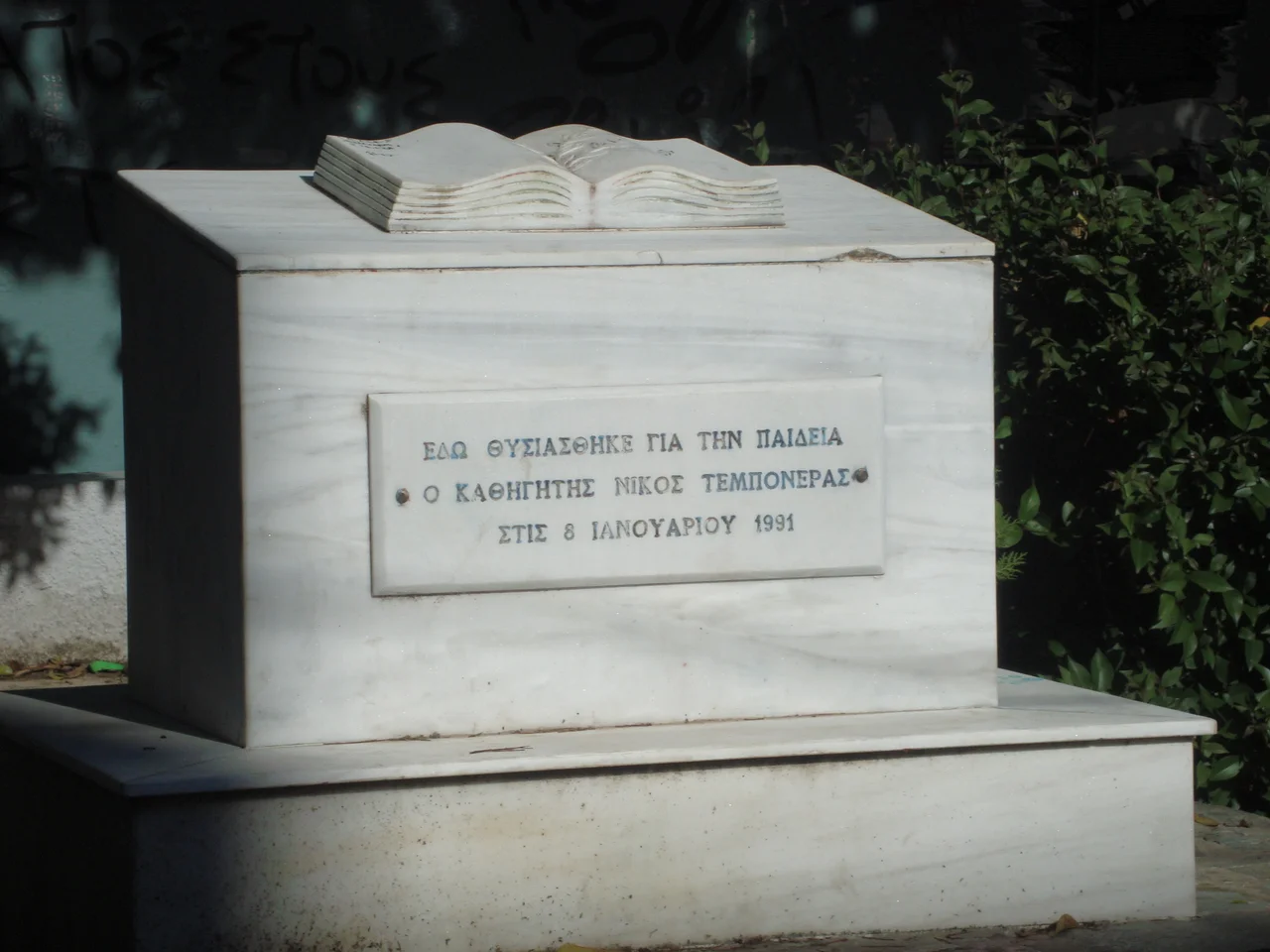

Assassination of Nikos Temponeras
Nikos Temponeras taught mathematics. He was born in 1954, and by January 1991 he was in his late thirties, working at a school complex in Patras that his students had occupied as part of a nationwide protest movement. On the morning of January 8, 1991, he was at the school. He was there because his students were there, and the situation had grown tense. By the end of that morning, he was dead. He was thirty-six or thirty-seven years old — a teacher who had gone to work and never came back.
What the Students Were Protesting
In the autumn of 1990, the conservative New Democracy government introduced an education bill that provoked widespread resistance across Greece. The bill proposed disciplinary control over students' lives outside school hours, mandatory school uniforms, and the abolition of social provisions — free food and housing — for financially struggling university students. Students across Greece responded by occupying their schools and universities, a form of protest with deep roots in Greek political culture. The occupations were not fringe events; they drew support from parents and teachers who saw the bill as an assault on the rights and dignity of young people. One of those teachers was Nikos Temponeras.
January 8, 1991
Giannis Kalampokas was a municipal councillor in Patras and the president of the local branch of ONNED, the youth organization of New Democracy. On January 8, he led a group of ONNED members to the complex housing the 3rd and 7th Patras high schools — the complex where Temponeras taught — with the aim of evicting the student occupiers. They came with bats, iron bars, and cement tiles. The occupiers were supported inside by parents and teachers, Temponeras among them. In the confrontation that followed, Kalampokas struck Temponeras in the head with an iron bar. The blow killed him. Temponeras died that day from his injuries.
The Grief That Spread Nationwide
The killing of a teacher by a political official during a student protest was not something Greece could absorb quietly. The news spread fast, and within days protests erupted across the country. In Athens, during those protests, four more people died — not from violence but from a fire started by a tear gas canister thrown by riot police, a tragedy compounding tragedy. The day after Temponeras was killed, the Minister of Education, Vassilis Kontogiannopoulos, resigned. The most controversial articles of the education bill were withdrawn. The government had moved against students and their teachers, and the death of one man had brought the policy down.
Justice and Its Limits
Giannis Kalampokas was tried for the murder and convicted. He was sentenced to life in prison. Over time, his sentence was reduced — first to 17 years and 3 months, then to 16 years and 9 months — and he was released on February 2, 1998, having served less than seven years. The legal outcome troubled many in Greece who felt that the sentence did not match the gravity of what had happened: a man of political influence had killed a teacher in front of a school, and the consequences were limited. The debate over that outcome has not entirely faded.
What Remains
The school complex where Nikos Temponeras died has been renamed in his memory. Outside the 3rd Lyceum of Patras, a monument marks the place. His name is remembered each year on January 8 by students, teachers, and those who were young in 1991 and have not forgotten what they lost or what they fought for. Temponeras was not a famous man. He was a mathematics teacher who believed that his place, when his students needed support, was beside them. That conviction cost him his life, and it is what people remember when they speak his name.
From the Air
The school complex associated with Nikos Temponeras is located at approximately 38.240°N, 21.735°E in the urban grid of Patras. The city sits on the northwestern Peloponnese coast where the Gulf of Corinth opens toward the Ionian Sea; the Rio-Antirrio Bridge is visible to the north. Nearest major airport is LGRX (Araxos), roughly 25–30 km to the south. At 2,000 feet on approach from the water, the compact blocks of central Patras are clearly visible below the castle hill, with the school district in the city's eastern residential neighborhoods.
Nearby Stories
- Thermos (Aetolia) 8.2 km away
- 1861 Eliki Earthquake 9.6 km away
- Pheneus 14 km away
- Battle of the Echinades (1427) 15 km away
- HMS Perseus (N36) 19 km away
- Amfissa 20 km away
- Astras 21 km away
- Acarnania 28 km away