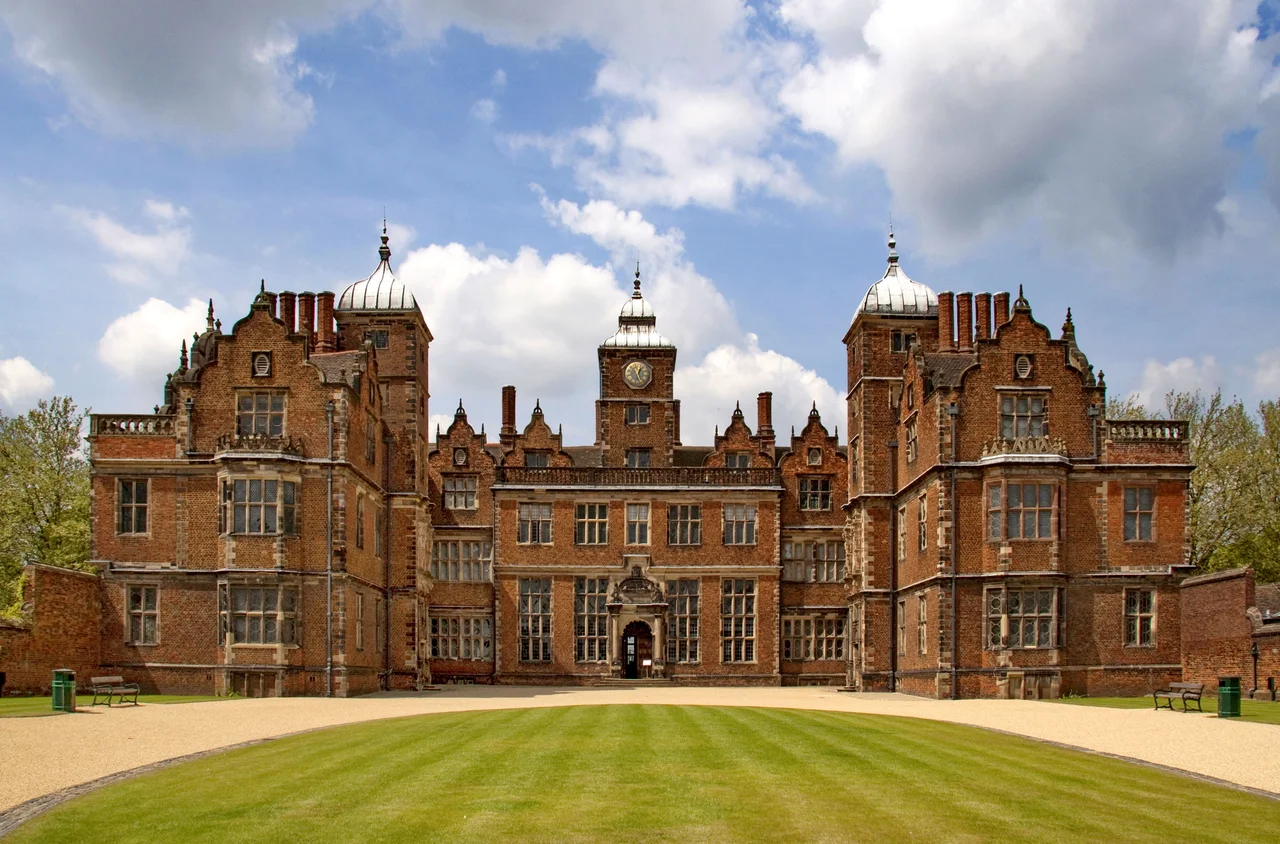

Aston Hall
There is a hole in the staircase. Visitors who climb the great oak stairs at Aston Hall pass it without noticing - a roughly circular wound in the banister, plugged but never disguised, on the inner curve of the flight. It was made by a cannonball in 1643, fired by Parliamentary troops attacking the house in the early years of the English Civil War. The shot came through a window, passed through an open door, and lodged in the wooden banister of a staircase that had been completed only eight years earlier. Sir Thomas Holte, the owner, was a royalist; King Charles I had stayed at Aston Hall in October 1642, on the eve of the Battle of Edgehill. The Parliamentarians knew which house belonged to which side. The cannonball mark is left visible by deliberate choice, the only kind of historical commemoration that requires no plaque to explain itself.
Sir Thomas Holte's Prodigy House
Aston Hall was built between April 1618 and April 1635, to a design by John Thorpe, for Sir Thomas Holte. Holte was a baronet of comparatively modest means by the standards of the Stuart aristocracy, but he chose to build the kind of house known as a prodigy house - a vast, ostentatious, deliberately impressive country mansion intended to demonstrate the owner's wealth and standing. The Jacobean prodigy house was a particular phase of English country-house architecture, marked by enormous symmetrical facades, ranks of mullioned windows, towers and gables, and great long galleries lined with portraits. Hardwick Hall in Derbyshire, Hatfield House in Hertfordshire, and Audley End in Essex are among its other survivors. Aston Hall took seventeen years to build. Holte did not move in until 1631, four years before the work was complete.
Charles I, Edgehill, and the Cannonball
On 22 October 1642 Charles I arrived at Aston Hall on his way south from Shrewsbury to confront the Parliamentary armies. Edgehill, the first major engagement of the English Civil War, was fought the next day at the southern end of Warwickshire. The king's overnight stay at Aston Hall placed the Holtes irrevocably on the royalist side - or, more accurately, confirmed where they already stood. In 1643 Parliamentary forces besieged the house, eventually breaching it. The cannonball that scored the staircase is the most conspicuous surviving evidence. The damage was extensive; Sir Thomas Holte was fined heavily for his royalism after the war, though the house and the family survived. The Holtes remained at Aston Hall until 1817, when the last of the line was no longer able to sustain the property.
Washington Irving's Bracebridge
After the Holtes came various tenants, including James Watt Jr., son of the steam-engine pioneer James Watt, who leased the house in the early nineteenth century. Around 1818 the American writer Washington Irving spent time at Aston Hall and was so struck by the place - and by the warm-hearted English Christmas festivities he experienced there, which he believed had largely been abandoned elsewhere - that he based an entire book on it. Bracebridge Hall, published in 1822, drew its name from Abraham Bracebridge, husband of the last Holte to live in the house, and its scenes from Irving's stay. An Aston Hall custom recorded in The Gentleman's Magazine in 1795 had described how on Christmas Eve the servants have full liberty to drink, dance, sing, and go to bed when they please. Irving turned the impression into prose; a generation of Anglophile Americans took their notion of English Christmas from his book.
The First Municipal Country House
In 1858 the Aston Hall and Park Company Ltd, a private concern, bought the house with the intention of running it as a public park and museum. The company struggled financially, and in 1864 the Birmingham Corporation acquired the property outright - making Aston Hall the first historic country house in Britain to pass into municipal ownership. The borough turned it into a public museum and amenity. From 1879, after a fire at the central library, the city's art collections and Museum of Arms were temporarily moved to Aston Hall while the new Council House art gallery was being built. In 1927 the Birmingham Civic Society commissioned formal gardens, constructed by an unemployed workforce paid through government grants - among the first interwar public-works projects on Birmingham heritage sites. A statue of Pan by William Bloye was installed in 1934. (The head later went missing, prompting a 2011 council appeal for old photographs to assist its restoration.)
Villa Park, Parkruns, and the Aston Expressway
Part of the original Aston Hall park became Villa Park, the home ground of Aston Villa Football Club. The stadium now stands less than 200 yards north of the hall, the floodlights visible from the upstairs windows. In 1972 the easternmost part of the grounds was taken for the A38(M) Aston Expressway, the urban motorway link between central Birmingham and the M6. In 1938, the centenary year of Birmingham's borough status, a Pageant of Birmingham with around 10,000 performers was staged in the grounds. The house received 28,804 visitors in 2019, the last full year before the pandemic; it is open on selected days through spring, summer and autumn. In October 2019, Spectrum Paranormal Investigations and the National Lottery named it the United Kingdom's top haunted heritage site. From October 2023 a weekly parkrun took place in the grounds; it ceased in August 2024, with hopes of an eventual restart. The cannonball hole, meanwhile, remains where it has been for nearly four centuries - on the staircase, in the banister, exactly as the Parliamentarian gunners left it.
From the Air
Located at 52.51N, 1.88W in Aston, north Birmingham, immediately south of Villa Park football stadium. The Jacobean stone mansion with its symmetrical facade and ranks of gables is visible amid the surrounding parkland, with the A38(M) Aston Expressway running close by to the east. The Birmingham city centre skyline lies two miles south. Nearest airports: EGBB (Birmingham International, 7nm SE), EGBE (Coventry, 14nm E). Best viewed at 1,500-2,500 ft AGL.
Nearby Stories
- Shepshed 8.5 km away
- Battle of Evesham 11 km away
- Hixon rail crash 12 km away
- Battle of Cropredy Bridge 12 km away
- Wenlock Priory 15 km away
- RAF Shawbury 16 km away
- Market Bosworth 17 km away