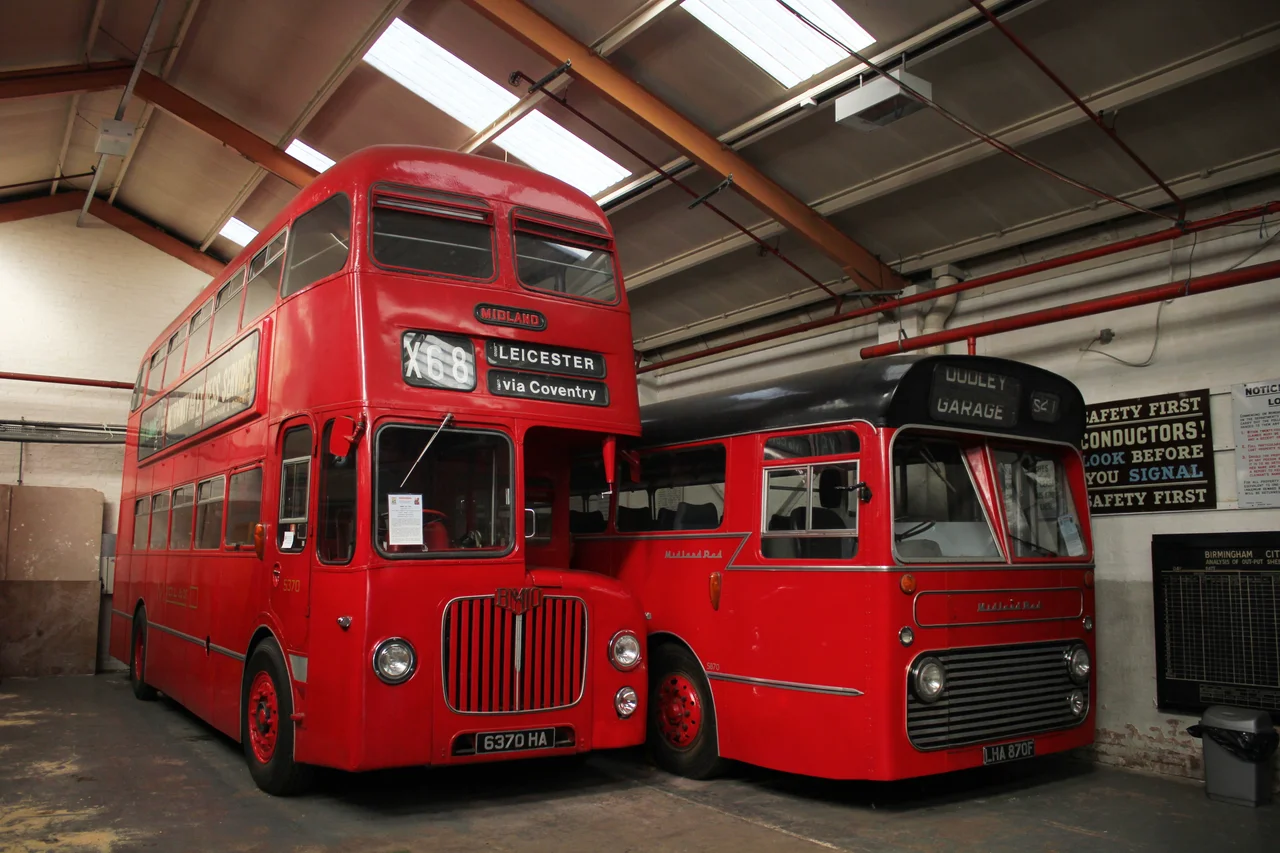

Aston Manor Road Transport Museum
On 14 November 1988, Prince Charles celebrated his fortieth birthday in a Birmingham tram depot. The old Witton shed had once dispatched the trams that knit Birmingham's industrial sprawl together; that evening, with the future king inside cutting a ribbon, it became something stranger and more sentimental. The Aston Manor Road Transport Museum was open. For nearly a quarter of a century, the cavernous Edwardian building on Witton Lane would house buses and tramcars in roughly the same rooms where their working ancestors had been parked between shifts. Then, in 2011, the rent ran out, and the collection went looking for a new home.
A Depot Becomes a Memorial
The Witton Tram Depot was always going to make a good museum. Built for Birmingham Corporation Tramways at the turn of the twentieth century, it had the high ceilings and the long, parallel inspection pits a fleet of double-deckers required. When the trams disappeared from Birmingham's streets, the building sat awkwardly between uses. A registered charity took it over, filled it with preserved vehicles, and turned it back to face the public. The collection grew the way enthusiast collections do -- one rescued chassis at a time, one retired Corporation bus saved from the scrapyard, one Midland Red coach donated by a former driver who could not bear to see it go. The royal birthday party in 1988 announced that this was more than a hobby. It was civic memory, with brakes and steering wheels.
Eviction and Exile
In 2011, Birmingham City Council announced it would no longer fund the rent on the Witton depot. For a small charity, that was the end. The museum closed in October. Over the following weeks, volunteers convoyed buses up the A34 to Aldridge in Walsall, where the former Jack Allen factory -- a plant that had once assembled dustcarts -- offered temporary shelter at the Beecham Business Park. The local press carried photographs of single-deckers being driven slowly through the suburbs, an unintended parade. By December the move was complete, but the new space was not the final destination. The collection moved again, this time only a short distance within Aldridge, to its current home on Shenstone Drive. In July 2013 the doors reopened. The Birmingham address was gone, but the Birmingham vehicles remained.
What Lives in the Sheds
The Aldridge collection is dominated by buses -- the lumbering double-deckers and stocky single-deckers that defined British public transport from the 1930s through to deregulation in the 1980s. Since the move, the trustees have leaned harder into commercial vehicles too: vans, trucks, light delivery lorries, the working machines that propped up small businesses across the Midlands. The displays rotate. Some vehicles live in safe storage off-site and surface only when a slot opens on the museum floor, which means returning visitors see fresh exhibits and the volunteers get to keep tinkering with everything in the fleet. The whole operation runs on goodwill. There are no paid staff. The mechanics are former mechanics; the conductors who explain ticket machines used to clip tickets for a living.
The Free Bus Service
Several weekends a year, the museum runs free heritage buses from Walsall's Hatherton Street to Shenstone Drive and back, ferrying visitors the way the same buses once ferried shift workers and shoppers. Other event days send the fleet to the Chasewater Railway, to Lichfield, or out to Barr Beacon to circle through landscape the vehicles have not seen in decades. There is something quietly affecting about a 1960s Daimler Fleetline pulling up at a modern bus stop, still painted in Birmingham Corporation blue, still smelling faintly of diesel and warm vinyl. Passengers climb aboard and pay nothing. The transaction is purely ceremonial -- a small piece of West Midlands transport history, briefly back in service.
Visiting
The museum opens Tuesdays, Saturdays, and Sundays from 10:30 to 16:00 throughout the year, closing only over the Christmas holiday period. It sits on the edge of Aldridge, surrounded by the kind of low industrial estate that suits a workshop full of buses. The volunteers are happy to talk; some of them remember when these vehicles were new. Children climb into driver's seats. Older visitors sometimes find a route number that triggers a particular journey -- the bus they took to a first job, or to a wedding, or home from school in 1962. The Aston Manor Road Transport Museum is not large, and Aldridge is not on the tourist trail. But the collection still does what Birmingham's old depot did: it keeps the buses warm, and ready, for the next time someone wants to ride.
From the Air
Located at 52.51N, 1.89W in Aldridge, Walsall, on the northern edge of the West Midlands conurbation. The museum sits on Shenstone Drive in a low industrial estate; the original Witton site in Aston is roughly 5nm south-southwest. Nearest airports: EGBB (Birmingham, 9nm S), EGBE (Coventry, 23nm SE), EGOC (RAF Cosford, 15nm WNW). Best viewed at 2,000-3,000 ft AGL against the patchwork of warehouses and the green belt to the north.
Nearby Stories
- Shepshed 8.5 km away
- Battle of Evesham 11 km away
- Hixon rail crash 12 km away
- Battle of Cropredy Bridge 12 km away
- Wenlock Priory 15 km away
- RAF Shawbury 16 km away
- Market Bosworth 17 km away