
Athenian Treasury
Athens built it to say something. The Athenian Treasury at Delphi is not large — it is a compact building in Doric style, perhaps the size of a generous living room — but it sits directly beside the Sacred Way at a point where every pilgrim, athlete, and foreign dignitary climbing toward the Temple of Apollo had to pass it. Every surface that could carry a story does. Thirty sculpted metopes in Parian marble depicted the labors of Theseus and Heracles across its four sides. An inscription on the platform's south face, dated to after 490 BC, declared in plain Greek that the Athenians dedicated the treasury to Apollo from the spoils of the battle of Marathon. The building was a monument, a treasury, and a political statement — and it has stood on this slope for roughly 2,500 years.
Built from Marathon's Spoils
Scholars still disagree about when exactly Athens built the treasury. Scholarly opinions range from 510 to 480 BC, a span that brackets the Persian Wars. Pausanias, the 2nd-century travel writer who documented the sanctuary in detail, was emphatic that it was financed from the spoils of Marathon — the extraordinary Athenian victory of 490 BC in which a Greek force turned back a Persian landing at the bay of Marathon north of Athens. The inscription on the platform's south face supports this: it is dated internally to after 490 BC and reads, in part, 'The Athenians to Apollo, first-fruits of the battle of Marathon.' John Boardman, the classical archaeologist, noted that on purely architectural and stylistic grounds many scholars place it around 500 BC, with some dating it earlier still. The question of exactly when is unresolved. What is clear is why: the treasury was a victory monument displayed at the most prominent religious site in the Greek world, at the point on the Sacred Way where no visitor could miss it.
Theseus Claims the Metopes
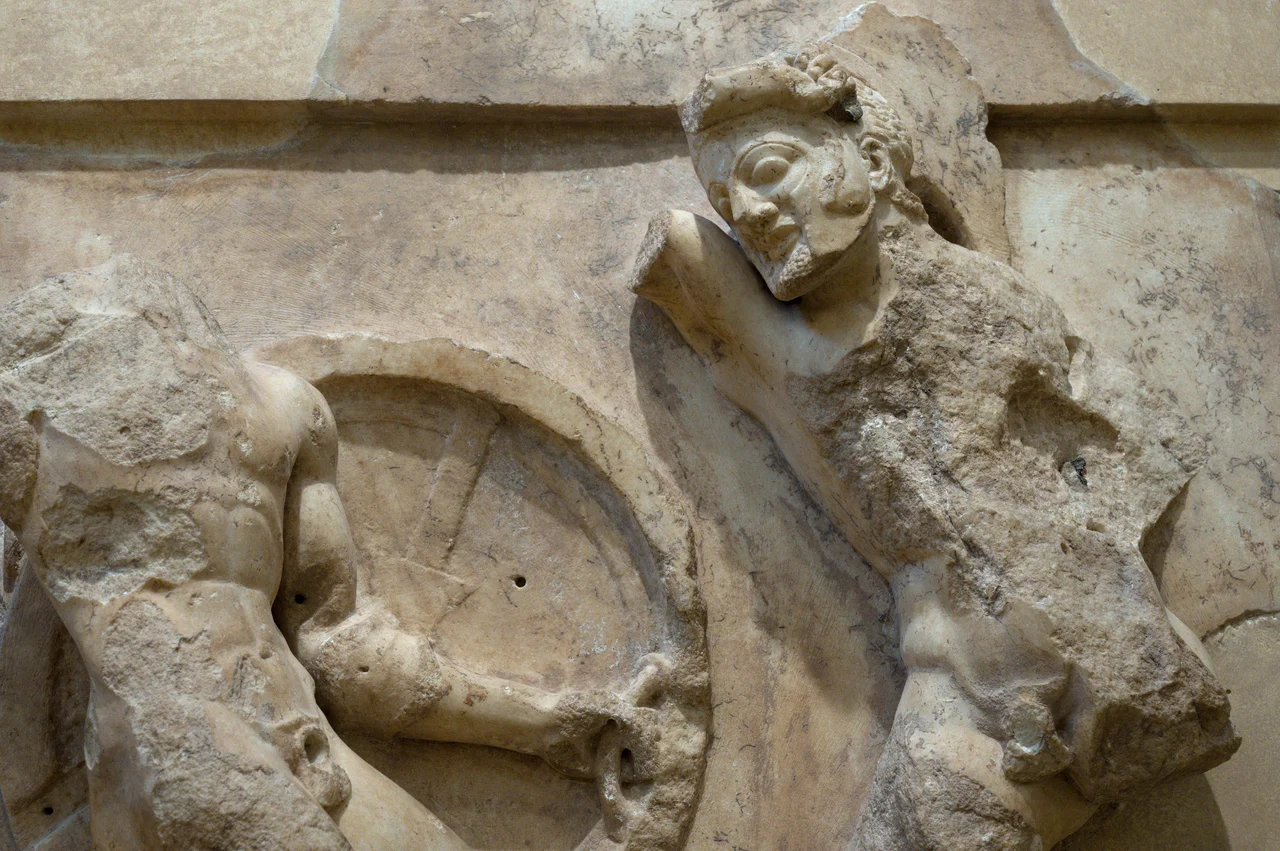
The thirty metopes — each about 67 centimeters tall and 62 to 64 centimeters wide — depicted the labors of Theseus and Heracles. Nine ran along each long side, six along each short side. This is the earliest surviving large-scale sculptural representation of Theseus: before this treasury, he appeared on Athenian vase paintings but not in architectural sculpture. The choice was deliberate. Theseus was the mythological founder and king of Athens, and by placing him alongside Heracles — who was already a fixture of Greek temple sculpture — the Athenians elevated their city-hero to pan-Greek status. The metopes depicted Theseus overcoming monsters and criminals along the road to Athens: Sinis, who bent pine trees to catapult victims; Sciron, who kicked travelers off cliffs; Procrustes, who adjusted guests to fit his bed; the Crommyonian sow; the Minotaur; the Captive Amazon. Beside them, Heracles fought the Nemean Lion, the Ceryneian Hind, a centaur, Cycnus, and Orthrus. The originals are now in the Delphi Museum. The metopes on the building today are reproductions.
The First Athenian Statement at Delphi
The Athenian Treasury was the first dedicated by Athens at a Panhellenic sanctuary. Delphi was not a local shrine — it was a site where city-states from across the Greek world competed for prestige, and a treasury was one of the primary ways a polis displayed its wealth and importance. Athens placed its treasury in a location of maximum visibility, chose marble from Paros for every element including the sculptural decoration, and commissioned a metope program that made an explicit argument: Athens and its heroes stood alongside the greatest figures of Greek myth. In the decades after Marathon, as Athens grew into a naval empire, that argument would seem obvious. In the years when the treasury was built, it was still a statement — one carved into stone and placed at the center of the ancient world's most watched address.
What Remains Today
The treasury was reassembled between 1903 and 1906 by French archaeologists, using the original blocks that had been found scattered around the site. It is the most completely restored building at Delphi and is visible in situ on the Sacred Way, about halfway up the slope from the main entrance to the sanctuary. The reproductions on the facade allow visitors to understand the original sculptural program; the originals in the Delphi Archaeological Museum are among the finest examples of early classical Greek relief sculpture. The platform inscription is still legible. Standing beside the building, you are at roughly the same elevation as the athletes and ambassadors who passed it in antiquity, on the same stone-paved path, looking up at the same Phaedriades cliffs behind the Temple of Apollo above.
From the Air
The Athenian Treasury stands at approximately 38.4818°N, 22.5014°E on the slope of the sanctuary of Delphi, directly below the Temple of Apollo along the Sacred Way. Delphi sits on the southern flank of Mount Parnassus at roughly 570 meters elevation; the Phaedriades cliffs rise dramatically behind the sanctuary and are visible from considerable altitude. Approaching from the south across the Gulf of Corinth, the cliff face is among the first identifiable features of the landscape. Recommended viewing altitude: 6,000–10,000 feet for the Parnassus massif context; lower approaches from the Itea coast offer the best view of the sanctuary's position on the slope. The usual gateway is LGAV (Athens International, Eleftherios Venizelos), approximately 170 km to the southeast. LGRX (Araxos) lies across the Gulf of Corinth. Mountain weather around Parnassus can change rapidly; thermal activity above the cliffs is significant in afternoon hours.
Nearby Stories
- Battle of Vasilika 7.9 km away
- Siege of Negroponte (1470) 8.5 km away
- Battle of Kalavryta 13 km away
- Church of the Nativity of the Theotokos, Limni 14 km away
- Pellene 16 km away
- Panagia Varnakova Monastery 18 km away
- Megara 21 km away
- Karpenisi 41 km away