
Australia Zoo
It started with two acres and a handful of snakes. In 1970, Bob and Lyn Irwin opened the Beerwah Reptile and Fauna Park beneath the volcanic peaks of the Glass House Mountains -- Bob a self-taught herpetologist who would become a pioneer of reptile breeding, Lyn among the first in south-east Queensland to nurse injured wildlife back to health. They taught their three children to love and respect animals, and one of them, a boy named Steve, grew up wrestling crocodiles alongside his father. That family farm is now Australia Zoo, home to more than 1,200 animals and a wildlife hospital that has treated tens of thousands of patients. The whole improbable story grew from a couple who simply could not turn an injured creature away.
Crikey
When Steve Irwin took over the park in 1991 -- renaming it Australia Zoo in 1998 as the family's television profile grew -- he and his wife Terri turned a regional attraction into a global phenomenon. Their documentary series The Crocodile Hunter, which ran from 1996 to 2004, made Steve's khaki shirts and breathless enthusiasm instantly recognisable on every continent, and visitors began arriving by the hundreds of thousands. But the fame was never the point. The Irwins funnelled the money from filming and merchandise straight back into conservation and new exhibits, guided by a stubborn order of priorities Steve repeated like a vow: the animals come first, the team second, the visitors third. He was, by most accounts, exactly as earnest off camera as on.
A Hospital for the Wild
Steve Irwin died on 4 September 2006, killed by a stingray while filming off Batt Reef on the Great Barrier Reef. He was forty-four. More than 300 million people are estimated to have watched the memorial held in the zoo's Crocoseum, and his family asked publicly that no stingray be harmed in his name. The conservation work he and Terri began only deepened. In 2008 a new wildlife hospital opened beside the zoo, built of mud brick and hay and claimed to be among the largest of its kind in the world, capable of caring for up to 10,000 animals a year. During the catastrophic bushfires of 2019 and 2020, the hospital treated its 90,000th patient -- koalas, kangaroos, and birds pulled from the smoke. The grief became a mission.
The Roving Khaki Army
Today the zoo sprawls across more than 750 acres of bushland, though only a fraction is open to the public. Its most theatrical space is the Crocoseum, a 5,000-seat stadium that was the first place in the world to stage snake, bird, and crocodile shows together. Beyond it lies an African savanna of giraffes, zebras, and white rhinos; a tiger temple modelled on Angkor Wat; and the largest elephant enclosure in Australia. Visitors can wander into open enclosures to feed kangaroos and meet a koala, while staff in the family's trademark khaki rove the grounds with snakes and lizards in tow. Many of the exhibits now carry the names of the next generation -- Bindi and Robert Irwin -- who have kept their father's loud, joyful style of wildlife education alive.
Land for the Future
The zoo's real footprint stretches far beyond Beerwah. Through their charity, Wildlife Warriors, the Irwins have bought up vast tracts of habitat for threatened species. At Ironbark Station near Blackbutt, where fewer than a dozen koalas survived, they planted tens of thousands of eucalypts and began rehabilitating native marsupials. At Mourachan, near St George, more than 117,000 acres -- expanded again with a further 33,000 acres in 2015 -- now shelter endangered creatures like the woma python and the yakka skink, giving them room to rebuild their numbers. It is the logical extension of a philosophy that started small: a single sick animal carried home, multiplied across a continent.
From the Air
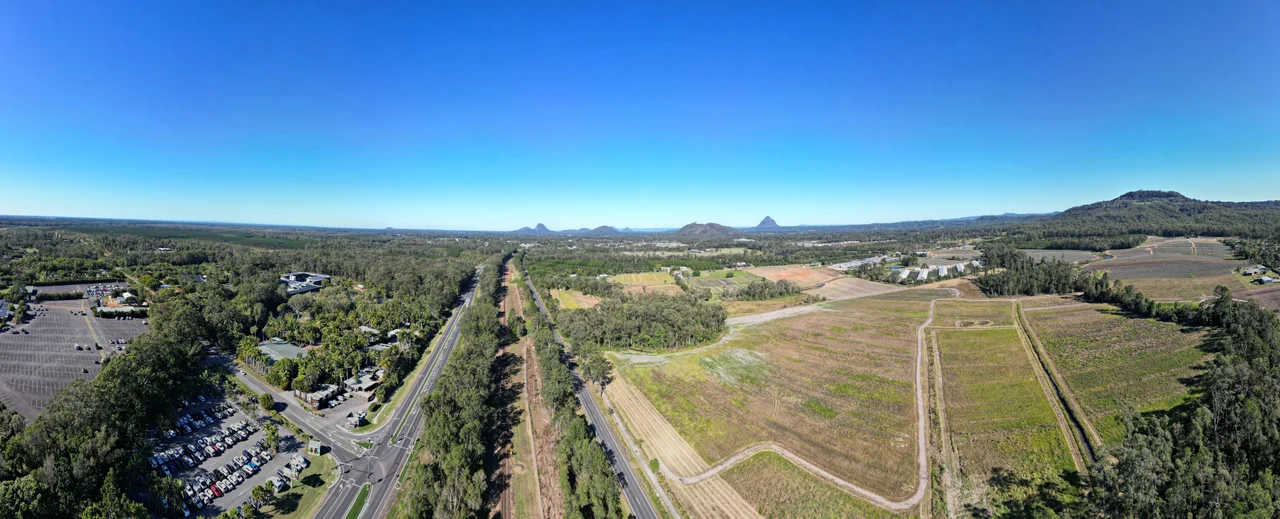
Australia Zoo sits at approximately 26.84S, 152.96E, near Beerwah on the Sunshine Coast hinterland, about 60nm north of Brisbane and just east of the Glass House Mountains. From the air the site is identifiable by its large car parks and cluster of pale exhibit roofs along Steve Irwin Way, set against open bushland and pine plantation. The dramatic volcanic plugs of the Glass House Mountains stand immediately to the west as an unmistakable navigation reference, with Mount Beerwah the tallest at 556m. Nearest airports: Caloundra (YCDR) approximately 15nm east, Caboolture (YCAB) approximately 18nm south, Sunshine Coast (YBSU, Maroochydore) approximately 18nm north-east, Brisbane (YBBN) approximately 55nm south. Expect afternoon cloud over the ranges in summer; terrain rises sharply over the peaks west of the zoo.
Nearby Stories
- Abbey Museum of Art and Archaeology 8.2 km away
- Noosa National Park 18 km away
- Cressbrook Homestead 33 km away
- 2010-2011 Queensland Floods 68 km away
- Childers Palace Backpackers Hostel fire 148 km away
- Cape Byron 174 km away
- Cape Byron Light 204 km away
- HMS Porpoise (1799) 514 km away