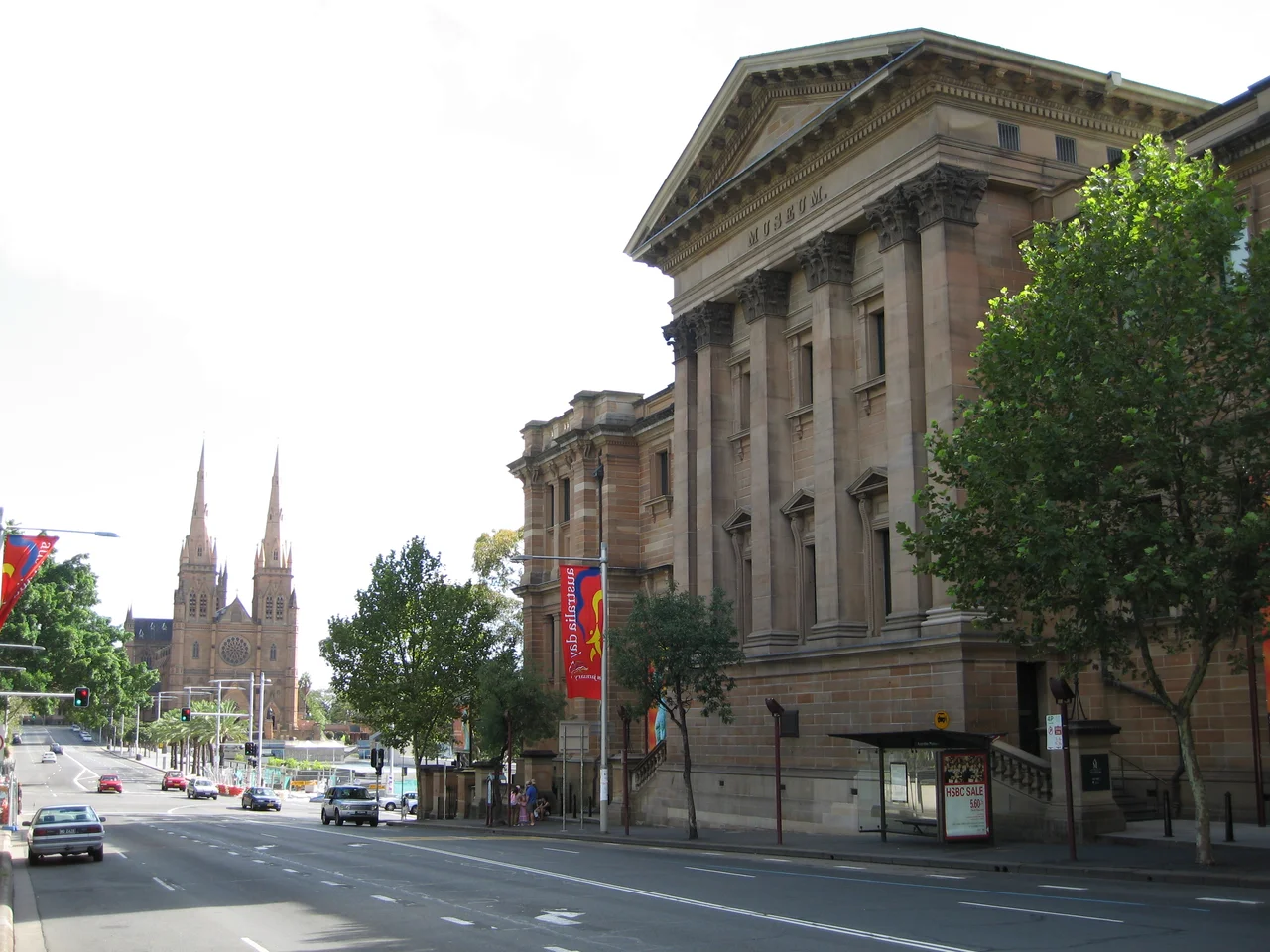

Australian Museum
A British earl who never set foot in Australia signed it into existence. In 1827, Earl Bathurst, Secretary of State for the Colonies, wrote to the governor of New South Wales pledging two hundred pounds a year toward a public museum for the collection of "rare and curious specimens of natural history." The colony was barely four decades old, a struggling penal outpost at the far edge of the known world. Yet from that letter grew the oldest museum in Australia and the fifth-oldest natural history museum on Earth. Today its sandstone galleries on College Street hold more than 22 million objects, and the institution that began as a colonial curiosity cabinet now studies coral reefs, names new species, and tells the stories of the world's oldest continuous cultures.
From Curiosity Cabinet to Encyclopedia
The early collectors had a simple ambition: gather everything. The museum was conceived along the European model of the age, an encyclopedic warehouse where the wonders of a strange southern continent could be sorted, labelled, and shipped to colleagues in London. In those first decades, collecting was the whole point. Specimens of unfamiliar birds, beetles, and minerals were traded with British and other European institutions, as Sydney introduced itself to science one crate at a time. Scientific credibility arrived with Gerard Krefft, who served as curator from 1861 to 1874 and was himself a published naturalist. Under him the museum stopped being a colonial attic and became a place that produced knowledge rather than merely storing it. The name took its own winding road. Originally the Colonial Museum, it was rechristened the Australian Museum in June 1836, the decision reportedly settled during an argument at a sub-committee meeting.
Dinosaurs, a Mummy, and a Cape for Cook
Walk the Westpac Long Gallery and you walk through Australia's first museum gallery, reopened in 2017 as "200 Treasures." The objects on display resist easy summary. A wooden sled hauled across Antarctica during Sir Douglas Mawson's expedition sits near an Egyptian mummy. Nearby rests a feathered cape, presented to Captain James Cook when he arrived in Hawaii. Elsewhere, the permanent "Dinosaurs" and "Surviving Australia" galleries trace deep time and the continent's famously dangerous wildlife, while "Wild Planet" arranges more than four hundred animals into a single sweeping portrait of evolution. The museum has never been shy about spectacle. It once ran a two-carriage Australian Museum Train that carried fossils and lessons to country schoolchildren across New South Wales, and it has hosted everything from Aztec artefacts to the treasures of Ramses the Great.
Telling First Nations Stories
An encyclopedic museum founded by colonisers carries an obligation, and in recent decades the Australian Museum has worked to meet it. The permanent gallery "Garrigarrang: Sea Country," opened in 2014, presents objects belonging to Aboriginal and Torres Strait Islander peoples on their own terms. In 2021 the temporary exhibition "Unsettled" examined the colonisation of Australia through Indigenous perspectives, curated by Laura McBride and Mariko Smith, drawing on more than eighty cultural artefacts and over a hundred contributions from First Nations people nationwide. The 2012 show "Sydney Elders" gathered portraits by the celebrated Aboriginal photographer Mervyn Bishop, honouring community leaders who shaped culture, health, education, and justice. These are not footnotes to the natural history. They are an acknowledgement that the land outside the doors has been lived on, named, and cared for across tens of thousands of years.
Science Beyond the Galleries
Much of the museum's most important work happens far from its display cases. Since 1973 it has run the Lizard Island Research Station on the Great Barrier Reef, studying coral ecology and the warming seas that threaten it. The Australian Museum Research Institute, launched in 2013, serves as the hub for its Sydney scientists, who play a leading role in describing and classifying life. The work sometimes carries a sense of humour: in 2017 researchers gave a Tasmanian semi-slug a new genus name, Attenborougharion, in honour of the museum's lifetime patron David Attenborough. The institution also turns the public into collaborators. Each year, ordinary Australians record frog calls on the FrogID app, and the pooled recordings become a nationwide snapshot of amphibian health. A nineteenth-century cabinet of curiosities has become, improbably, a working laboratory for the twenty-first century's defining environmental questions.
From the Air
The Australian Museum stands on the corner of College and William Streets at 33.874°S, 151.213°E, on the eastern edge of Hyde Park in central Sydney. From the air it reads as a long sandstone block among the green of the park, a short walk from the Anzac Memorial and St Mary's Cathedral. Best appreciated on a city overflight at 1,500 to 2,500 feet, with the harbour and Opera House visible to the north. Sydney Airport (YSSY / Kingsford Smith) lies roughly 8 km south; Bankstown (YSBK) sits to the southwest for general aviation. Sydney's controlled airspace is busy and tightly managed, so coordinate with ATC; clear summer mornings offer the sharpest light over the CBD.
Nearby Stories
- Royal National Park 28 km away
- Jervis Bay 107 km away
- Hive shipwreck 149 km away
- Apsley Falls 283 km away
- Smoky Cape Lighthouse 316 km away
- South West Rocks Pilot Station Complex 346 km away
- Roxy Theatre and Peters Greek Cafe Complex 413 km away
- 2003 Fiordland Earthquake 1774 km away