
Axum
The Great Stele of Axum weighed more than five hundred tonnes when it was quarried, dressed, and somehow raised upright from a single piece of solid granite. It stood over thirty-three metres tall - the largest monolith ever erected by human hands - before it toppled, sometime in the fourth century AD, and shattered into the fragments that still lie on the ground today. No one knows exactly how the Aksumites moved it. No one is entirely sure why they carved it. What the stelae make unmistakable is that the kingdom that rose here on the Tigrayan plateau considered itself the equal of Rome.
An Equal of Empires
For nearly eight centuries, Aksum sat in the conversation of the ancient world alongside Rome, Persia, and China. Caravans crossed the Red Sea loaded with ivory, gold, and obsidian; coins struck in the city's mints circulated from Egypt to South Asia. The Ezana Stele still stands at a deliberate lean in the centre of the Northern Stelae Field, propped against gravity as a precaution against the fate of its taller siblings. The Obelisk of Axum, 24 metres high, spent most of the twentieth century in Rome - looted in 1937 by the forces of Fascist Italy, displayed near the Circus Maximus, and finally returned home in pieces by Italian military aircraft. In 2008 it was re-erected between the Ezana Stele and the fallen giant. The symbolism was not subtle.
Granite Carved from the Sky
The stelae are monolithic - each carved from a single block of granite quarried roughly four kilometres away. Their faces are dressed with false windows, false doors, and bands that imitate timber beams, as if the Aksumites had translated the houses of the living into housing for the dead. Beneath them lie tombs: the mausoleum, the Tomb of the False Door with its astonishingly precise joinery, and the brick-walled chambers reopened to visitors in recent years. The purpose of the stelae is still debated. Grave markers seems the best guess. The scale of them says more. To raise that much stone, a society needed granaries, bureaucrats, masons who inherited their craft, and a ruler powerful enough to command decades of labour.
The Ark and the Fig Tree
Ethiopian Orthodox tradition teaches that the Ark of the Covenant rests here, inside the Chapel of the Tablet at the Cathedral of St Mary of Zion. Only one monk - a guardian chosen for life - is permitted to see it. Pilgrims accept this with the same unquestioning certainty that has carried Ethiopian Christianity across seventeen centuries, since Ezana of Aksum converted his kingdom and made it one of the first officially Christian states in history. On the first seven days of each Ethiopian calendar month, a replica Ark is paraded near the fig tree by the churches complex at 03:00 by the standard clock. Most visitors never see it. Sitting beneath the fig tree in the pre-dawn quiet, waiting, turns out to be the point.
The Quieter City
Axum today is a Tigrayan town of around 56,000, its cobbled side streets shaded by flame trees, its bajaj rickshaws whining between the Northern Stelae Field and the main road. It is cleaner than many Ethiopian towns, and quieter - the tourist pressure that once filled the Yeha Hotel terrace has thinned with the region's recent troubles. From that terrace, with a St George beer in hand, the stelae field spreads below: standing, leaning, fallen, re-erected. Local couples still come here for their wedding photos. The granite behind them has been watching weddings in one form or another for almost two thousand years.
Across the Highlands
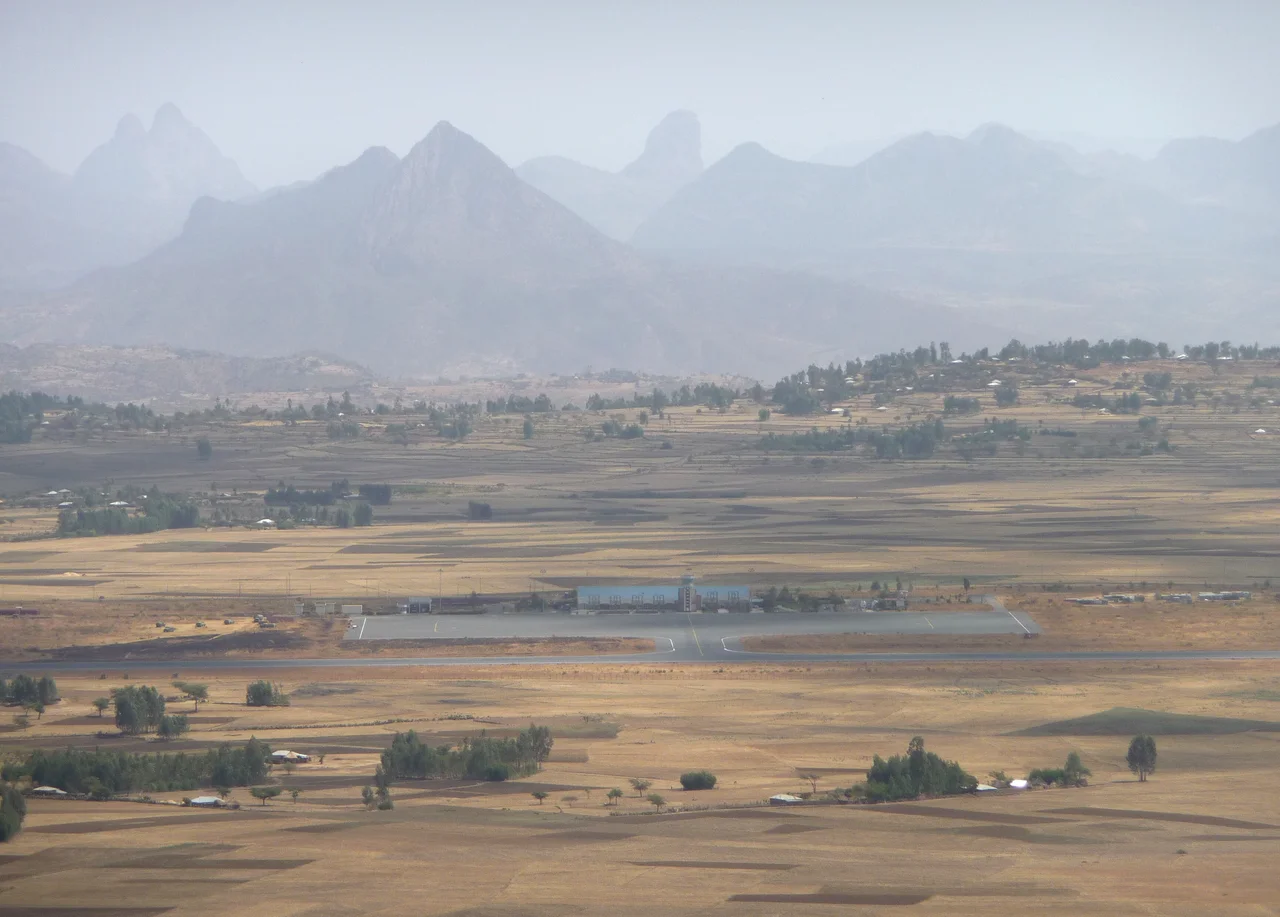
Axum sits at 2,130 metres in the Tigray highlands, just south of the Eritrean border it shares through the Tigrinya language. The Yohannes IV Airport, named for the nineteenth-century Ethiopian emperor, handles flights from Addis Ababa; the road from Gondar through Debarik climbs some of the most spectacular mountain country in Africa before descending into the Shire plains. Yeha, with its pre-Christian temple from a civilisation older than Aksum itself, lies a short minibus ride east. The past in this landscape is not layered. It all sits on the surface, visible at once.
From the Air
Axum sits at 14.12 degrees N, 38.73 degrees E in the Tigray highlands of northern Ethiopia, at an elevation of roughly 2,130 metres. The nearest airfield is Yohannes IV/Axum Airport (ICAO HAAX), with Shire Airport (HASR) about an hour by road. From cruising altitude the Northern Stelae Field appears as a distinctive cluster of monoliths north of the town centre; the cobbled main street and the Cathedral of St Mary of Zion complex are visible just south of the stelae. Clear dry-season visibility is best from October through May.
Nearby Stories
- Dedebit Elementary School airstrike 42 km away
- Tigray Region 43 km away
- Mekelle 45 km away
- Southern region (Eritrea) 46 km away
- Eritrean-Ethiopian War 57 km away
- Simien National Park 84 km away
- Battle of Amba Aradam 92 km away
- Adulis 99 km away