.jpg)
Babbacombe Cliff Railway
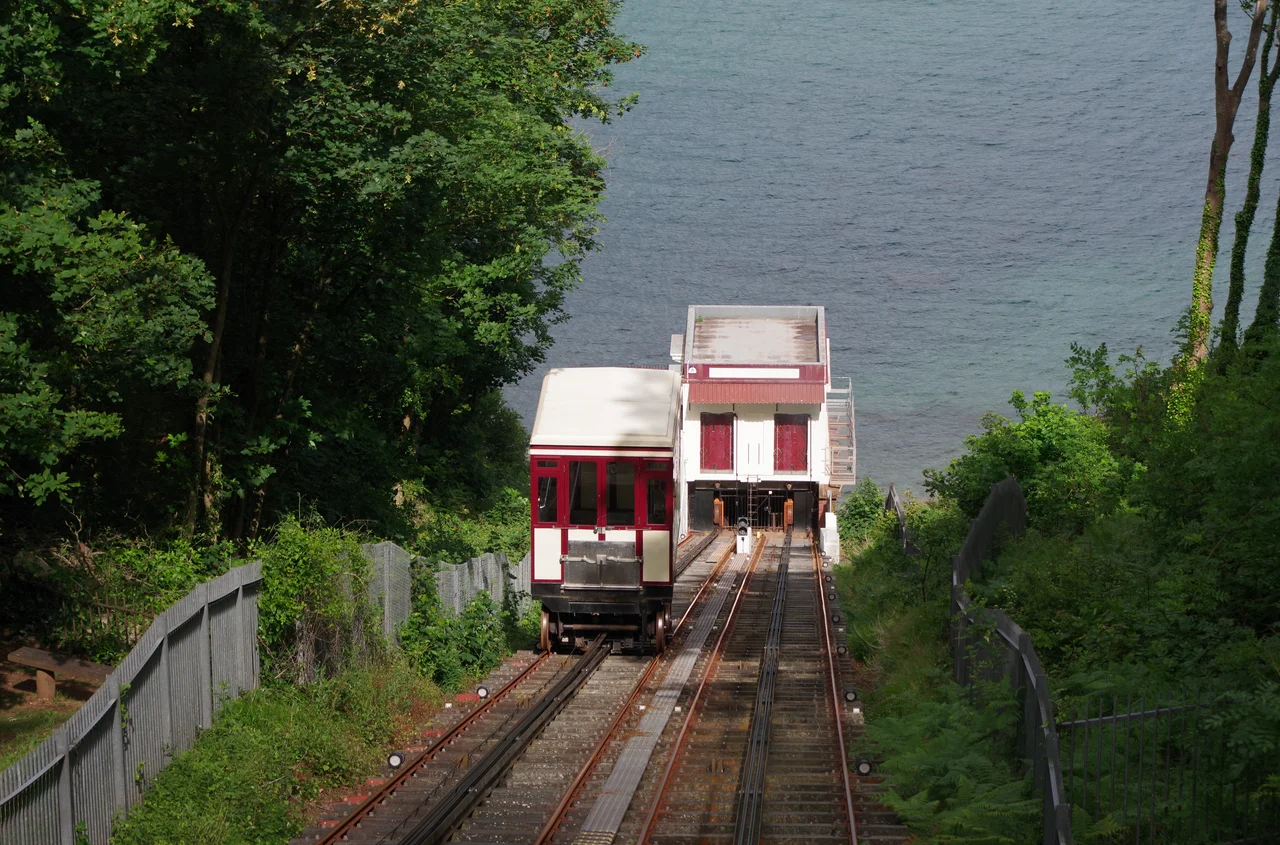
A bell rings inside the small upper station at Babbacombe Downs, fifteen minutes before closing time, the way it has rung since the line opened on 1 April 1926. Out the window, the cliff drops away to a curve of red sand far below. The two cars of the Babbacombe Cliff Railway are connected by a single hoisting cable and balance each other on a 720-foot inclined track between Babbacombe Downs and Oddicombe Beach. Walk to the lower station and the sea is right there, the air heavy with salt and chip-shop vinegar. The cliff is too steep, in most places, for a footpath of any dignity. So for ninety-nine years the funicular has done the work. It is the kind of small Victorian-era public infrastructure that became more cherished, not less, as the century turned over and the world hurried elsewhere.
Thirty-Six Years of Trying
The idea was older than the railway. In April 1890, Charles Richardson of Cary Castle in St Marychurch proposed building a cliff lift at Babbacombe along the same lines as the one at Lynton, which had opened the year before. George Newnes, the publisher and Liberal MP who had backed the Lynton line, took up the cause. The Babbacombe scheme was talked about, planned, abandoned in 1893, revived in 1907, and still being argued over when the First World War broke out in 1914. The patience of the seaside town was not bottomless, but it was real. In February 1923 the Torquay Tramway Company finally commissioned Waygood-Otis to design and build the line. Construction started in 1924. The line opened in 1926 at a final cost of 15,648 pounds, a substantial sum for a cliff railway and a much smaller one for the half-century of decision-making that had preceded it.
Closed for the War
The Torquay Tramway Company worked the line for nine years, until 13 March 1935, when ownership passed to Torquay Borough Council. The railway then ran another six years before the war shut it down. In 1941, under wartime security restrictions that quietly affected hundreds of small public works along the south coast, the line was closed. The boathouses, the funiculars, the pleasure piers, the seafront tramways, all became unnecessary luxuries in a country preparing for invasion. Babbacombe stayed closed for ten years. The reopening in 1951, after extensive modernisation by J & E Hall of Dartford, became its own small celebration. The fare that summer was sixpence return, fourpence going up, threepence coming down. The cars carried families to the beach, and the rope and the brake gear and the bell did what they had always done.
How It Works
The railway is a counterbalanced funicular of traditional design. Two cars, each capable of holding forty standing passengers, are connected by a hoisting rope so that when one car descends, the other rises. A compensating rope balances the load on the track regardless of where the cars happen to be. The drive equipment lives at the top station and runs on a direct-current system through a servomotor-operated controller. The maximum speed is 2.5 metres per second, which is just slow enough for the descent to be enjoyable and just fast enough that the geology rolling past the window starts to become a kind of pleasure in itself. Major refurbishment came in 1993, another three-year programme of renovation in 2005, and in 2009 the ownership of the line moved from Torbay Council to a community interest company. In 2019 the CIC became a Charitable Incorporated Organisation, which is how the line is operated today.
Tragedy and the Long Reopening
On 4 September 2022, an engineer working on the railway was killed in what the company described as an industrial incident. The line closed. The investigation that followed, and the work needed to make sure something like it would not happen again, kept the cars idle for almost a year. The railway reopened in July 2023, after months in which the lower station looked out at an empty beach and the upper station's ticket window stayed shuttered. It had to close briefly again that August for further repairs. The community that runs the line, and the small trust that owns it, were sustained through that time by the same patience that built the railway in the first place: the long memory of a Devon seaside town that knows what it has, knows what was lost, and intends, as far as it is able, to keep the cars running for the next set of children who will press their faces against the glass and watch Oddicombe rise toward them.
From the Air
Babbacombe Cliff Railway runs between 50.4814N, 3.5146W at the top station and the sea below. From 1,500 to 3,000 feet, the line and its two stations are visible cut into the red Devon cliffs between Babbacombe Downs and Oddicombe Beach, just north of Torquay. Exeter Airport (EGTE) lies about 18 nautical miles to the north and offers the most convenient arrival. Look for the red sandstone cliffs of Babbacombe, the curving beach of Oddicombe, and Petitor Point projecting east into Lyme Bay just to the north of the railway.
Nearby Stories
- Childe's Tomb 5.7 km away
- Coldharbour Mill Working Wool Museum 11 km away
- Montacute Castle 18 km away
- Action of 18 June 1793 18 km away
- Portland Bill 25 km away
- Eddystone Lighthouse 30 km away
- Manor of Orleigh 33 km away
- German Submarine U-672 33 km away