
Bahía Blanca
The name is a description you can see from space: Bahía Blanca, the White Bay, named for the pale crust of salt that whitens the soil along its shores. Ferdinand Magellan glimpsed this estuary in 1520, hunting for a passage between two oceans that did not exist here. Three centuries later, Argentina planted a fort on the salt flats, and that lonely outpost on a hostile frontier grew into a city of more than 336,000, the principal hub of Argentina's deep south. Locals simply call it Bahía. To understand it, you have to understand that almost everything here, the railways, the grain, the navy, the oil, has flowed toward one thing: the only naturally deep harbor on this stretch of coast.
A Fortress on the Frontier
Bahía Blanca began as a defensive act. On 11 April 1828, Colonel Ramón Estomba founded a fort here on the orders of Juan Manuel de Rosas, naming it the Fortaleza Protectora Argentina, the Argentine Protective Fortress. It guarded settlers from cattle raiders and watched the coast against the Brazilian navy, which had landed nearby the year before. This was contested ground. In 1859 some 3,000 warriors led by the Mapuche chief Calfucurá attacked the settlement, one of many such raids the frontier endured. In September 1833 a young naturalist named Charles Darwin passed through during the voyage of the Beagle, riding the pampa and noting its fossils and its dangers. The fort held, and slowly a town gathered around it.
The Railways Made It
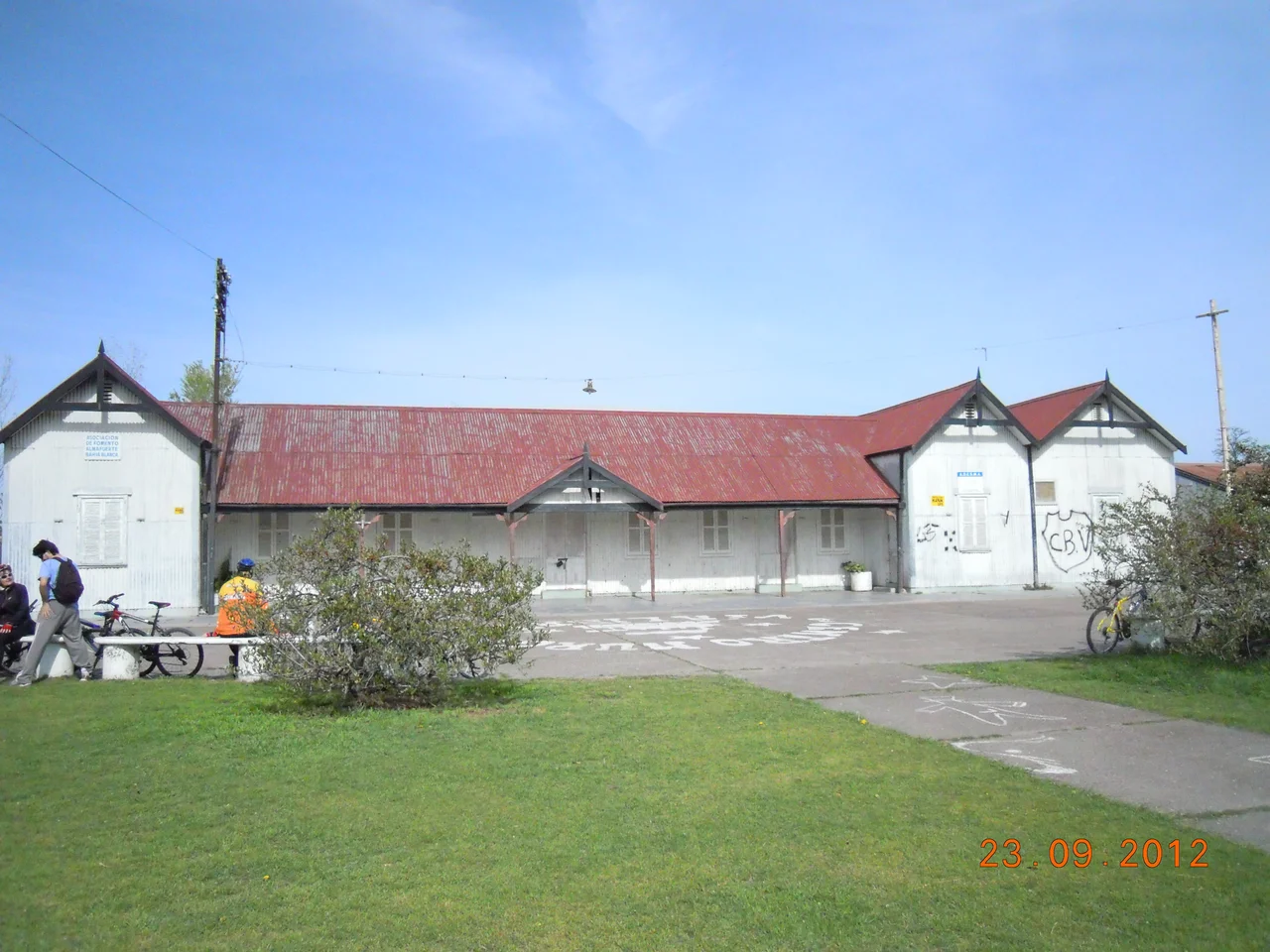
What turned a fort into a city was iron. In 1885 the British-built Buenos Aires Great Southern Railway reached the town, linking it to the capital and opening a route for the grain of the Pampas to reach the sea. The Bahía Blanca Sud station had opened the year before. Two more railways followed: a British line in 1891 and a French line, the Rosario and Puerto Belgrano, in 1912. Trains pulled in wheat and wool, oil from Neuquén, and fruit from the Río Negro valley, and the port sent it all out to the world. The rails also pulled in people. Immigrants arrived mainly from Spain and Italy, with notable French, Dutch, German, and Eastern European Jewish communities settling the city and the towns around it.
Opera Houses and a Titanic Survivor
Those immigrants brought their world with them. By the early twentieth century Bahía Blanca had at least five opera houses and, by 1920, six cinemas, an unexpected richness for a frontier port. The city has sent remarkable people out into the world ever since. The biochemist César Milstein, born here in 1927, won a Nobel Prize in Medicine. Manu Ginóbili, born in 1977, became a basketball Hall of Famer and Olympic champion. Footballers Lautaro Martínez and Daniel Bertoni both won World Cups. And Violet Jessop, born here in 1887, survived not one but two ocean-liner disasters, the sinkings of the Titanic and the Britannic, after also surviving a collision aboard the Olympic. Few cities of its size have scattered such a varied diaspora.
The Day the Rain Came
In March 2025, Bahía Blanca endured the worst rainfall the city had known in living memory. In a single storm that raged for roughly six hours through the early morning, roughly 290 millimeters fell, more than half the city's average for an entire year and the most devastating rainfall in Argentina since 1975. Streets became rivers. At least seventeen people died, and hundreds were reported missing in the chaos. The disaster drew help from across the country and beyond: donations poured in, President Javier Milei cut short a trip abroad, and political rivals set aside their quarrels to coordinate the response. Even Starlink offered the city a month of free internet. It was a brutal reminder that this port, built at the edge of land and water, lives always within reach of both.
From the Air
Bahía Blanca lies at approximately 38.72 degrees south, 62.27 degrees west, at the head of its eponymous bay on the Argentine Sea. From altitude, look for the wide, shallow estuary fringed by pale salt flats and tidal channels, with the dense urban grid set back from the water and a sprawl of port and petrochemical infrastructure along the northeastern shore at Puerto Ingeniero White and Puerto Galván. The city is served by Comandante Espora Airport (SAZB / BHI), whose runways are shared with the Argentine Navy's nearby air base. National Route 3 splits here, running north toward Buenos Aires and south into Patagonia, while Route 35 heads northwest to Santa Rosa (SAZR) and Route 22 leads west toward Neuquén (SAZN). The flat surrounding pampa offers few obstacles; coastal humidity and sea fog can reduce visibility near the bay.
Nearby Stories
- Desert Campaign (1833–1834) 53 km away
- Sierra de la Ventana (mountains) 55 km away
- Monte Hermoso 56 km away
- Tres Arroyos 141 km away
- Carmen de Patagones 196 km away
- Viedma 227 km away
- Lihué Calel National Park 245 km away
- Disappearance of ARA San Juan 869 km away