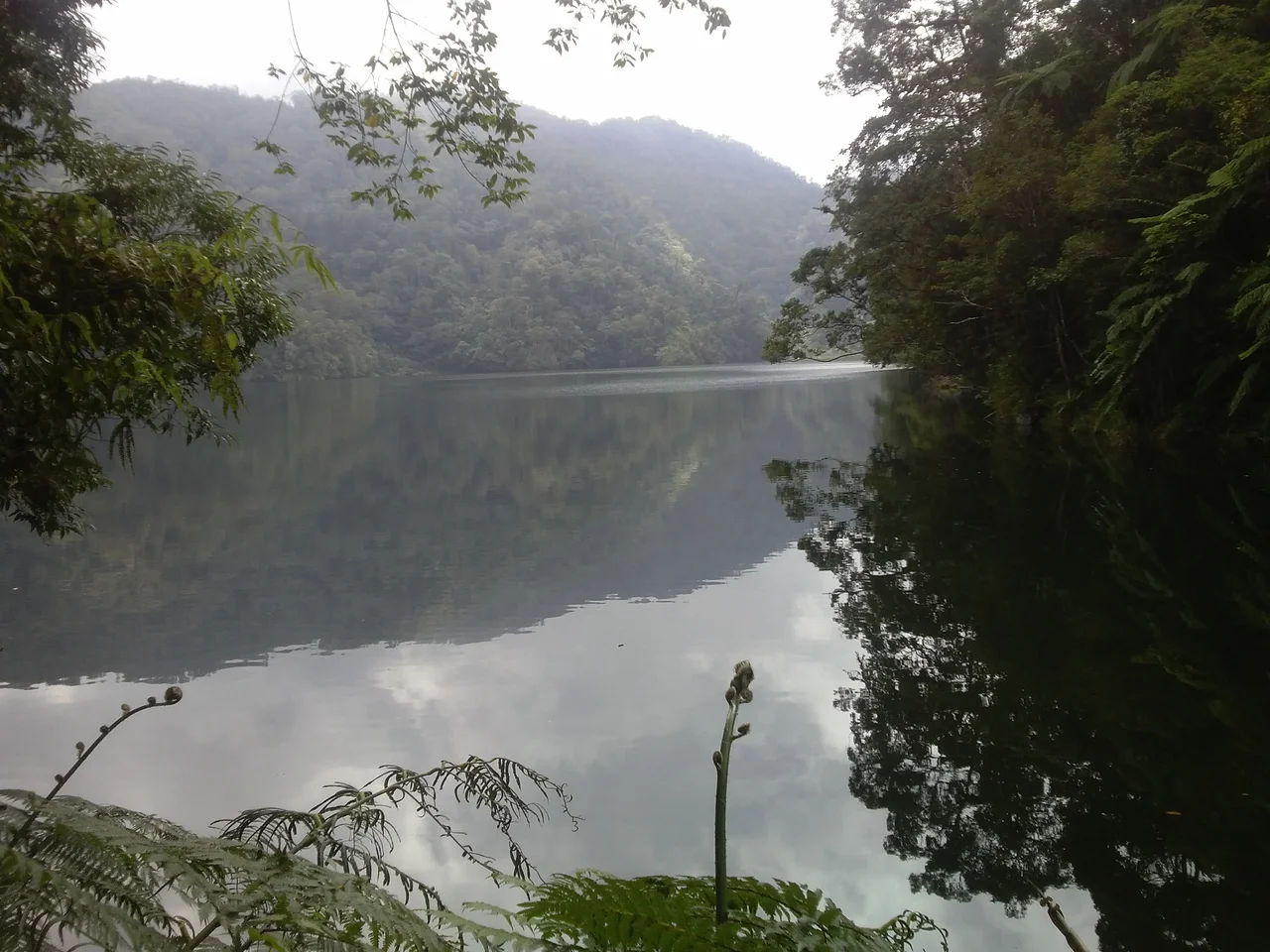

Balinsasayao Twin Lakes Natural Park
Two lakes, separated by a knife-edge ridge, sit inside a volcanic caldera 14.5 kilometers west of Dumaguete. No road signs announce their significance. You climb through dipterocarp forest, the trail switching back through terrain that rises from 830 meters to the caldera rim, until the canopy opens and the water appears below -- dark, still, and deep enough to swallow a nine-story building. Balinsasayao Twin Lakes Natural Park protects these crater lakes and the 8,016 hectares of highland forest surrounding them, an ecosystem so exceptional that the ASEAN Centre for Biodiversity included it in its network of topnotch nature reserves in 2024, and ASEAN designated it a Heritage Park in 2025.
Two Lakes, One Caldera
Lakes Balinsasayao and Danao lie within the Guintabon Caldera on the eastern slope of the Cuernos de Negros volcanic range. Mount Guintabon rises to the west, Mount Balinsasayao to the east, Mount Kalbasaan to the north, and Mount Mahungot to the south -- a ring of peaks that shelters the lakes from wind and development alike. Balinsasayao, the larger lake, spans 76 hectares with a maximum depth of about 90 meters. Danao is more modest at 30 hectares and 58 meters deep. A third, smaller lake called Kabalin-an lies nearby. All three formed in volcanic craters, their waters fed by springs and rainfall rather than rivers.
The Forest That Feeds Five Rivers
The twin lakes and their surrounding primary and secondary dipterocarp forests are not just scenery. They function as the watershed for all of southern Negros Oriental, feeding the headwaters of five major river systems -- the Amlan, Ayuquitan, Hinotongan, Okoy, and Cauitan. These rivers irrigate the lowland communities, supply their drinking water, and sustain the agriculture that feeds much of the province. Strip the forest, and you strip the region's water security. The park spans the municipalities of Valencia, Sibulan, and San Jose, and also overlaps with the 133,000-hectare Negros Geothermal Reservation operated by the Energy Development Corporation, where underground volcanic heat is harnessed to generate electricity for Dumaguete and the surrounding region. Protection of this landscape serves both ecological and economic imperatives -- a rare case where conservation and development argue for exactly the same thing.
Wings in the Canopy
Birdlife International recognizes Balinsasayao as an important bird area, and with good reason. The park supports at least 114 bird species, including two critically endangered birds found only in this region: the Negros bleeding-heart pigeon, a dove whose crimson breast patch looks startlingly like a wound, and the Visayan wrinkled hornbill, a large, spectacular bird whose numbers continue to decline. The Negros striped babbler, flame-templed babbler, Japanese night heron, and white-throated jungle flycatcher are among the other endangered species that shelter here. Philippine ducks paddle the lake margins. Rufous-lored kingfishers flash through the understory. Celestial monarchs -- small, brilliant blue flycatchers -- dart among the branches. White-winged cuckooshrikes, streaked reed-warblers, Visayan flowerpeckers, and Philippine cockatoos round out an avian community that ornithologists travel considerable distances to observe.
Giants on Leathery Wings
The park's 27 documented mammal species include some of the rarest in the world. Philippine spotted deer browse in forest clearings -- endangered animals found on only a few islands. Visayan warty pigs root through the understory, a species surviving in scattered pockets across the central Philippines. The endemic Negros shrew, found nowhere else, inhabits the forest floor. Visayan leopard cats hunt by night along the ridgelines between the lakes. But the most spectacular mammals take to the air: the giant golden-crowned flying fox, one of the largest bats on earth with a wingspan approaching 1.7 meters, roosts in the canopy alongside the Philippine naked-backed fruit bat, the Philippine tube-nosed fruit bat, and the little golden-mantled flying fox. These animals are not just charismatic. They are seed dispersers whose nightly flights maintain the forest that maintains the watershed that maintains the province.
From the Air
Balinsasayao Twin Lakes Natural Park sits in the highlands of southern Negros Island at approximately 9.35N, 123.17E, within the Cuernos de Negros volcanic complex. From altitude, the twin crater lakes appear as dark oval mirrors amid dense forest canopy. The park spans the municipalities of Valencia, Sibulan, and San Jose. The nearest airport is Dumaguete-Sibulan Airport (RPVD), about 14.5 km to the east. Terrain rises sharply; maintain safe altitude. Cloud cover frequently obscures the caldera.
Nearby Stories
- Apo Island 8.7 km away
- Japanese Cruiser Abukuma 19 km away
- Kawasan Falls 22 km away
- Guimaras Oil Spill 65 km away
- Cebu 74 km away
- 1995 Ipil Massacre 152 km away
- November 2023 Mindanao Earthquake 420 km away
- Balut Island 481 km away