
Kawasan Falls
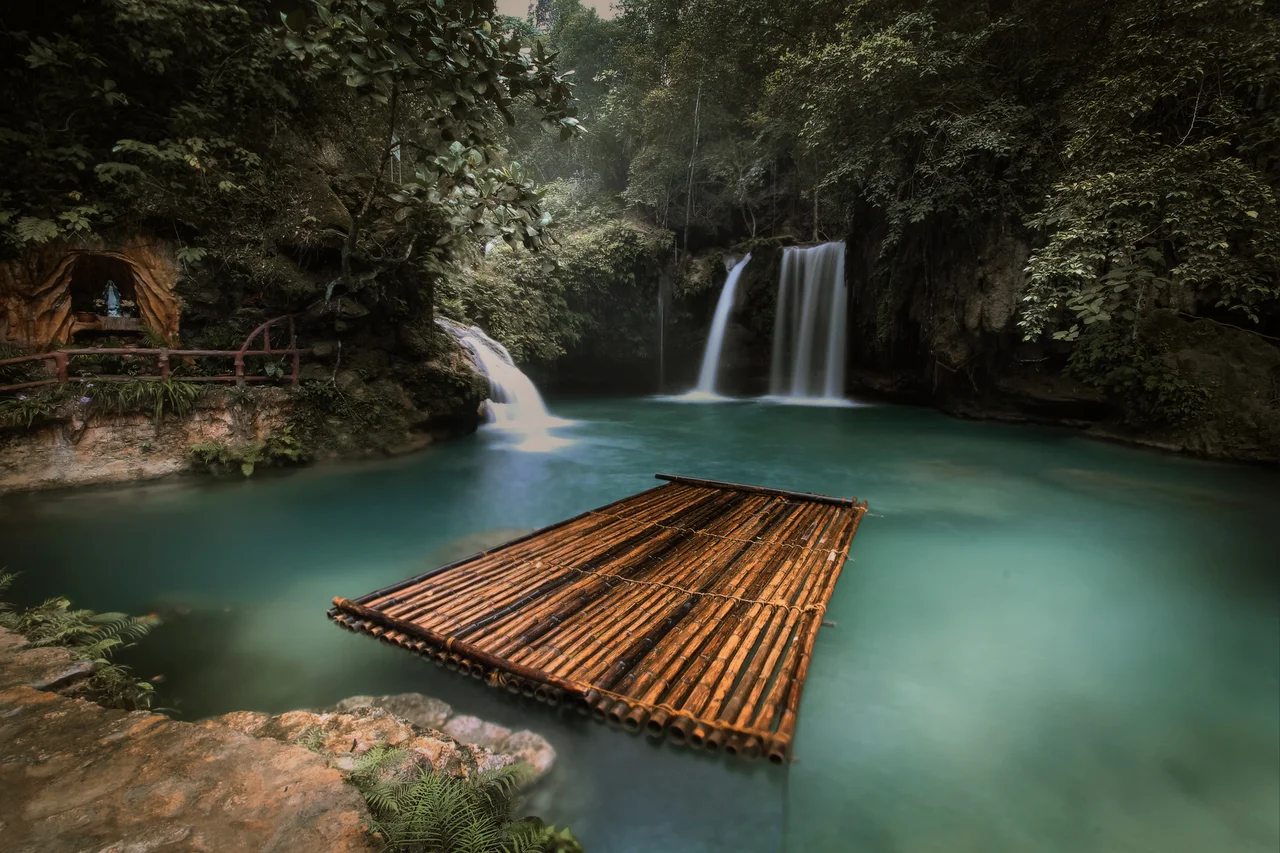
The color is what stops you. Not the roar of the water, not the mist on your skin, but the impossible turquoise of the pools below Kawasan Falls. This is not the murky brown of tropical rivers swollen by rain. The water that feeds Kawasan originates from the Kabukalan Spring deep in the mountains of Cebu, filtered through limestone until it emerges so clear and mineral-rich that it glows blue-green against the dark rock of the canyon walls. Three cascading tiers of falls, the largest plunging roughly 40 meters, await anyone willing to trek into the jungle gorge of Badian, Cebu.
Springs, Canyon, Strait
Kawasan Falls is part of a water system that begins underground and ends in the sea. Spring water from the Kabukalan Spring enters the Kawasan River, cuts through the Kawasan gorge in the Matutinao River canyon, joins the Matutinao River, and finally empties into the Tanon Strait -- the channel separating Cebu from Negros Island. The geography compresses a remarkable journey into a short distance: from subterranean limestone aquifer to jungle canyon to coastal coral reef in a matter of kilometers. The gorge itself is the star. Limestone walls rise on either side, narrowing the river into channels where the water accelerates before spilling over rock ledges into deep, still pools. The geological forces that created this canyon -- the slow dissolution of limestone by slightly acidic spring water over millennia -- are still at work, imperceptibly widening the passage.
Three Tiers of Blue
The first and largest cascade is the one most visitors encounter: a curtain of white water dropping approximately 40 meters into a turquoise basin wide enough for swimming. Bamboo rafts pole across the pool, carrying visitors under the spray for the full sensory experience -- the thundering impact of water from above, the cold shock against sun-warmed skin. Above the main falls, smaller cascades and pools step up the canyon in tiers. Each is quieter, less crowded, more intimate. Adventurous visitors scramble upstream to find pools they can have to themselves, cliff edges they can dive from, and stretches of river where the only sound is water on stone.
Canyoneering and the Adventure Economy
Kawasan is not just a waterfall. It has become the terminus of one of the Philippines' most popular canyoneering routes, a half-day adventure that involves jumping off cliffs, sliding down natural rock chutes, and swimming through narrow canyon passages before arriving at the falls from above rather than below. The activity draws thousands of tourists annually and supports a local industry of guides, equipment outfitters, raft operators, and the small restaurants and shops that line the trail from the road to the falls. The economic impact is substantial and reveals how dependent Badian has become on this single natural feature -- when the Cebu Provincial Government temporarily halted access in June 2023 to revoke permits from unregistered canyoneering operators and address safety and environmental concerns, the town was estimated to be losing 11 million pesos daily.
The Color Beneath the Canopy
What makes Kawasan distinctive among the Philippines' many waterfalls is not its height -- taller falls exist on other islands -- but the quality of its water and the drama of its setting. The spring-fed flow means the pools remain turquoise even during rainy season, when other falls turn opaque with sediment. The jungle canopy filters the light into green-gold shafts that illuminate the mist rising from the basin. Sunlight hitting the mineral-rich water creates a luminescence that photographs cannot quite capture. It is a place where geology, hydrology, and tropical light conspire to produce something that looks engineered for beauty but is entirely the work of limestone, gravity, and time.
From the Air
Kawasan Falls is located in the interior jungle of Badian municipality on Cebu's southwestern coast at approximately 9.80N, 123.37E. The falls are not visible from high altitude due to dense canopy cover, but the Matutinao River canyon is traceable from the coast inland. The nearest airport is Mactan-Cebu International Airport (RPVM), approximately 100 km to the northeast. The Tanon Strait, into which the river system empties, is visible between Cebu and Negros islands.
Nearby Stories
- Balinsasayao Twin Lakes Natural Park 17 km away
- Japanese Cruiser Abukuma 25 km away
- Guimaras Oil Spill 31 km away
- Cebu 37 km away
- Kanlaon Volcano 45 km away
- Fort San Pedro (Iloilo) 104 km away
- November 2023 Mindanao Earthquake 457 km away
- Balut Island 517 km away