
Balsall Heath
Two Yemeni sailors walked off a ship in 1940 and bought a small artisan cottage on Mary Street in Balsall Heath. They had come from a colonial port to a wartime city, and they were looking for somewhere quiet to pray. The mosque they founded would grow into one of the largest Muslim communities in Birmingham, and Balsall Heath, then a tired Victorian suburb of Birmingham, would become something the original surveyors could never have predicted: a working-class neighbourhood with a Pakistani and Bangladeshi heart, the curry-house engine of the Balti Triangle, and the place where in the 1990s residents organised themselves to take their own streets back.
Bord's Nook
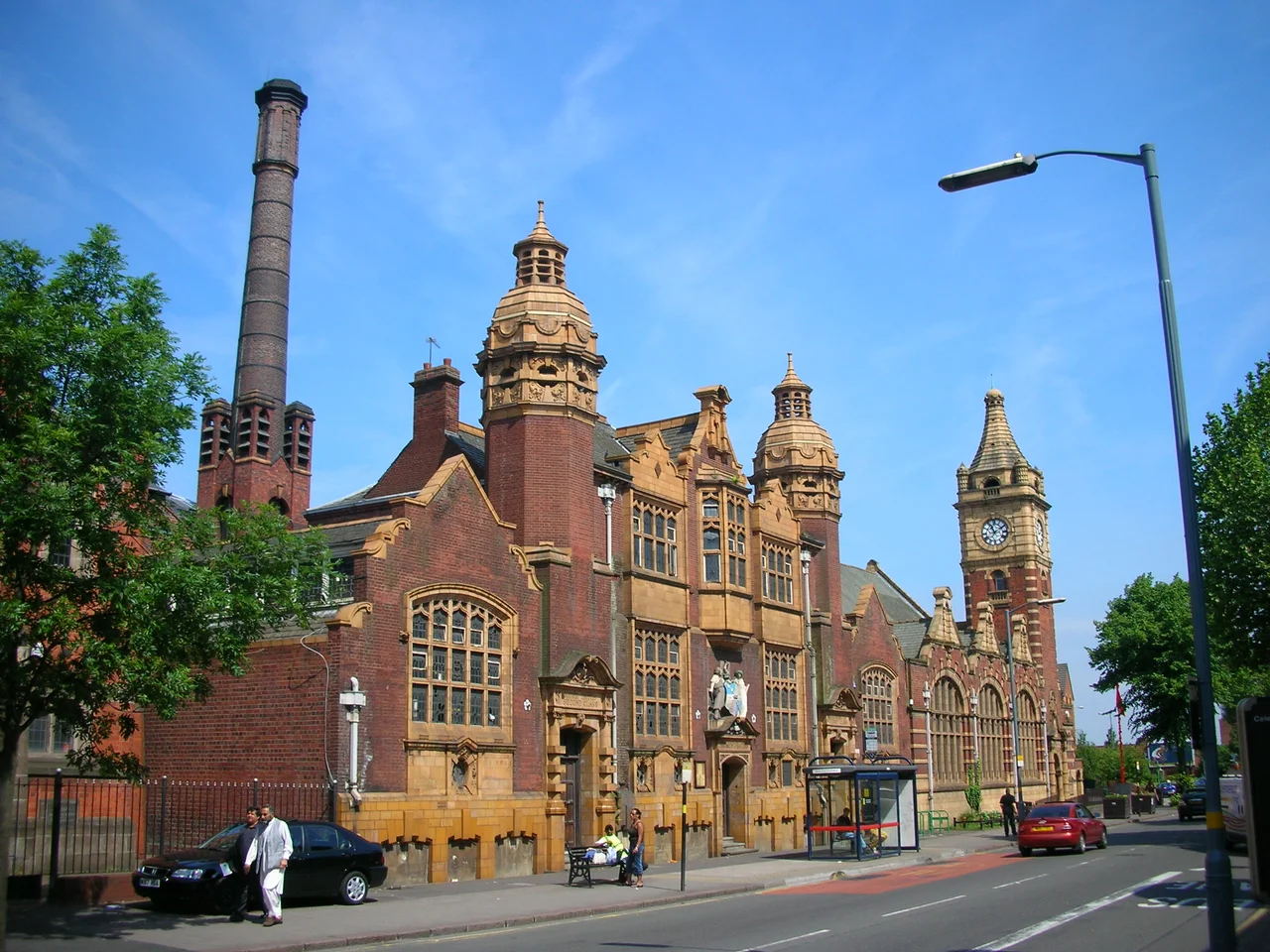
The name shows up in 1275 as Bordeshale -- Old English for Bord's heath, or perhaps Bord's nook, suggesting a sheltered hollow in the landscape protected by trees. The Anglian Bord also lent his name to nearby Bordesley, which means Bord's clearing. Until the 1850s the area was farms and parkland between Moseley village and the city of Birmingham, but expansion along Moseley Road joined the two settlements together. Balsall Heath was originally part of the parish of King's Norton in Worcestershire; on 1 October 1891 it was annexed to the County Borough of Birmingham in Warwickshire. By 1911 the civil parish held 39,884 people. A library opened on Moseley Road in 1895. Public baths followed in 1907 in the building next door. The Birmingham College of Art opened on the same road in 1900. The grand brick civic architecture of this period still defines the local skyline.
Cheddar Road
By the 1950s, Balsall Heath had begun a long slide. Property values fell. Poorer migrants moved in. Street prostitution appeared in the 1950s, and by the 1970s the area was nationally notorious for it. Cheddar Road became the centre of a red-light district worked by around 450 women. About half of the fifty houses on the road had women advertising themselves in the windows, like the De Wallen district in Amsterdam. The Birmingham Mail called it Britain's busiest cul-de-sac. The 1980 film Prostitute, directed by Tony Garnett, depicted the period from the workers' point of view. In 1986 the Sisters of Charity founded ANAWIM, an outreach organisation that worked with the women on the street, treating them as people in difficult circumstances rather than as a public nuisance to be moved on.
The Murder of Samo Paull
In September 1992 a report proposed making Balsall Heath an official zone of tolerance for prostitution, formalising what had grown up informally. The local police inspector opposed it. Residents opposed it more loudly. The following year Samo Paull, a young woman working as a prostitute in the area, was abducted and murdered. In 1994 residents began organising street patrols, walking the roads at night and standing outside houses where soliciting was suspected. The patrols had qualified police support. Some called them vigilantes. The effect was immediate: within months, street and window prostitution dropped by two-thirds. By November 1995 it had been almost entirely eliminated from the neighbourhood. The campaign became a case study in community organising, sometimes praised, sometimes criticised, but rarely denied its effectiveness. The women who had worked in Balsall Heath did not vanish from the world; they moved elsewhere or moved into different work. The street outside the houses, finally, belonged to the people who lived there.
The Balti Triangle
Birmingham's balti is a particular Pakistani-British dish -- meat and vegetables cooked and served in a thin pressed-steel two-handled bowl, with naan instead of rice -- and the restaurants that perfected it cluster across Balsall Heath, Sparkbrook and Sparkhill. The Balti Triangle, locals call it. Ladypool Road runs through the heart, lined with restaurants that opened from the 1970s onwards as the Pakistani community established itself. The cuisine spread from Birmingham to almost every British high street, though the balti's original recipe has never quite been pinned down. Pubs were rare; halal restaurants were not. The food economy reshaped the neighbourhood the way the Cadbury factory had reshaped Bournville a hundred years before -- by giving people something to do, something to sell, and a reason to put down roots.
Cluedo, UB40, and Other Exports
Balsall Heath produced an inheritance disproportionate to its size. Anthony E. Pratt, a music-hall pianist, invented the board game Cluedo here in 1944 -- the murder mystery in a country house, with Colonel Mustard and the lead piping, that has sold tens of millions of copies worldwide. The reggae band UB40 formed in Balsall Heath in 1978; they took their name from the unemployment benefit form of the period and grew up musically in the back rooms of local pubs. Oscar Deutsch, who would found the Odeon cinema chain, was born in the area. The artist Conroy Maddox brought surrealism to Birmingham from here. William Mosedale earned the George Cross in 1940 for rescuing trapped people from a bombed building. The neighbourhood's nineteenth-century terraces, refurbished rather than demolished in the 1980s, still stand. A July 2005 tornado tore through Church Road and Ladypool Road and caused enormous damage, but the area rebuilt, the way it has rebuilt several times before.
From the Air
Located at 52.46N, 1.89W, roughly 1.5 nm south-southeast of Birmingham city centre, sitting between Moseley to the south and Highgate to the north. The Moseley Road artery runs north-south through the district, with the distinctive red-brick Moseley Road Baths and adjacent library forming a recognisable cluster. Nearest airports: EGBB (Birmingham, 5nm ESE), EGBE (Coventry, 21nm ESE), EGOC (RAF Cosford, 18nm WNW). Best viewed at 2,000-3,000 ft AGL with the dense Victorian terrace grid clearly visible.
Nearby Stories
- Shepshed 8.5 km away
- Battle of Evesham 11 km away
- Hixon rail crash 12 km away
- Battle of Cropredy Bridge 12 km away
- Wenlock Priory 15 km away
- RAF Shawbury 16 km away
- Market Bosworth 17 km away