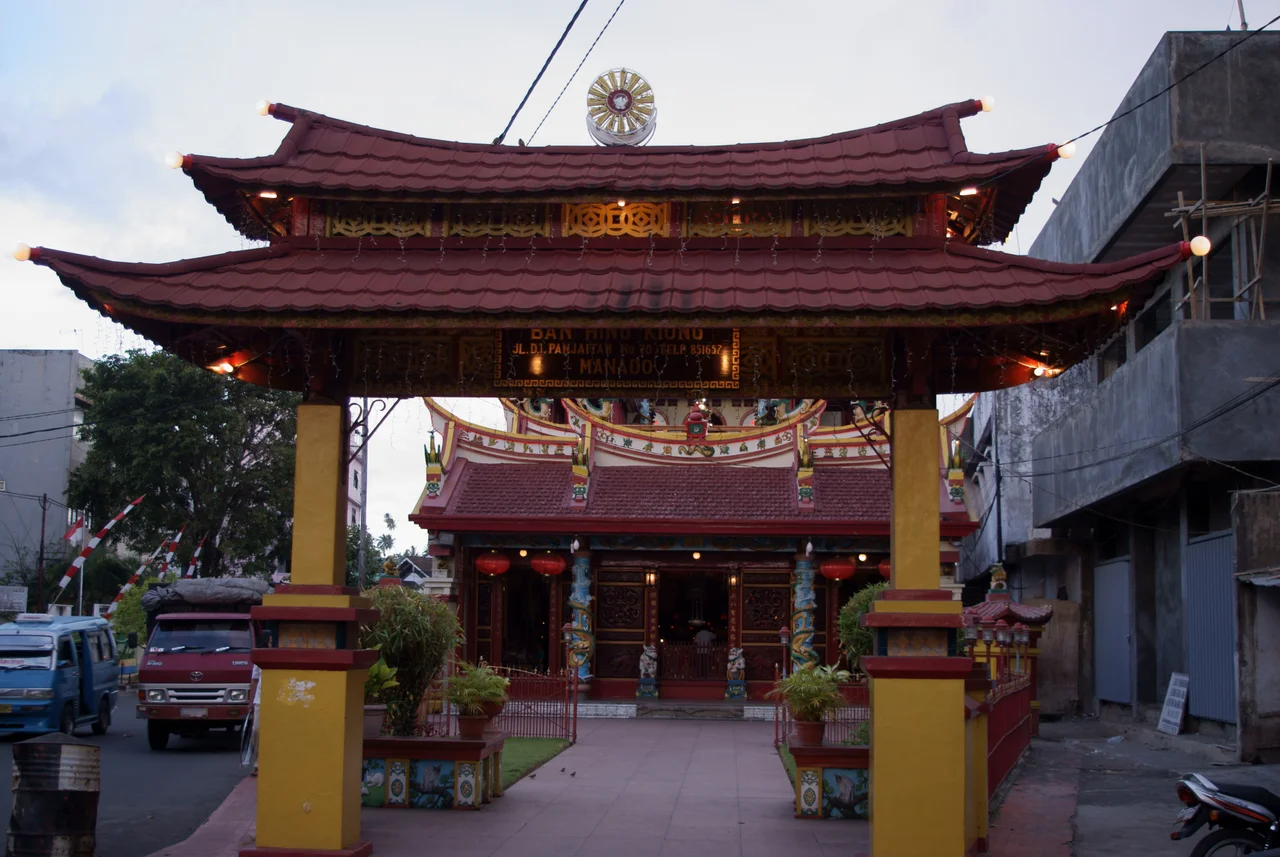

Ban Hin Kiong Temple
The name is a promise in Hokkien. Ban means abundant. Hin means blessings. Kiong means palace. Since 1819, this Taoist temple on Jalan D.I. Panjaitan in Manado has been making good on that promise, serving as a spiritual anchor for the Chinese community at the northeastern tip of Sulawesi. In a city where Christian churches dominate the skyline and mosques call from every neighborhood, Ban Hin Kiong stands as quiet proof that North Sulawesi's religious diversity runs deeper than most visitors expect.
From Bamboo to Stone
The temple's first incarnation was humble: bamboo wood and faith. It began as a gathering place for Hokkien-speaking Chinese traders and settlers who had made the long voyage south to Manado, drawn by the port city's position along lucrative spice trade routes. In 1893, a shrine known as Tek Kong Su in the Hokkien dialect was added to the grounds, formalizing what had been a modest place of worship into something more permanent. The transformation from bamboo to stone mirrored the community's own evolution, from transient merchants to rooted citizens with stakes in the city's future.
The Fire and What Followed
On 14 March 1970, Ban Hin Kiong burned. The fire was no accident. Several people deliberately set the temple ablaze during a period of anti-Chinese sentiment that periodically swept through Indonesian politics. The destruction could have been the end. Instead, it became a turning point. Nyong Loho, known also by his Chinese name Soei Swie Goan, stepped forward to lead the rebuilding. He would go on to serve as both chairman of development and chief of the temple, guiding a renovation that transformed Ban Hin Kiong from a scarred ruin into something grander than what had stood before. The temple has since undergone several additional renovations, expanding its floor space and courtyard to accommodate growing congregations.
A Community Organized
Ban Hin Kiong's institutional life took formal shape in 1935, when two community leaders, Yo Sio Sien and Que Boen Tjen, founded the Sam Khauw Hwee association to manage the temple's affairs. The organization brought structure to what had been informal stewardship, ensuring the temple's maintenance, its ceremonies, and its role as a social hub would survive the upheavals that the twentieth century had in store. That foresight proved essential. Through Japanese occupation, Indonesian independence, political purges, and waves of modernization, the association kept the temple's doors open and its incense burning.
A Thread in Indonesia's Temple Tapestry
Ban Hin Kiong belongs to a network of historic Chinese temples scattered across the Indonesian archipelago, each one a testament to centuries of migration and adaptation. Jakarta has its Kim Tek Ie Temple, founded in 1650. Semarang boasts the Tay Kak Sie Temple. Bali claims the Satya Dharma Temple. Each preserves Taoist and Buddhist traditions carried across the South China Sea by merchants, laborers, and families seeking new lives. In Manado, a city more commonly associated with Christianity and coral reefs than with Chinese heritage, Ban Hin Kiong's survival carries particular weight. It is the oldest temple in the city, and its continued vitality says something about Manado's capacity for coexistence.
Blessings, Still Abundant
Today Ban Hin Kiong draws visitors during the Chinese New Year celebrations, when the temple grounds fill with red lanterns, the percussion of lion dances, and the thick haze of joss sticks. But it functions year-round as a working Taoist temple, a place where the Tridharma tradition, blending Taoism, Buddhism, and Confucianism, continues to shape daily practice. The courtyard that Nyong Loho rebuilt has become a gathering place once more. Two centuries after its founding in bamboo and faith, the Palace of Abundant Blessings remains exactly what its Hokkien name describes.
From the Air
Located at 1.494N, 124.845E in the heart of Manado, North Sulawesi. The temple sits within the dense urban center near the waterfront. Sam Ratulangi International Airport (ICAO: WAMM) is approximately 13 km to the northeast. From the air, look for Manado's coastal strip along the Bay of Manado with Bunaken Island visible offshore. Best viewed below 5,000 ft for urban detail. Tropical weather year-round with frequent afternoon convective activity.
Nearby Stories
- Battle of Kendari 16 km away
- Bangka Island (North Sulawesi) 19 km away
- Gorontalo 173 km away
- Otanaha Fortress 192 km away
- USS Shark (SS-174) 196 km away
- Fort Kastela 207 km away
- Japanese Minelayer Tsugaru 278 km away
- Indonesia-Malaysia Border 576 km away