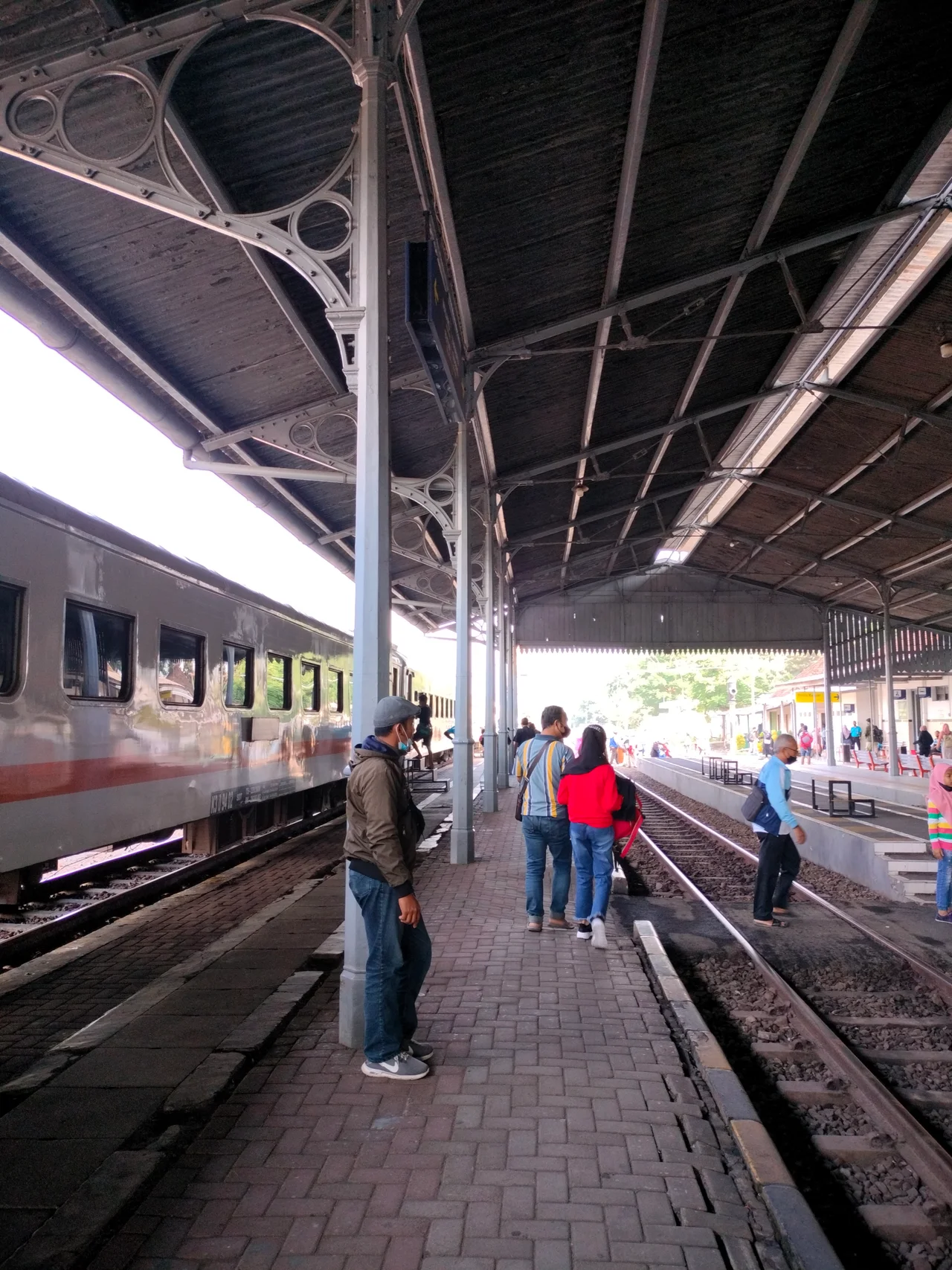

Bangil Railway Station
The locomotive turntable still sits behind the station, seized by rust and overgrown with creeping vines. No engine has turned on it in decades, yet Bangil railway station remains one of the busiest stops in East Java -- a junction where three of the island's great rail corridors converge. Commissioned on May 16, 1878, by the Staatsspoorwegen's Oosterlijnen division, Bangil was among the very first stations built in the Dutch East Indies. From the beginning, it was not merely a stop but a crossroads: east toward Pasuruan, Probolinggo, and the far tip of Java at Banyuwangi; south into the cool highlands of Malang; west back to the teeming port city of Surabaya.
The Fast Five
What made Bangil more than a provincial junction was the mountain. The railway to Malang climbed through plantation country and volcanic slopes, steepening sharply near Sengon. Early locomotives could not manage the grade alone, so Bangil's engine shed became essential -- a place where small steam engines from Fox, Walker & Co. in England and Hartmann in Germany waited to assist trains up the incline. As the fleet grew more powerful, so did the ambitions of the railway. By the late 1930s, the Vlugge Vijf -- 'The Fast Five' -- offered five daily round trips between Surabaya and Malang, with express engines reaching speeds of 90 kilometers per hour. The service once completed the entire run in just 75 minutes, a feat made possible by the double-track line from Surabaya to Porong. That second track would not survive the Japanese occupation; it was torn up during World War II and shipped to Burma for military construction.
An Ironhorse Graveyard
The engine shed outlived its purpose slowly. Through the 1970s and 1980s, as diesel replaced steam across Indonesia's national railway, the shed became a resting place for orphaned locomotives. Visitors in those final years found an unlikely gathering: Georg Krauss tank engines from the defunct Mojokerto Steam Tramway, a Hartmann from the original Staatsspoorwegen fleet, a Werkspoor express engine, Hohenzollern locomotives from the old Malang tramway, and a massive Hanomag 'Javanic' -- a 2-12-2 tank engine with twelve driving wheels, originally designed for the steep mountain grades of West Java. One by one, they were scrapped or hauled away to become museum pieces. The shed stands empty now, a cathedral of rust beside a turntable that no longer turns.
Sugar, Textiles, and the Tramway That Moved
Bangil's rail history extends beyond the main lines. In 1899, the Modjokerto Stoomtram Maatschappij -- the Mojokerto Steam Tramway -- opened a branch from Bangil heading south toward Pandaan and the sugar mills at Japanan. But in 1914, the state railway claimed part of the tramway's route for a new line to the Sumberredjo sugar mill north of the station, forcing the private company to relocate its entire branch to a new alignment south of the depot. The tramway built its own small station behind Bangil's locomotive shed -- a building that still exists today as a private residence. When the Great Depression killed the sugar industry in the early 1930s, Sumberredjo reinvented itself as the Kantjil Mas textile factory in 1937. The tramway line limped on through the Indonesian War of Independence, was damaged, rebuilt by the railway's construction service around 1949-1950, and finally deactivated in 1969.
Bombed, Rebuilt, Still Standing
The station's original main building did not survive independence. During Operation Kraai -- the second Dutch Military Aggression against the Republic of Indonesia in 1948 -- the structure was bombed and destroyed. The DKA-RI, the new republic's railway department, rebuilt it the following year. The replacement shares its design with Kertosono station: a practical main building flanked by covered platforms. What the bombs could not reach still endures. The platform canopy, with its ironwork and colonial proportions, shelters passengers today much as it did under Dutch rule. Bangil now operates with eight active tracks, modern electronic signaling installed in 2010, and a steady flow of intercity and commuter trains. Fuel-tank wagons still idle on the loop tracks at the station's edge. The turntable and the empty shed behind it have become relics -- physical memory of an era when steam power and sugar money built an empire's railway, one junction at a time.
From the Air
Located at 7.60°S, 112.78°E in Pasuruan Regency, East Java, at approximately 9 meters elevation. The station sits at the junction where rail lines diverge east toward Banyuwangi and south toward Malang. From altitude, the rail yard and track fan are visible south of Bangil town center. Nearest major airport is Juanda International (WARR/SUB) approximately 40 km northwest near Surabaya. Abdul Rachman Saleh Airport (WARA/MLG) near Malang lies roughly 50 km to the southwest.
Nearby Stories
- Ninety-Nine Names in Steel and Stone 6.7 km away
- Malang: The City Built on a Cursed Dagger 8.1 km away
- The Kedopok War: When Probolinggo Rose Against Its Buyer 15 km away
- Madura: Salt, Bulls, and the Island That Emptied Itself 39 km away
- Where Teak Meets Oil 39 km away
- The Train Builders of Madiun 69 km away
- The School That Gave Itself Away 72 km away
- Meru Betiri: The Last Forest on Java's Southern Edge 89 km away