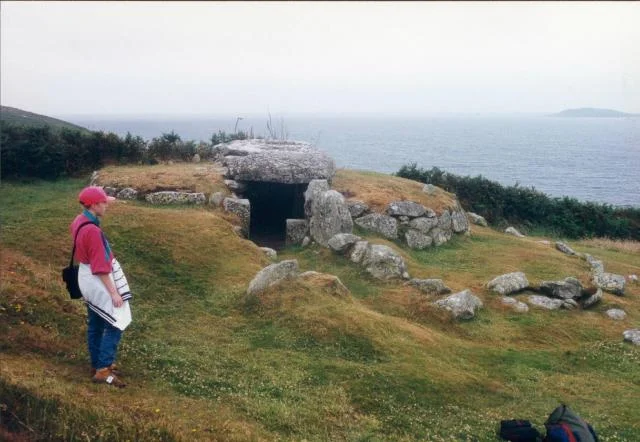

Bant's Carn
The chamber inside Bant's Carn is just under five metres long, a metre and a half wide, and only as tall as a child can stand in. Four enormous capstones make the roof. The entrance passage runs four and a half metres into the hillside before a deliberately set jamb-stone separates the outer world from the inner. When the archaeologist George Bonsor first crawled inside in 1900, he found the tomb mostly empty: cremated human remains at the back of the chamber, and the broken sherds of Neolithic and Bronze Age pottery on the floor. Whatever had been here had been here a long time. The dead were not many. The work to bury them had been considerable.
Scillonian Entrance Graves
Bant's Carn is one of the best surviving examples of a Scillonian entrance grave, a Bronze Age tomb type that is almost unique to these islands. They differ from the larger chambered cairns of the mainland in being smaller, more numerous, and built directly into hillsides rather than as freestanding mounds. The tomb itself measures around 8 metres in diameter, set on a low platform 12 metres across, and was constructed around 4,000 years ago by people whose names and language are entirely lost to us. What we know is that they chose this slope above what would later be Halangy Down with care, and they put their effort into a structure that has remained standing through every storm, war, and reform of the past four millennia.
The Village Below
Walk a few hundred metres downhill from Bant's Carn and you reach Halangy Down, the remains of an Iron Age and Romano-British village. The juxtaposition is striking. The Bronze Age tomb is at the top of the slope; the later village sits below it, occupied perhaps from around 200 BC into the Romano-British period of the first few centuries AD. Each generation of villagers would have looked up the hillside at a structure already ancient. The dead in the tomb above were genuinely the ancestors, ancestors who had been ancestors for two thousand years by the time anyone here had a Roman coin in their pocket. The relationship between the two sites is one of the clearest illustrations in Britain of how prehistoric people lived with monuments they did not build.
An Excavation and a Lost Notebook
George Bonsor was a curious figure: born in France, raised in Belgium, an artist and archaeologist who came to Spain as a young man and ran his own excavations across Andalusia and somehow ended up digging on St Mary's in 1900. He found Bant's Carn surprisingly empty, the cremated remains scattered at the back of the chamber rather than placed in any obvious order, perhaps because the tomb had been disturbed many times over many centuries. He took the finds away to his castle in Seville and never published the results. In 1926, his friend and fellow archaeologist Thomas Kendrick, then Assistant Keeper of British and Medieval Antiquities at the British Museum, visited Bonsor in Spain and discovered the notes, drawings, and finds in their entirety. Kendrick persuaded Bonsor to send some of the artefacts to the museum. After Bonsor's death the plans were obtained for the museum as well, and they proved essential when restoration work began on the tomb in 1970.
The 1970 Restoration
In 1970, archaeologist P. Ashbee led a restoration of Bant's Carn. The eastern capstone had slipped; the southern portal stone needed re-setting. During this work, 140 decorated prehistoric pottery fragments were uncovered around the portal stone, along with two worked flints. They were given to the Isles of Scilly Museum in December 1976. The discoveries pushed the dating evidence further and complicated the story, because the decoration on the sherds suggested ritual deposit rather than ordinary domestic loss. People had been leaving things at the threshold of this tomb, perhaps for centuries. Today the site is in the guardianship of English Heritage, along with the Halangy Down village, the post-medieval field systems on the slope, and a military battery built nearby in 1905. Four thousand years of human use have left their stratigraphy on a single hillside. The tomb is the oldest stratum, and still the most intact.
From the Air
Located at 49.93N, 6.31W on the north-west coast of St Mary's, Isles of Scilly. Best viewed at 1,000-2,000 ft AGL. Nearest airport is St Mary's (EGHE) 1.5 nm south-east of the site. Land's End (EGHC) is 28 nm east on the Cornish mainland. The Bronze Age tomb appears as a low, oval mound set on the hillside; Halangy Down's Iron Age village remains lie immediately below. The site is open to visitors as an English Heritage property, accessed by footpath from Telegraph Road or via the coast path.
Nearby Stories
- Penlee lifeboat disaster 5.8 km away
- SS Georgia (1890) 18 km away
- Great Wheal Charlotte 28 km away
- 1979 Fastnet Race 37 km away
- Wheal Coates 66 km away
- SM U-27 93 km away
- HMS Affray 151 km away
- Tower of Hercules 719 km away