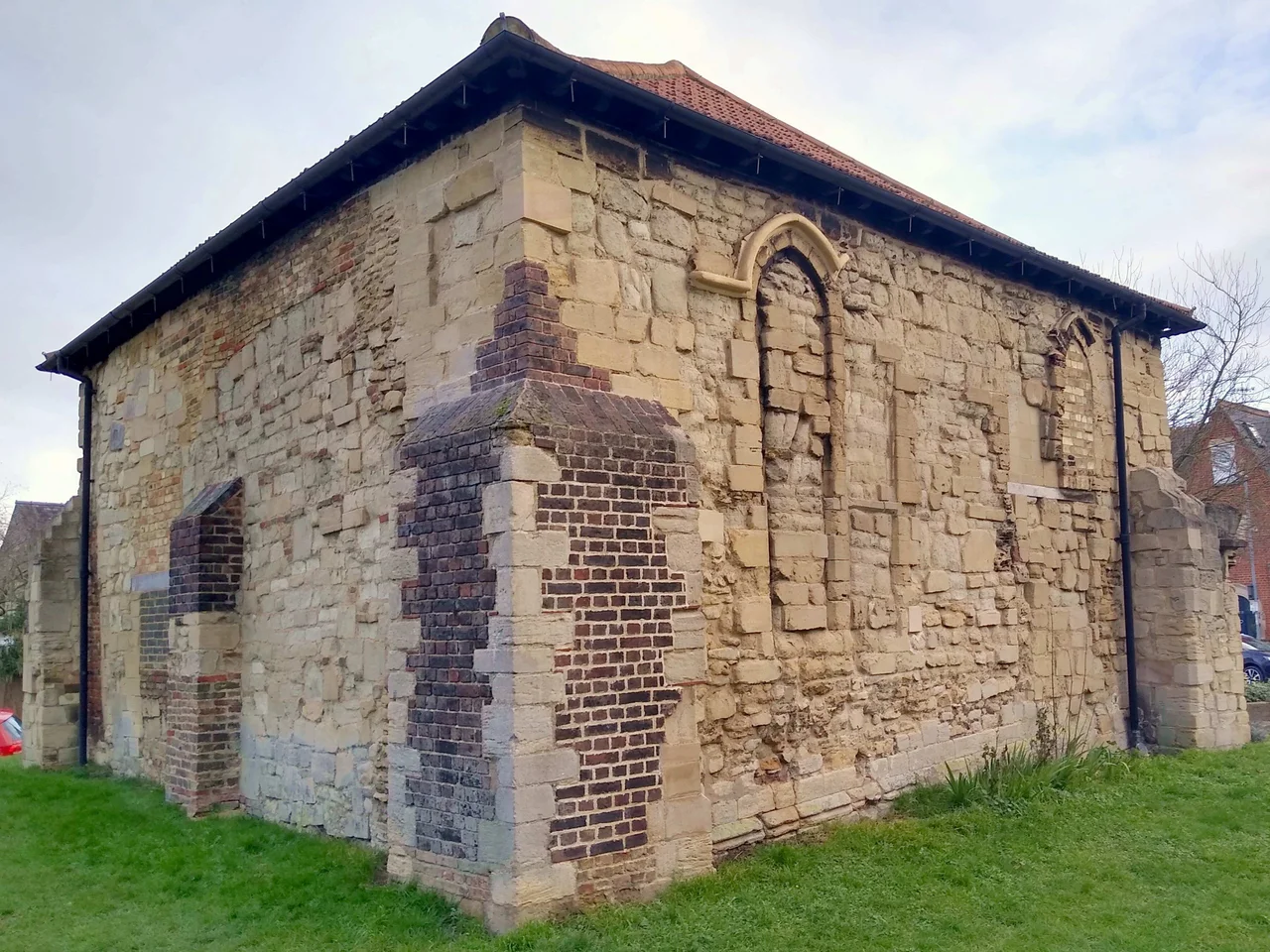

Barnwell Priory
The story starts with a promise. Picot of Cambridge, High Sheriff of Cambridgeshire, and his wife Hugolina — according to the priory's own records — had an arrangement with God. Hugolina fell gravely ill. She vowed that if she recovered, she would found a religious house. She recovered. And while the Liber Memorandorum Ecclesie de Bernewelle, the Book of Things to do with Barnwell, is careful to note that Picot provided the endowment, it adds that the inspiration may well have been entirely his wife's. Around 1092, the priory was established beside St Giles' Church near Cambridge Castle. It would stand for nearly four and a half centuries.
From Six Canons to Thirty
The priory began modestly — six canons following the Rule of St Augustine, endowed with tithes and rectories by Picot and Hugolina. After the couple died, the priory passed to King Henry I, who gave it to Pain Peverel. Peverel had ambitions: he persuaded Henry to grant him land on the eastern edge of Cambridge so the priory could be relocated, expanded, and properly established as Barnwell Priory. Over time the community grew through donations from local landowners until thirty canons were in residence. The priory held an annual fair — the Barnwell or Midsummer Fair — that added to its income. An active scriptorium produced manuscripts; a well-stocked library supported scholarship. Barnwell, in its prosperity, seems to have played a stabilising role in the early decades of the University of Cambridge, which was finding its footing in the same city at roughly the same time.
When Parliament Came to Barnwell
At its height, Barnwell Priory was a significant institution: wealthy, literate, and embedded in the life of Cambridge and its surrounding region. The priory was wealthy enough to attract the destructive attention of the Peasants' Revolt in 1381, when rebels targeted local landowners and the properties they controlled. And in 1388, the priory hosted one of the more unusual events in English constitutional history: the English Parliament met here from 10 September to 17 October, the only time Parliament ever convened at Barnwell. The Cambridge Parliament, as it is known, was a remarkable episode. A functioning religious house briefly became the seat of national government — a measure of how significant Barnwell Priory had become in the landscape of late medieval England.
Dissolution and Disappearance
The priory was dissolved on 11 November 1538 as part of Henry VIII's general Dissolution of the Monasteries. Its lands were granted first to Anthony Brown around 1546, then to Edward, Lord Clinton around 1552. The buildings fell into ruin gradually and were almost completely demolished in 1810, when John Bowtell made the last systematic description of what remained. Today, only a thirteenth-century claustral building survives — a Grade II* listed structure that stands as the sole visible remnant of what was once a community of thirty canons with its own scriptorium, library, fair, and parliamentary history. Fragments persist in the walls, cellar, and gardens of the adjacent Abbey House. It is not much, given how much was here.
What the Canons Left Behind
Two texts survive that give unusual insight into Barnwell's inner life. The Barnwell Observances, written in the thirteenth century, provide one of the most detailed records of English Augustinian life that exists — a practical manual of how the canons organized their days, their meals, their prayers. And the priory was home to the Barnwell Chronicler, an anonymous writer whose account of the reign of King John remains a significant source for that troubled period of English history. Barnwell Priory was not simply a community of prayer and land management. It thought, it wrote, and it kept records. The dissolved stones may be mostly gone, but the words remain.
From the Air
Barnwell Priory stands in the Barnwell neighbourhood of Cambridge, at approximately 52.210°N, 0.139°E, east of the city centre near the River Cam. The surviving thirteenth-century claustral building is a distinctive low stone structure visible from low altitude. Cambridge Airport (EGSC) is roughly 3 miles to the northeast. At 1,500 feet the east Cambridge grid of streets, with Abbey House beside the priory remains, is clearly identifiable. The flat Fenland on the city's eastern edge stretches away toward Ely.
Nearby Stories
- Walden Abbey 4.6 km away
- Bury St Edmunds 5.5 km away
- RAF North Pickenham 8.1 km away
- Ampthill 9.5 km away
- RAF Wittering 10 km away
- Murder of Una Crown 12 km away
- Colchester Community Stadium 18 km away
- John Bunyan Museum 19 km away