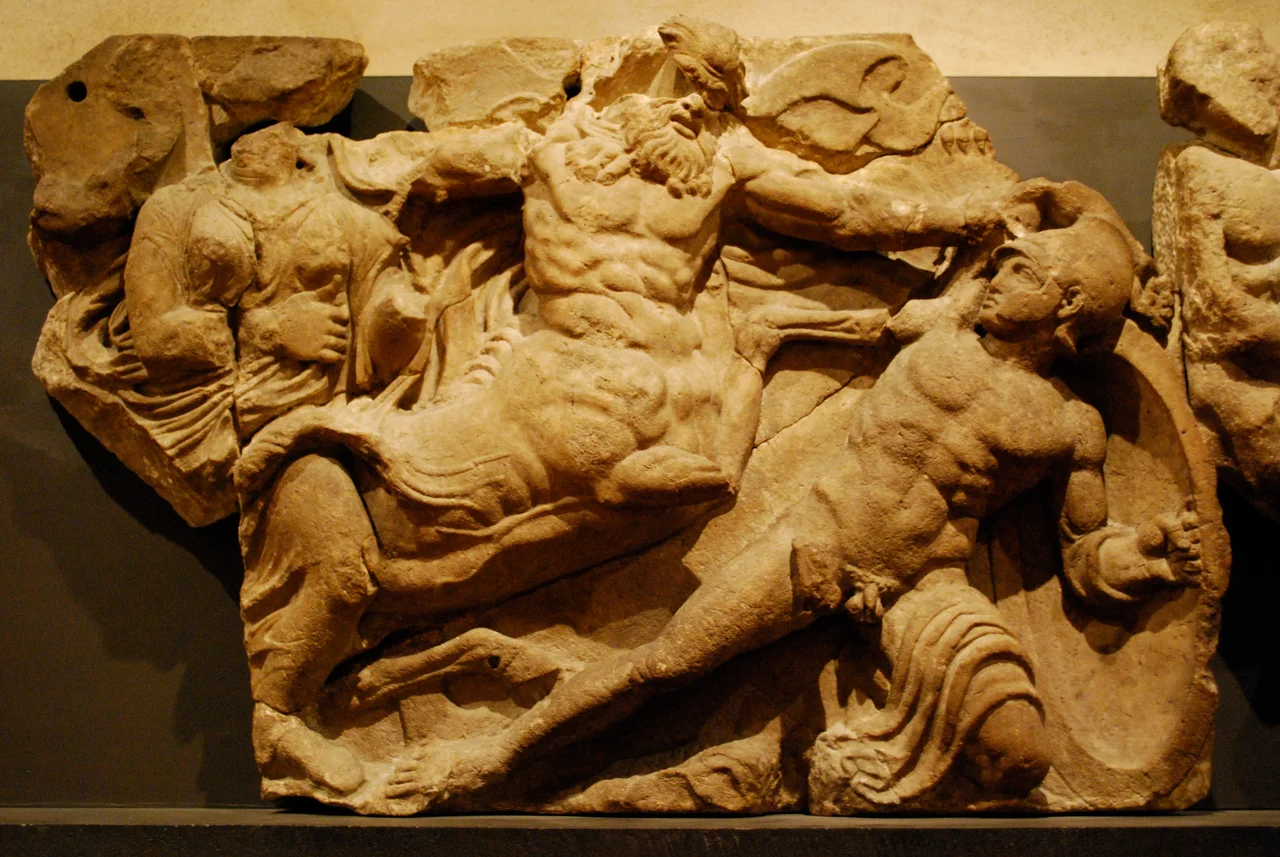

Bassae
The French architect J. Bocher stumbled upon it in November 1765 while he was building villas on the island of Zante. He recognized what he had found and went back for a second look. Bandits murdered him before he could report it to the scholarly world. The Temple of Apollo Epikourios at Bassae had been waiting, largely undisturbed, for over a thousand years in the mountains of Arcadia — and it would keep its secrets a little longer. When European antiquaries finally reached it in force, they found something remarkable: a temple so remote, and so complete, that it seemed to have survived by sheer inaccessibility.
High in the Rocks
Bassae — from the Greek Bassai, meaning 'little vale in the rocks' — sits at an elevation of 1,131 meters on the steep slopes of Mount Kotilios in the Arcadian highlands. The name tells you something about the site: not a grand plateau but a notch in the mountains, chosen precisely because the Phigalians needed a defensible, sacred place above the plain. The temple is dedicated to Apollo Epikourios — Apollo the Helper — a title Pausanias connects to the god's aid during a plague that struck the Phigalians during the Peloponnesian War.
The second-century AD travel writer Pausanias praised it in terms that stopped just short of the Temple of Athena Alea at Tegea: in beauty of stone and harmony of construction, he wrote, it was the finest in the Peloponnese after that one. 'Including the roof, is of stone' — an observation that distinguished it from temples with terracotta tile, and that helps explain its exceptional preservation. The site's remoteness, which made it difficult to quarry for building material, also protected it from the fate of most ancient structures.
An Architect's Experiment
The temple was designed by Iktinos, the same architect responsible for the Parthenon on the Athenian Acropolis. Working at Bassae, he had unusual constraints and unusual freedoms. The site's steep terrain forced him to orient the temple north-south rather than the conventional east-west, with the principal entrance from the north. To address the resulting lack of morning light on the cult statue, a side door was cut into the eastern wall.
The result is a building of studied peculiarities. The exterior colonnade follows the Doric order, six by fifteen columns, in grey Arcadian limestone. But inside, the decoration shifts — an Ionic frieze of carved marble ran continuously around the interior walls, showing Athenians battling Amazons and Lapiths fighting Centaurs. Most significantly, Bassae contains the earliest known example of a Corinthian capital: a single column, proto-Corinthian in its detailing, that stood at the center of the naos. That capital was discovered by the British antiquary Charles Robert Cockerell in the early nineteenth century, then lost at sea during transport. What it represented — whether an aniconic image of Apollo Borealis or simply an architectural experiment — remains debated. The columns have entasis; the floor, unlike the Parthenon's, is not subtly curved.
Discovery and Removal
Cockerell and the German archaeologist Carl Haller von Hallerstein arrived at Bassae in 1811, fresh from excavating sculptures at Aegina. Haller made careful drawings of the entire site. All of them were lost at sea on the return voyage. The following year, 1812, British antiquaries mounted a more systematic expedition. With permission from Veli Pasha, the Ottoman governor of the Peloponnese — who was reportedly bribed to relinquish his claim on the finds — they removed twenty-three slabs from the Ionic cella frieze, transporting them to Zante. In 1815, the British Museum purchased the frieze at auction; it now occupies its own room there. Plaster casts Cockerell later made from the frieze panels were used to decorate the walls of the Ashmolean Museum's Great Staircase and the Travellers Club in London.
Conservation of what remains at Bassae is ongoing under the Greek Ministry of Culture. Since the late 1980s, the entire temple has been enclosed within a large fabric tent — an ungainly but necessary shelter that protects the ancient grey limestone from the freeze-thaw cycles and acid rain that were accelerating deterioration. The tent is visible from a considerable distance across the mountains.
First on the World Heritage List
In 1986, the Temple of Apollo Epikourios at Bassae became the first Greek monument to be inscribed on the UNESCO World Heritage List — before the Acropolis of Athens, before Olympia, before Delphi. The inscription recognized both its exceptional architectural significance and the unusual circumstances of its survival: a fifth-century BC temple in near-original structural condition, designed by the architect of the Parthenon, standing complete in a remote mountain landscape.
The site attracts visitors who make the winding drive up from Andritsaina or the valley below. Inside the tent, which admits diffuse natural light, the columns stand in their ancient arrangement. The frieze is gone — its place is marked and documented — but the fabric of the building is largely as it was when Pausanias visited in the second century. That continuity, across nearly 2,500 years of Greek history, is what Bassae offers: not spectacle but duration.
The Arcadian Highlands from the Air
Bassae lies at approximately 37.430°N, 21.900°E in the Arcadian mountains, roughly west of Megalopoli and south of Andritsaina. The protective tent over the temple is visible from the air as a white or pale grey structure on a steep mountain ridge at over 1,100 meters elevation. The surrounding terrain is dramatically rugged — bare limestone ridges, deep valleys, scattered oak and fir forest. Nearest major airport: LGKL (Kalamata International), approximately 55 kilometers to the southwest. Approach the site from the west at 6,000–8,000 feet to appreciate the temple's setting on Mount Kotilios. Mountain weather can change rapidly; the area frequently sees cloud cover and winter snow.
From the Air
Coordinates: 37.430°N, 21.900°E, on Mount Kotilios at approximately 1,131 meters elevation. The protective tent over the temple is visible from the air as a pale structure on a steep mountain ridge. Nearest airport: LGKL (Kalamata International), approximately 55 km southwest. Recommended altitude: 6,000–8,000 feet for terrain clearance and full view of the site's dramatic mountain setting. Mountain weather is variable; expect cloud cover and reduced visibility in winter and spring.
Nearby Stories
- International Flight Training Center, Kalamata 5.3 km away
- Karyes 6.8 km away
- Barony of Akova 11 km away
- Agios Andreas, Katakolo 13 km away
- Diocese of Amyclae 14 km away
- Larisa (Argos) 19 km away
- 2023 Messenia Migrant Boat Disaster 26 km away
- Panagia Skafidia Monastery 40 km away