
Battle of Adwa
On the morning of 1 March 1896, a European army marched into the Ethiopian highlands under orders to defeat an African emperor and turn his country into an Italian protectorate. By sunset, over six thousand Italian and colonial soldiers were dead in the narrow valleys around the town of Adwa, an entire Italian brigade had been annihilated, and Emperor Menelik II - supported by his wife and co-ruler Empress Taytu Betul - had won one of the most consequential battles in modern African history. Twenty-nine years before Italian tanks would return, and forty years before Mussolini would scream Adua e vendicata - Adwa has been avenged - an Ethiopian force of well over 70,000 troops decisively defeated a European colonial army and made Ethiopia the only major African state to remain independent through the Scramble for Africa. The Italians had believed African kings were not supposed to win.
The Treaty That Wasn't
The battle began with a translation problem. The Treaty of Wuchale, signed in 1889 between Menelik II and the Italians, had two versions. In Amharic, Article 17 read that Ethiopia could use Italian offices if it wished to communicate with foreign powers. In Italian, the same article read that Ethiopia must do so - reducing Ethiopia to an Italian protectorate by treaty. Menelik denounced the Italian version and, crucially, told the European powers that Ethiopia would speak for itself. Italy, committed to becoming a colonial power, decided to enforce its reading with soldiers. Menelik, unlike many African rulers of the era, had spent years importing modern rifles - mostly from France and Russia - and training an army to use them. When General Oreste Baratieri pushed into Tigray in late 1895, Menelik was ready. At the Battle of Amba Alagi on 7 December 1895, Ethiopian forces under Ras Makonnen annihilated a small Italian unit. The stage was set.
A Coalition of Ethiopian Nobles
Menelik did not march alone. The army that gathered near Adwa was a coalition of regional nobles, each commanding their own troops: Ras Makonnen Wolde Mikael with 15,000 riflemen from Harar; Ras Mikael of Wollo with 6,000 rifles, 5,000 spearmen, and 5,000 Oromo cavalry; Ras Mengesha Yohannes and Ras Alula Engida with 12,000 riflemen from Tigray; Negus Tekle Haymanot of Gojjam; Ras Welle Betul; Fitawrari Gebeyyehu Gora; Fitawrari Habte Giyorgis. Total estimates run from 73,000 to over 100,000 combatants. Empress Taytu Betul, whose counsel at court had hardened Menelik's response to the Italian protectorate claim, brought 5,000 of her own infantry and commanded 600 horses and 4 guns. Thousands of Ethiopian women traveled with the army - as nurses, cooks, and water bearers. Ethiopians remember Taytu not just as the emperor's wife but as a co-architect of victory.
Three Separated Columns
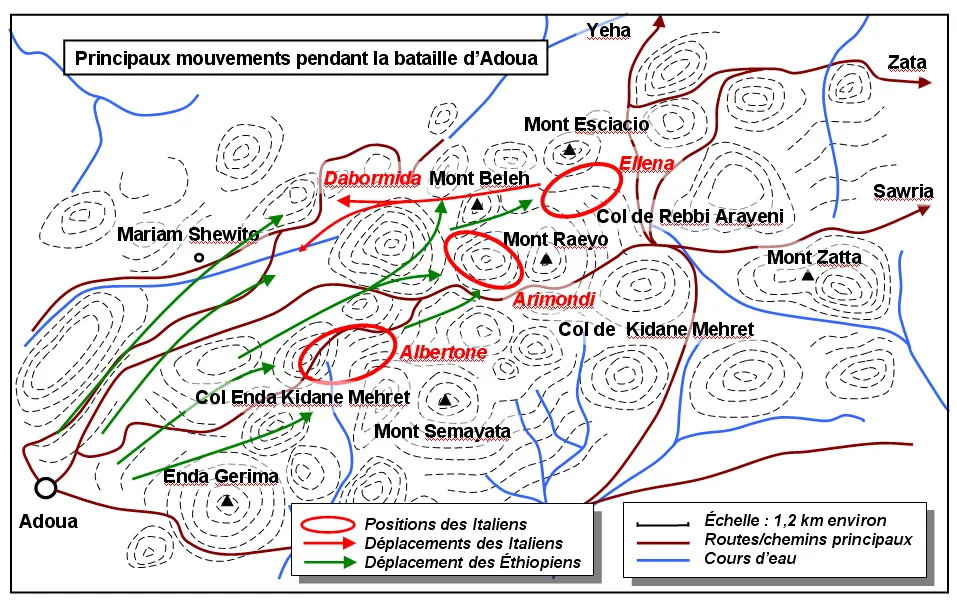
Baratieri's Italian corps numbered around 17,770 troops, including one brigade of Eritrean ascari under General Matteo Albertone led by Italian officers, and three brigades of Italians under Generals Dabormida, Ellena, and Arimondi. On the evening of 29 February, with supplies running out and Rome demanding action, Baratieri ordered his three lead brigades to advance on Adwa in parallel columns. The maps were bad. The terrain was bad. By dawn on 1 March the columns had become separated across miles of ridge and valley. Albertone, misreading his position, advanced directly into the Ethiopian lines. Menelik, who had risen early that morning to pray for guidance, learned from the scouts of Ras Alula that the Italians were coming. He sent his army down from the ridges overlooking the Adwa valley, and the Italians walked into a coordinated envelopment from ground that left them entirely exposed.
Reap, Reap
Albertone's brigade was overwhelmed by midmorning. The Ethiopians took his heavy artillery once Balcha Safo's Hotchkiss guns neutralized the Italian artillery from the slopes of Mount Abba Gerima. Arimondi's center held until noon, when the Shewan and Wollo cavalry broke through and pursued the Italians relentlessly across the valley. Dabormida's brigade, marching to support Albertone, received no communication from Baratieri and did not realize the rest of the army was already retreating. Late in the afternoon, as Dabormida tried to break out of encirclement, Ras Mikael's Wollo Oromo cavalry drove him into a narrow valley and destroyed his command, shouting Ebalgume! Ebalgume! - Reap! Reap! Dabormida's body was never found, though an old woman later told Italian searchers she had given water to a mortally wounded officer with spectacles, a watch, and golden stars. The retreat became a rout. Baratieri's survivors crossed the Belessa River and reached Italian Eritrea by 4 March.
What Adwa Meant
Over 6,000 Italian and colonial soldiers died. Around 3,800 were captured. Ethiopian losses were probably 4,000 to 7,000 dead and up to 10,000 wounded - staggering numbers, though the contemporary Italian traveler Augustus Wylde, visiting the battlefield months later, saw heaps of severed hands and feet that spoke to atrocities against Eritrean ascari taken prisoner by the Ethiopians. Menelik declined to press into Eritrea. Harold Marcus has argued this was strategic caution: a push into the Italian colony would have turned a colonial defeat into a national crusade, and Menelik's army was running out of food after months in the field. The Treaty of Addis Ababa, signed later in 1896, formally recognized Ethiopian sovereignty. For Italy, Adwa became a national trauma that Mussolini would invoke in 1935 when he launched the Second Italo-Ethiopian War - this time with aircraft, tanks, and poison gas. For Ethiopia, and for Pan-Africanists the world over, 1 March became a date of reference: the day an African army defeated a European one and held its country. Teddy Afro's modern ballad Tikur Sew - Black Person - still plays every Adwa Victory Day, carried on loudspeakers through Menelik Square in Addis Ababa, beside banners bearing the faces of Menelik and Taytu.
From the Air
The battlefield lies at 14.019 N, 38.973 E, in Ethiopia's Tigray Region, near the town of Adwa. Axum Emperor Yohannes IV Airport (HAAX) is 25 km west; Shire Airport (HAIR) lies 50 km west. The Adwa mountains rise steeply - cruise altitudes of 14,000+ feet needed for clearance. The topography that trapped Baratieri's columns is still visible from altitude: three parallel ridges separated by narrow valleys, ideal for the Ethiopian coordinated attack. Subtropical highland climate offers clear dry seasons for VFR. The region has experienced conflict during the recent Tigray War; current airspace conditions vary.
Nearby Stories
- Mekelle 26 km away
- Tigray Region 30 km away
- Dedebit Elementary School airstrike 44 km away
- Southern region (Eritrea) 65 km away
- Simien National Park 65 km away
- Eritrean-Ethiopian War 67 km away
- Battle of Amba Aradam 73 km away
- Dallol (hydrothermal system) 100 km away