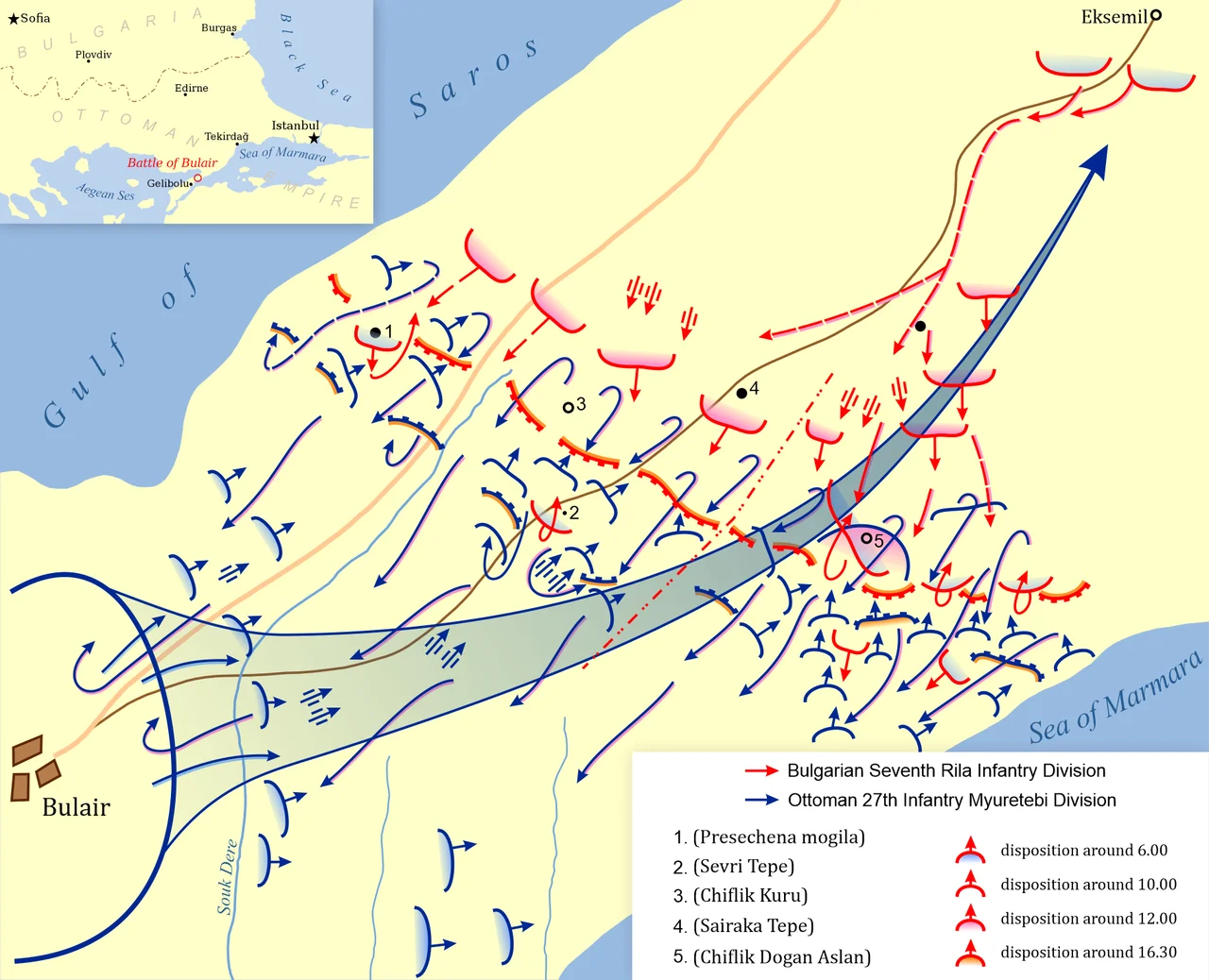

Battle of Bulair
The plan looked decisive on paper. Enver Pasha would hit the Bulgarian lines from two directions at once — an infantry assault from the front, a naval landing from the sea to the flank — and break open the siege of Edirne in a single blow. But aboard the transport ship where Enver briefed his staff, one officer spoke up. Mustafa Kemal, then still a relatively junior figure, argued that the two-day preparation window was a catastrophic mistake. He wanted a night raid, an attack before the Bulgarians had dug in. Enver dismissed him. That decision would cost the Ottoman 27th Division its ability to mount any further large-scale offensive at the isthmus of Gallipoli.
The Isthmus That Everyone Needed
The Gallipoli Peninsula juts south into the Aegean like a pointed finger, and the narrow land bridge at its neck — the isthmus near Bulair — has always been the hinge of strategic control over the whole of the Thracian Chersonese. In the First Balkan War of 1912–1913, Bulgaria and Serbia had jointly besieged Edirne, one of the Ottoman Empire's most important cities in Europe, since the opening weeks of fighting. By early 1913, Edirne had been under siege for months. To relieve it, Ottoman commanders needed to strike at the Bulgarian rear — and the quickest route ran straight across the isthmus. The Bulgarian Seventh Rila Infantry Division had occupied the northern parts of the peninsula, anchoring their line at the neck. Dislodging them was the precondition for everything else Enver hoped to accomplish.
Two Days That Changed the Battle
Enver's concept was ambitious: elements of the 27th Division would fix the Bulgarians in place around Bulair while additional units landed from the sea at Saor Bay, flanking the defenders and completing an encirclement. The naval landing required two full days to organize. Mustafa Kemal and Ali Fethi both pushed back directly, warning that the Bulgarians would use that time to consolidate their positions and bring in reinforcements. They were correct on both counts. By the morning of 8 February 1913 — 26 January by the old-style calendar then still in use — the Bulgarian 13th Regiment had moved into position alongside the original defenders, artillery had been repositioned on the overlooking hills, and what had been a relatively exposed line was now a defended one. The tactical window that Kemal had wanted to exploit had closed before the Ottoman troops even crossed the water.
Fog, Fire, and a Collapsing Assault
The Ottoman auxiliary platoons — irregular reservists from the 27th Division — pushed inland from Saor Bay at dawn. At seven in the morning the Bulgarian 13th Regiment opened fire. Thick fog had settled over the bay, making Ottoman counter-battery work nearly useless; shells landed short or wide while Bulgarian artillery repositioned with relative precision. In the early hours the Ottomans did capture the farm complex at Doganarslan Chiflik, routing a smaller Bulgarian force there and threatening to turn the left wing of the 22nd Infantry Regiment. But a Bulgarian flanking counterattack drove the irregulars back in disorder. By three in the afternoon the 22nd Regiment had counterattacked the Ottoman right, and within two hours the Bulgarian center had struck the Ottoman left, which collapsed with little resistance. A renewed Ottoman push at five o'clock was repulsed before it reached the Bulgarian lines. Mustafa Kemal organized a retreat to defensive positions roughly half a kilometer south, maintaining order where the assault had found none. The Bulgarians anchored their own line near the old walls of Çimpe Castle. Neither side attacked again.
What the Battle Left Behind
The human cost of the fighting at Bulair on 8 February 1913 was borne by the men on both sides who crossed that ground — soldiers whose names are mostly absent from the surviving accounts, which record commanders and unit numbers far more carefully than the individuals who carried the rifles. The strategic consequence was clear: the Ottoman 27th Division could no longer conduct large-scale offensive operations. Edirne remained under siege, and it would fall to Bulgarian and Serbian forces on 26 March 1913. For Mustafa Kemal, the episode was one more data point confirming his belief that operational caution demanded the kind of clear-eyed assessment that rank did not guarantee. A Bulgarian village in Varna Province would later take the name Bulair in memory of the victory here, and a military march was composed to commemorate it. On the isthmus itself, the old fortifications and the ground where those units maneuvered are still part of the landscape near the town of Bolayır.
From the Air
The battlefield lies at approximately 40.53°N, 26.79°E on the Gallipoli isthmus — the narrow neck connecting the peninsula to the Thracian mainland. At 3,000–5,000 feet you can trace the entire isthmus in a single sweep, with the Gulf of Saros (ancient Gulf of Melas) opening to the northwest and the Sea of Marmara visible to the east. The old farmlands of Doganarslan Chiflik and the hills above Saor Bay where Bulgarian artillery repositioned are recognizable as slight rises in otherwise flat terrain. Nearest airport: LTBH (Çanakkale Airport, roughly 50 km southwest across the Dardanelles strait). Regional alternative: LTBU (Tekirdağ Çorlu Airport, approximately 100 km northeast). Approach from the north gives the clearest view of the isthmus and its strategic narrowness.
Nearby Stories
- Battle of Lone Pine 7.3 km away
- Avşa Island 7.7 km away
- Zeleia 16 km away
- Altıkulaç Sarcophagus 28 km away
- Battle of Hill 60 (Gallipoli) 28 km away
- Uzunköprü Bridge 58 km away
- 2025 Istanbul Earthquake 68 km away
- Battle of Philippi 177 km away