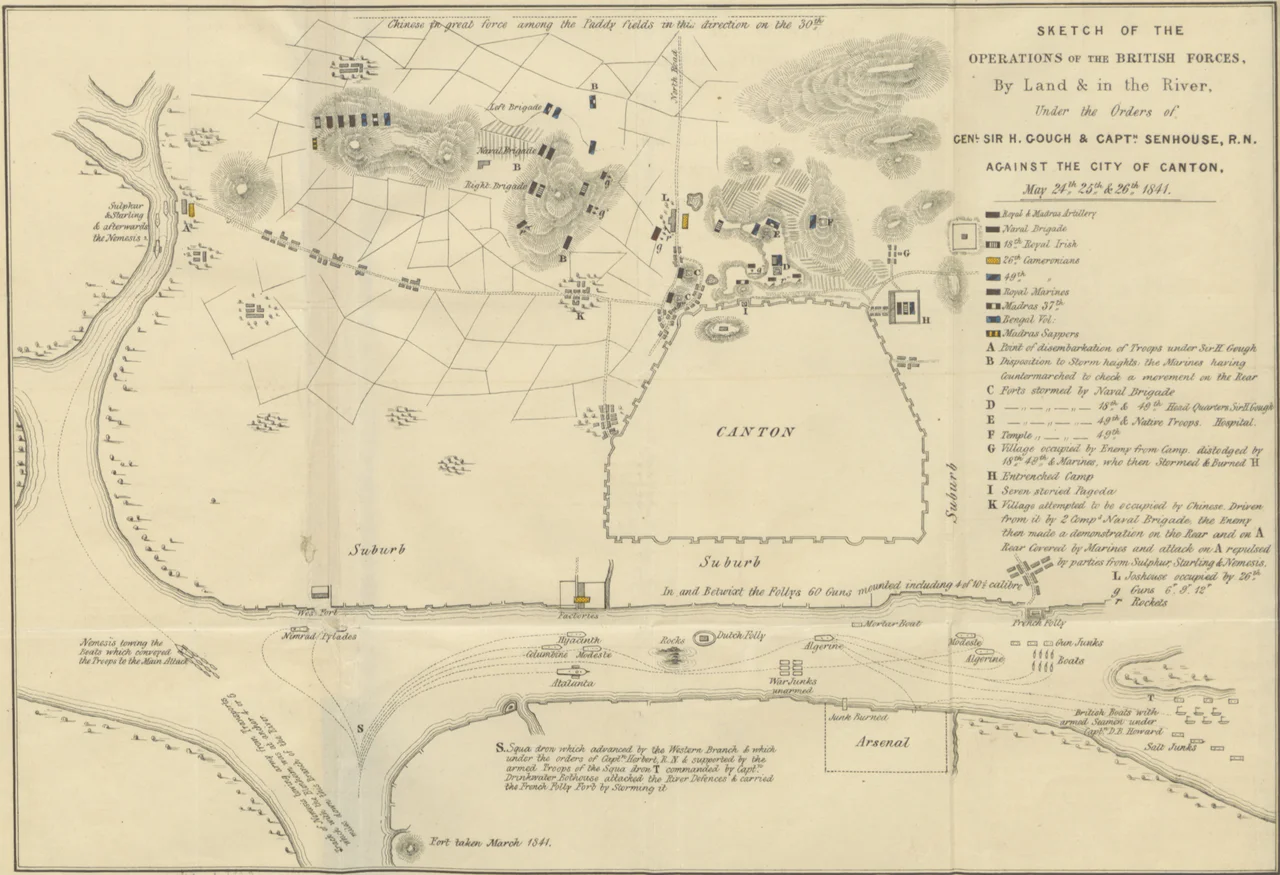

Battle of Canton (May 1841)
Canton had been the only Chinese port open to foreign trade for most of the preceding century, the single gate through which European commerce had to pass. By May 1841, that arrangement had become the heart of a war. British forces under Major-General Hugh Gough were assembling in the rivers north of the city, and on the heights that looked down over Canton's walls, soldiers and sailors were preparing to do what the Qing government's diplomats had been unable to prevent.
The War Behind the War
The First Opium War had its roots in a trade imbalance that Britain resolved through narcotics. Under the Canton System, Canton was the only port where foreign merchants could conduct business in China. European demand for Chinese tea, silk, and porcelain far exceeded Chinese appetite for European exports, and silver flowed eastward in quantities that worried British merchants and the East India Company alike. Their solution was opium — shipped from company plantations in India into Canton, creating the dependency that reversed the trade balance.
When Chinese official Lin Zexu destroyed a large confiscated quantity of opium at Humen — the fortified gateway to Canton — in 1839, the British government treated it as a provocation sufficient for war. The First Opium War began. Local officials who sued for peace and signed agreements with British representatives were punished by Beijing for their capitulations. The Qing court sent more troops. The fighting resumed.
Three Days on the Heights
On the night of May 21, 1841, Qing forces attempted a surprise attack on British positions in the hills north of Canton. They were repelled. By 2:00 am on May 24, Gough had assembled a combined force of roughly six thousand soldiers and sailors for the assault on the city itself — the 49th Foot, the 26th Cameronians, Royal Marines, Madras Artillery, Bengal Volunteers, and others. The iron-hulled steamer Nemesis towed the left column upriver.
British troops captured the four northern forts in under half an hour. Within that time, soldiers stood on the heights looking down on the city walls from one hundred paces. On May 25, a force of approximately four thousand Qing soldiers advanced across the paddy fields to the northeast and made repeated attacks. They were repelled. Their encampment was burned; their magazines blown up. By the morning of May 26, Gough was prepared to take the city. Then a white flag appeared on the wall.
The People Who Didn't Wait for Officials
A ceasefire was negotiated between British plenipotentiary Charles Elliot and the governor-general of Canton. The terms were significant: a six-million-dollar indemnity, Chinese troop withdrawal of sixty miles, British withdrawal down the Pearl River. Canton would not be destroyed. But elements of the British forces looted the city after the battle, and their presence in the surrounding countryside ignited something the treaty had not anticipated.
What became known as the Sanyuanli incident involved local Cantonese villagers — farmers and tradespeople, not soldiers — who attacked a small contingent of British troops and briefly forced them to take shelter. The British regarded it as a minor skirmish. The Chinese public received it differently. It was the first time civilians in Qing China had taken up arms against a foreign military force. The officials and troops had failed. The people had not. Stories spread. Accounts grew. The episode took on, as historian Frederick Wakeman later wrote, "almost mythic proportions."
The Memory That Outlasted the Battle
The battle itself had limited effect on the broader war, which continued until 1842. Canton's wall was breached, its forts taken, its treasury paid. By June 1, all British forces had left the area.
But the Sanyuanli incident left something behind that the battle itself did not: a usable story about civilian resistance. Historian Wakeman observed that Chinese history extracted from these humiliating defeats "a great popular victory, blemished only by the cowardice of Qing officials." Every tablet, every shrine to those who died at Sanyuanli, was recorded. The incident helped cultivate the idea that when the state fails its people, the people must act — an idea that reverberated through the Taiping and Boxer Rebellions that followed.
The dead of these battles — Qing soldiers, British troops, Cantonese civilians caught between competing forces — left thinner records. Their names are not on the shrines. The village of Sanyuanli still stands north of Guangzhou, a reminder that what gets remembered from a war is not always what determined its outcome.
From the Air
The battle unfolded across the hills north of Canton and the Pearl River approaches to the city, centered at approximately 23.110°N, 113.244°E. The heights that British forces captured — then looking down over the walled city — are now part of urban Guangzhou, the city having expanded far beyond its 19th-century walls. Guangzhou Baiyun International Airport (ZGGG) lies approximately 18 kilometers north of the historical battle area. From the air, the Pearl River's characteristic loops mark the southern boundary of the old city. Viewing altitude for the Guangzhou metro area is best between 3,000 and 8,000 feet. The village of Sanyuanli, site of the famous civilian incident, is located in Baiyun District, northwest of the airport.
Nearby Stories
- Shunde 12 km away
- 2015 Shenzhen Landslide 15 km away
- Mount Luofu 23 km away
- Qingyuan Maglev Tourist Line 32 km away
- Kaiping 56 km away
- Heyuan 90 km away
- Chikan, Kaiping 92 km away
- Erlitou Site Museum of the Xia Capital 1257 km away