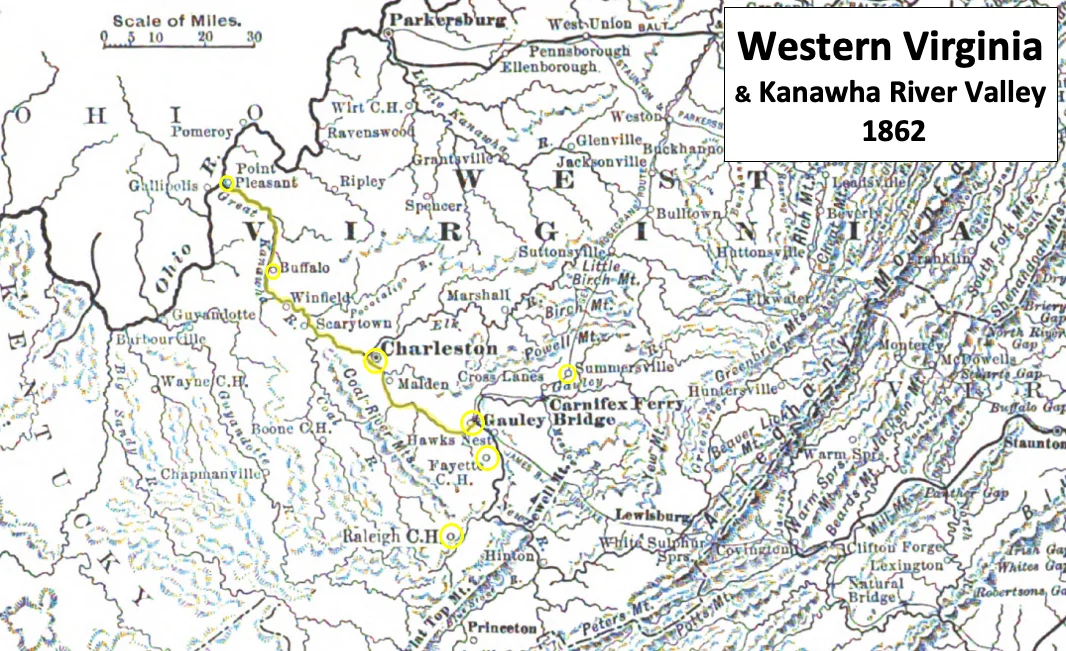

Battle of Charleston (1862)
Just before 9:30 on the morning of September 13, 1862, Union pickets east of a small Virginia town began falling back through the cornfields above the Kanawha River. The Confederates were closer than expected. By 1:30 that afternoon, with both sides hammering each other with artillery, the Union commander gave the order to burn the government supply houses he could not haul away. By 2:00, the Union infantry was streaming across the wire-suspension bridge over the Elk River, setting it on fire as they crossed. By nightfall, Charleston was Confederate. The Union army was retreating toward the Ohio River in what would become known as Lightburn's Retreat - an eighty-mile fighting withdrawal that ended six days later at Point Pleasant.
The Approach
By the late summer of 1862, the Kanawha Valley was a strategic prize. The river led west to the Ohio, and the salt works upriver supplied much of the eastern Confederacy. Confederate Major General William W. Loring, commanding the Department of Southwestern Virginia, brought about 5,000 men north out of camps near the Sulphur Springs of Monroe County in early September. Brigadier General Albert Gallatin Jenkins - the same Jenkins who lived at Green Bottom on the Ohio - took 550 cavalry on a swing ahead of Loring's column to disrupt Union supply lines. On August 30, Jenkins captured a Union supply depot and resupplied his men. By September 5 he was at Buffalo on the Kanawha, between Charleston and the Ohio. Word of the approach reached Union Colonel Joseph A. J. Lightburn at Gauley Bridge, and his outposts at Raleigh Court House and elsewhere began pulling back.
Fayetteville
On September 10, Loring's force attacked the Union garrison at Fayette Court House, today's Fayetteville. Federal Colonel Edward Siber commanded the post. The fighting lasted all day - artillery exchanges, infantry assaults on the entrenchments, a stiff back-and-forth in the broken country between the New River gorge and Cotton Hill. Between one and two o'clock the next morning, Siber's men slipped out of their fortifications and headed north toward the Kanawha River. The largest skirmishes of the withdrawal came at Cotton Hill and Montgomery Ferry. Lightburn, at Gauley Bridge with the main Union force, now realized that the entire Federal position in the valley was untenable. He ordered everything that could move to converge on Camp Piatt, thirteen miles upriver from Charleston, and from there to fall back toward the Ohio River at Point Pleasant. By September 12, his command was reunited at Camp Piatt and falling back on Charleston.
The Battle in the Town
Charleston in 1862 was a town of about 1,500 people on the north bank of the Kanawha River, with the Elk River entering from the north on the downstream side. The James River and Kanawha Turnpike crossed the Elk on a single suspension bridge. The geography forced the fight. Lightburn placed part of his force - the 47th Ohio, three mountain howitzers, a detachment of the 2nd Loyal Virginia Cavalry - east of the Elk under Colonel Lyman Elliott, with the main body west of the bridge. Loring approached on both banks. Colonel John McCausland led the northern column with the 22nd, 50th, and 63rd Virginia Infantry, the 23rd Virginia Battalion as skirmishers, and the 36th Virginia in reserve. Brigadier General John S. Williams commanded the south-bank force with artillery and the 30th Sharpshooters. The pickets gave way around 9:30 a.m. By 1:30 p.m. both sides were dueling with cannon, supply depots were burning by Union order, and the 47th Ohio was being pressed into the town center. At 2:00 p.m. the regiment crossed the Elk under fire. Lieutenant Colonel Augustus Parry set the bridge ablaze and cut its cables. The suspension bridge fell into the river.
Lightburn's Retreat
Cutting the Elk River bridge bought Lightburn time but did not end the battle - the artillery exchange continued until ten o'clock that night. Around three in the afternoon, the Union wagon train had jammed because overloaded wagons and a panicky quartermaster had stopped the column. Colonel Charles Gilbert rode forward, put Elliott in charge, and got the train moving again. Lightburn chose to retreat northwest on the Ripley Road rather than down the Kanawha, which would have kept him in range of Williams's artillery on the south bank. The army marched through the night to Sissonville, then on toward Ripley and Ravenswood. Loring's troops paused to build a pontoon bridge over the burned Elk crossing on September 14, then halted the pursuit - they had outrun their own supply train. The Union army did not reach Point Pleasant until the evening of September 18. Eighty miles of fighting withdrawal, the loss of Charleston, and the burning of millions of dollars in supplies - and Loring's victory, in the broader war, would last only a month. By mid-October, with no reinforcements arriving, the Confederates withdrew and Union forces reoccupied the valley they had abandoned in such haste.
From the Air
The Battle of Charleston unfolded across the modern downtown of Charleston, West Virginia at 38.35 degrees north, 81.64 degrees west, where the Elk River joins the Kanawha River. Best viewed at 4,000 to 7,000 feet AGL: look for the confluence of the Elk and Kanawha at the western edge of downtown - this is where the burned bridge stood. The state capitol dome, the river bend, and the line of the I-64 corridor are reliable orientation landmarks. Yeager Airport (KCRW) sits on a ridge a few miles east of downtown on its distinctive flat-topped runway.
Nearby Stories
- Mystery Hole 6.5 km away
- West Virginia Colored Children's Home 9.4 km away
- Clay, West Virginia 13 km away
- Staats Mill Covered Bridge 14 km away
- Hobet Coal Mine 23 km away
- Appalachia 23 km away
- Fred M. Vinson Museum and Welcome Center 30 km away
- Ponn Humpback Covered Bridge 43 km away