
Battle of Goose Green
Days before the attack, the BBC World Service announced that British paratroopers were poised to assault Goose Green. The men who would have to make that assault listened in disbelief and fury. Their surprise was gone, broadcast to the very garrison they were meant to ambush. Lieutenant Colonel H. Jones was livid. Yet on the freezing night of 28 May 1982, 2 PARA set off anyway across the narrow neck of land linking Darwin and Goose Green, marching into the longest and most desperate firefight the British would face in the entire war.
A Battle Nobody Planned to Fight
Goose Green was never meant to be a set-piece assault. The original plan was to bypass it. But after the landings at San Carlos, British ground forces had barely moved while Argentine aircraft sank their ships, and London grew desperate for a visible victory. So the job fell to 2 PARA: roughly 600 men ordered to take a position that conflicting intelligence variously described as a single company or a reinforced regiment. The truth was the larger figure. Dug into well-sited trenches with overlapping fields of fire, supported by artillery and anti-aircraft guns firing flat into the advancing infantry, the defenders of Task Force Mercedes were far more numerous and far more determined than the paras had been led to expect.
The Ground and the Cold
There is no cover on the Darwin isthmus. It is rolling, treeless ground of grass, gorse, and peat bog, soaked through in the southern winter and frequently glazed with salt water. Camouflage is nearly impossible; movement is slow and loud. Through the long night the paras pushed forward in a six-phase plan of alternating silent and noisy attacks, clearing trench after trench in the dark. By first light they were strung out and pinned along the forward slope of Darwin Hill, looking up at Argentine positions that held the high ground and the gorse line above them. For hours, in plain daylight, they could neither advance nor safely retreat, their ammunition running critically low.
The Death of Colonel H
With both lead companies stalled and the entire attack in jeopardy, Jones decided to break the deadlock himself. He gathered a small party and charged up a gully toward the Argentine trenches. Three of the men who followed him were cut down. Jones pressed on alone, ran up the slope toward an enemy position, was hit, rose, charged again, and fell mortally wounded a few feet short of the trench. He died within minutes. The 42-year-old commanding officer of 2 PARA received a posthumous Victoria Cross, Britain's highest award for valor. Historians have argued ever since about whether his charge was heroism or a commander losing sight of the wider battle. What is not in dispute is the courage of the man, or the soldiers on both sides who kept fighting after he fell.
Surrender by Daylight
Command passed to Major Chris Keeble, who spent two hours reorganizing before resuming the assault. Slowly the British prised the defenders off Darwin Ridge and pushed toward the airfield and the settlement, where Argentine 35mm cannon, meant for aircraft, were turned on the infantry with terrible effect. There were grim moments here, including a confused exchange under a white flag in which a British officer and two men were killed. By nightfall the settlements were surrounded but not taken, and both sides were spent. Rather than flatten Goose Green and the civilians sheltering in it, Keeble sent terms of surrender. The next morning, on Argentina's National Army Day, the garrison commander marched his men into captivity.
The Cost and the Turning Point
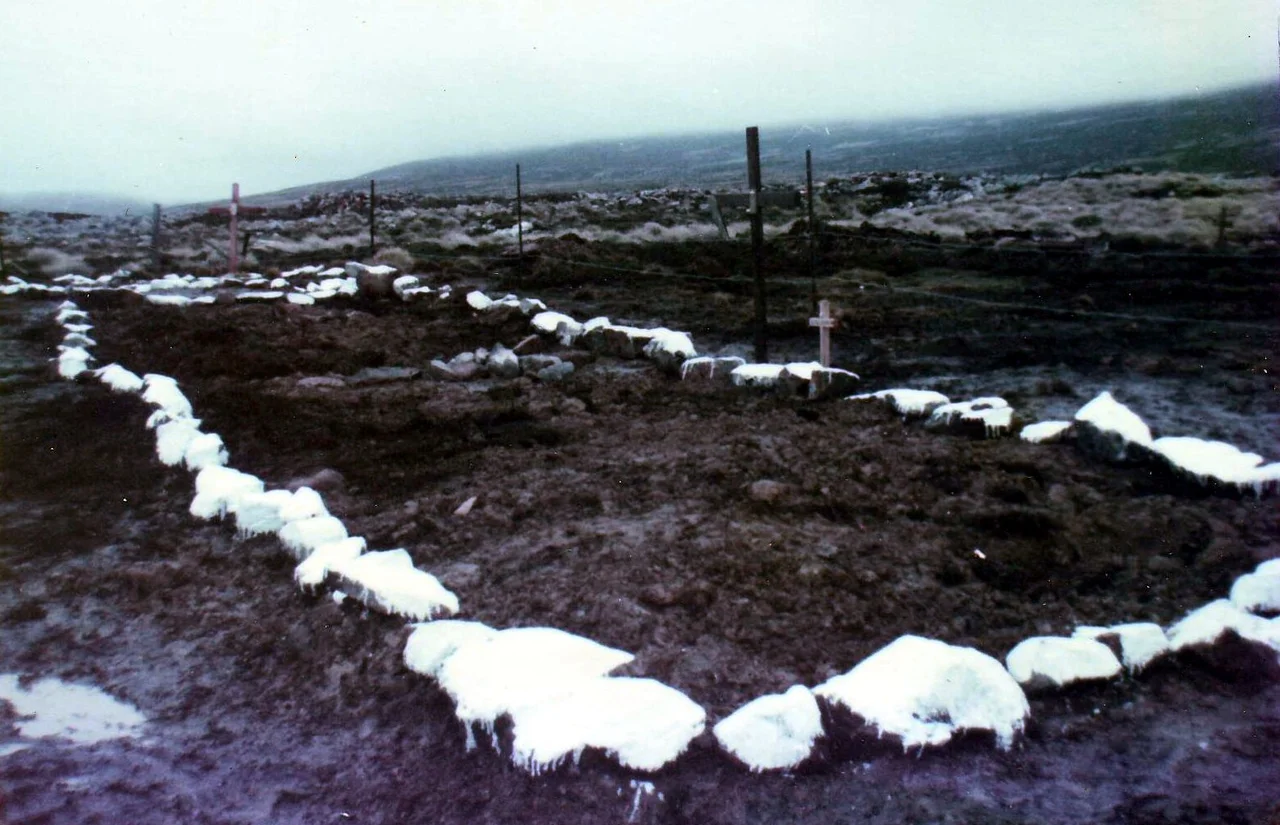
Around 18 British soldiers died at Goose Green, most of them paratroopers, alongside roughly 45 to 55 Argentines; nearly a thousand Argentine personnel were taken prisoner. The Argentine dead were buried just north of Darwin, in graves that would later become the Argentine Military Cemetery. For all the controversy over how it was fought, the battle's effect was decisive. It broke the sense that the British advance had stalled, it freed the beachhead, and from that morning on the initiative never left British hands. The civilians of Goose Green, held for weeks in the community hall, walked out free. Today the isthmus is quiet sheep country again, marked by memorials to the men who died winning it.
From the Air
Goose Green and the neighboring settlement of Darwin lie on the central isthmus of East Falkland, at roughly 51.83 degrees south, 58.97 degrees west, connecting the southern plain of Lafonia to the rest of the island. From the air the isthmus reads as a narrow waist of land pinched between two inlets, with the airfield (the wartime Argentine Condor air base) beside the settlement. The nearest major airport is RAF Mount Pleasant (ICAO: EGYP), roughly 30 nautical miles east; Port Stanley Airport (ICAO: SFAL) lies further east near the capital. Best viewed at low to medium altitude in clear weather; the terrain is open, treeless moorland of grass, gorse, and peat, offering long sightlines but frequently obscured by drizzle and fast-moving fog. Note that uncleared wartime ordnance was a hazard here for decades; the islands were declared landmine-free in 2020.
Nearby Stories
- Bluff Cove Air Attacks 10 km away
- Falkland Islands sovereignty dispute 13 km away
- Pebble Island raid 26 km away
- Volunteer Point 36 km away
- Sea Lion Island 47 km away
- HMS Coventry (D118) 75 km away
- HMS Sheffield (D80) 150 km away
- Sinking of ARA General Belgrano 400 km away