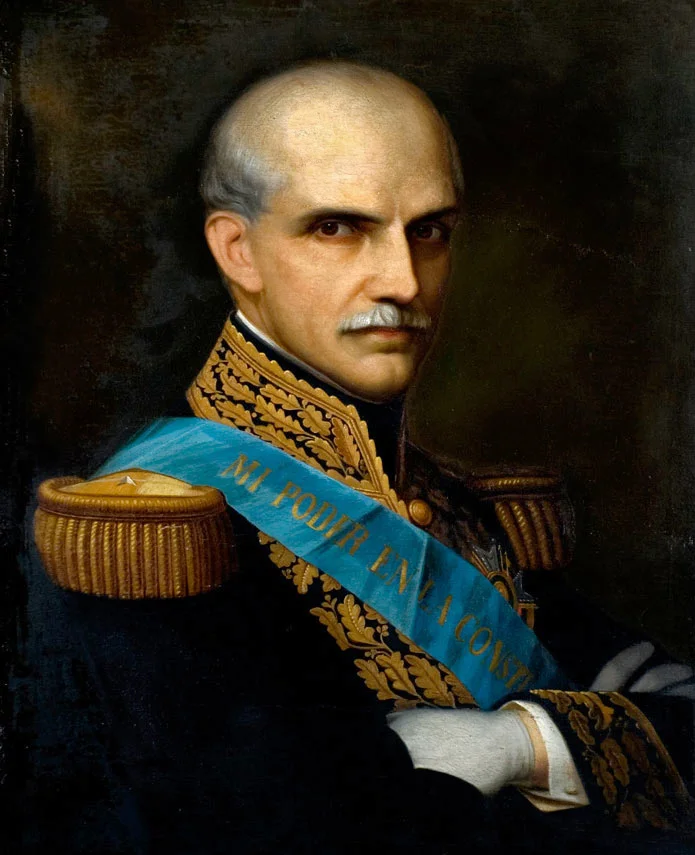

Battle of Guayaquil
They called him El Traidor - the traitor. In January 1860, General Guillermo Franco had signed a treaty handing Ecuador's disputed Amazonian territories to Peru, and for that, his own countrymen were marching on Guayaquil to tear him down. Ecuador in 1860 was not a country so much as a collection of warlords. The president had resigned the previous May, leaving four self-declared Supreme Chiefs fighting over the pieces while a Peruvian fleet blockaded the Gulf of Guayaquil. What finally ended it was not diplomacy but a three-day battle fought partly through mangrove swamps infested with alligators, where a colonel's betrayal for 3,000 pesos decided the fate of a nation.
The Terrible Year
Ecuadorians would remember 1859 as el ano terrible. It began with President Francisco Robles trying to sell Amazon territory Peru claimed, to pay off British creditors - a desperate maneuver that collapsed his government instead. Robles resigned on May 1st, and four men immediately declared themselves Supreme Chief of something: Gabriel Garcia Moreno from a provisional government in Quito, General Guillermo Franco from Guayas, and two others who mattered less. Peruvian President Ramon Castilla saw opportunity in the chaos. He sailed to Guayaquil with thousands of soldiers, blockaded the Gulf, and shopped for a counterpart willing to sign away the disputed territories. Garcia Moreno refused. Franco, sitting in Guayaquil with limited options, accepted. In January 1860, the two men signed the Treaty of Mapasingue, conceding to every Peruvian demand. When Castilla's troops sailed home in February, they left Franco with boots, uniforms, and 3,000 rifles. They also left him, in the eyes of most Ecuadorians, a traitor.
Unlikely Allies
The treaty accomplished what nothing else had: it united the fragmented country against a common enemy. Garcia Moreno, the pious conservative intellectual, accepted help from General Juan Jose Flores - the fourth president of Ecuador, deposed fifteen years earlier in the Marcist Revolution and now nursing grievances of his own. The two had been enemies. They became commanders. Garcia Moreno even wrote secretly to France's charge d'affaires, Emile Trinite, on three separate December days in 1859, proposing Ecuador become a French protectorate. Nothing came of it, which may have been for the best. In Guaranda, marching south toward Guayaquil, Garcia Moreno issued his ringing order: 'Soldiers, I order you to march on to victory!' In August, General Francisco Javier Salazar ambushed Franco's forces at Babahoyo. Deserters began flooding toward the provisional army. By early September, Garcia Moreno's forces stood at Daule, across the Guayas River from the city, waiting.
The Crossing of the Salado
Flores drew up the battle plan on September 23rd. A diversionary column under Colonel Jose de Veintemilla would attack from the north against Santa Ana hill. The main force, led by Flores and Garcia Moreno themselves, would cross the Salado estuary to the west and encircle Franco's army. The Paso del Salado - the Crossing of the Salado - became the battle's defining moment. Flores' men had to push through tropical mangrove swamps they had never trained for, water thick with alligators and choked with prop roots. Defending the estuary was Franco's Colonel Pedro Pablo Echeverria. What Franco did not know was that Echeverria had already been bought: 3,000 pesos and the promise of promotion to general in Garcia Moreno's army. The colonel opened his lines. The provisional army passed through. That same afternoon, the bombing of Guayaquil began.
A Traitor's Exit
At dawn on September 24th, Flores' and Garcia Moreno's men closed on Guayaquil from every direction Franco had not expected. The battle collapsed quickly. At what is now the La Victoria park in Guayaquil, Franco's lines broke. His soldiers fled toward the harbor, trying to reach the Peruvian ships anchored there. Many drowned attempting to swim for them. The Peruvian captains, watching the battle turn, weighed anchor and sailed without waiting. Franco and his officers escaped aboard one of those ships - or possibly aboard the Ecuadorian schooner Cuatro de Julio, depending on which account you believe. Either way, he was gone. Two days later, Garcia Moreno hauled down Franco's blue-and-white banner and raised the flag of Ecuador over the city. Franco never returned. He died in Callao, Peru, in March 1873, still in exile, still disgraced.
What the Battle Built
The feared Peruvian retaliation never came. Castilla had problems of his own - revolt at home, trouble on the Bolivian border - and the moment passed. The Treaty of Mapasingue was annulled by the Ecuadorian Congress in 1861 and by the Peruvian Congress in 1863, under President Miguel de San Roman. The grounds, elegantly, were that the treaty had been signed with the chief of a political party, not a legitimate government. Garcia Moreno restored order to Ecuador, and his victory ushered in what historians call the era of Conservatism - an authoritarian, frankly dictatorial regime that outlived Garcia Moreno himself and did not fully end until 1895. The Terrible Year was over. The long consequences had just begun.
From the Air
Battle site at 2.19S, 79.89W, on the outskirts of Guayaquil where the Guayas River meets the Salado estuary. The present-day La Victoria park marks where Franco's final defense collapsed. Jose Joaquin de Olmedo International Airport (SEGU) lies immediately southwest. Approach from the north to trace the path of the provisional army from Daule; the mangrove estuary west of the city, still visible today, is the Salado crossing ground.
Nearby Stories
- Guayas Province 20 km away
- Montañita 29 km away
- Santa Elena, Ecuador 39 km away
- 2023 Guayas earthquake 48 km away
- El Cajas National Park 50 km away
- Santiago de Bolivar 57 km away
- Alausí Canton 67 km away
- Department of Tumbes 158 km away